






























































































The Dragon pantacle is one of the figures in Abbé Julio’s collection that associate an unsettling animal with a text of trust. The author draws on a passage from the Psalms mentioning the asp, the basilisk, the lion, and the dragon. This enumeration makes the sign a representation of the perils faced under divine protection.
Julio does not present a dragon here as a power animal to be tamed. He places it within biblical language, where dangerous creatures symbolize adversity. The entry then extends the request for protection to travel on land, at sea, and in the air, as well as to explorations.
Essential reference points
| Tradition | Protection and adversity in the Psalms |
|---|---|
| Figure | Dragon surmounting a protective verse |
| Application | Protection in danger and during travel |
| Source | Abbé Julio, 1908, entry no. 66 |
Reading the symbolism
The presence of the dragon should be read together with the other animals mentioned in the verse. The asp and the basilisk evoke poisonous dangers, while the lion and the dragon embody threatening power. The psalm expresses the trust of one who passes through these obstacles. The illustrated figure condenses this language into a distinct emblem.
The entry explains the sign through a passage mentioning the asp, the basilisk, the lion, and the dragon. The figure of adversity is placed within a composition in which the text expresses trust in divine protection.
It would be inaccurate to confuse this Dragon with an engraving in which a Pentagram also dominates a dragon. Julio presents distinct images in his volumes. The role of the dragon, the arrangement of the letters, and the applications belong to each particular plate.
History and traditions
The dragon occupies very different positions in the world’s traditions. Here, its context is explicitly biblical and Christian: the references to dangerous animals come from a psalm of protection. The figure should therefore not be interpreted through Asian symbolism or a bestiary unrelated to the entry.
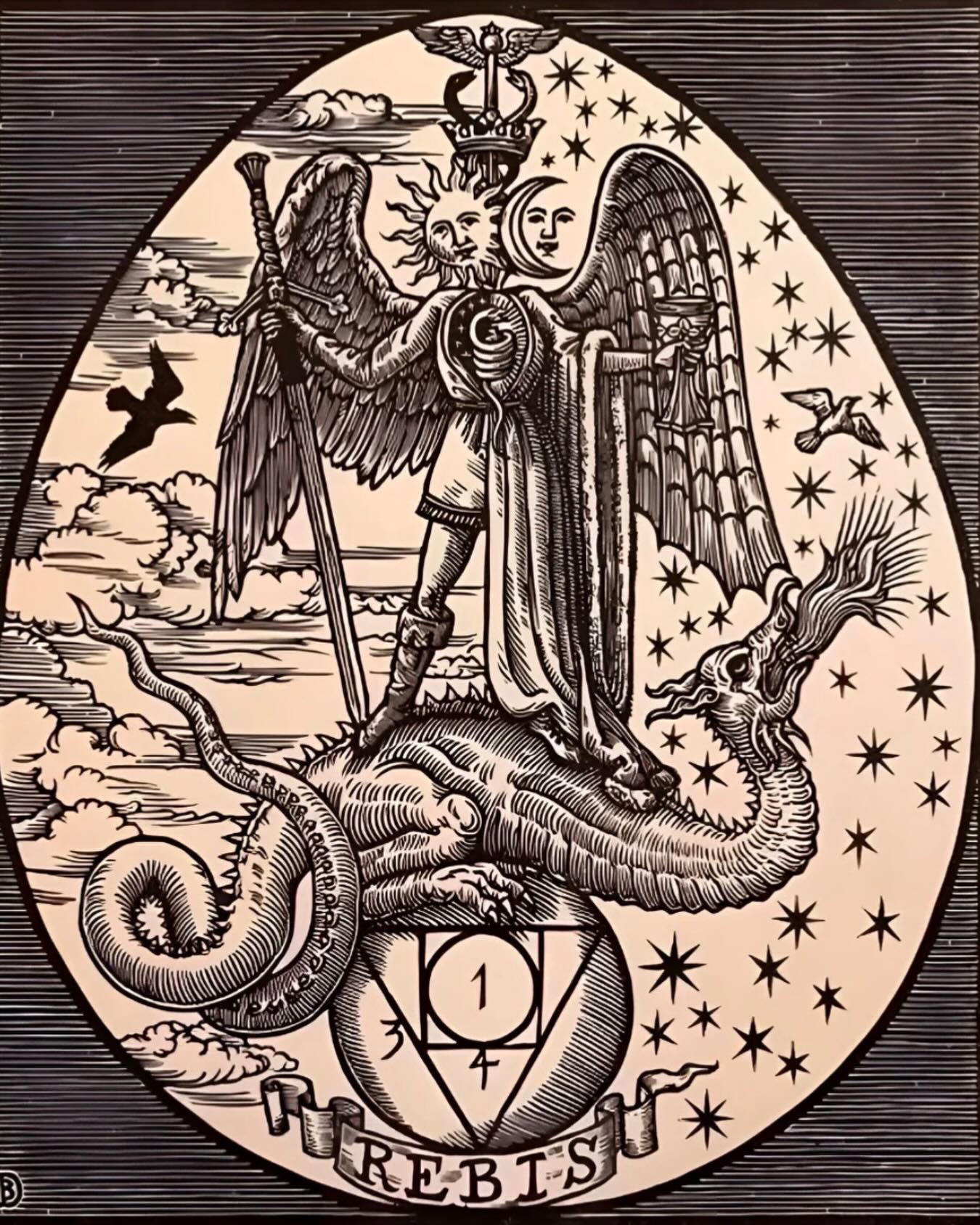
In Christian traditions, victory over the dragon also appears in the stories of Saint Michael and in Revelation. This parallel sheds light on the general motif of adversity, but Julio’s plate has its own formula, which should remain the starting point for its study.
Attributed effects
Julio attributes to the sign a defense against evil powers and dangerous animals. He also associates it with travel on land, at sea, or in the air, and with scientific or commercial explorations. These are its historical protective applications.
Julio attributes to the sign a defense against evil powers, dangerous animals, and certain travel-related perils. He also mentions journeys connected with scientific or commercial exploration. The protection sought thus encompasses very concrete situations in the author’s religious language.
These attributions do not constitute a guarantee of material safety. The meaning of the pantacle is that of a prayer for protection, accompanying prudence and the preparations for a journey.
Use in Julio’s work
The sign accompanies an intention of travel or defense in Julio’s practices of blessing and consecration. His entry does not distinguish a separate rite for each means of transport.
The support belongs to the blessed and consecrated pantacles in the work. The entry does not distinguish a separate ritual for the ship, the road, and air travel. It associates the same figure with the dangers these journeys may present.
Studying the engraving benefits from tracing the source of the verse and identifying the animals named. This method makes it possible to understand the dragon from the actual inscription rather than from a universal meaning attributed to the animal.
Distinctive features of this pantacle
The Landscape expresses protection in day and night, in connection with the natural elements. The Three Roads concern the choice of life rather than transportation risks. The Archangel Michael represents spiritual defense through the name of an angel, with a different composition.
The Dragon illustrates the richness of the motifs used by Julio: a figurative creature can convey a request for protection as clearly as a cross or a monogram.
Source and variants
Abbé Julio, The Secret Book of Great Exorcisms and Blessings, Vincennes, published by the author, 1908. Explanation and application no. 66, p. 451. Practical advice on blessed and consecrated supports: pp. 462–463.
Classical repertoire numbering: 33 of 44. This numbering differs from the inventory of engravings in the old volumes.
Read the entry in the 1908 edition
Engraving taken from the copy digitized by the Divinity School Library, Duke University / Internet Archive, at 360 dpi. Composition, lettering, and colors preserved.