




























































































In the table of contents...
If you are new to the world of magic, you will quickly come across the terms sigils, seals, or even chaos. In fact, they are all related to what is known as sigil magic, that is, magic that condenses the intention of a magical act into a very specific symbol. The word sigil comes from "signature," so all your magical work will involve creating the sigil that perfectly corresponds to your will. Although this may seem complex at first, it is actually one of the most accessible forms of magic. Follow me, and I will explain everything.
1. Sigil Magic Through the Ages
Like most magical practices, it is quite difficult to date its origins. However, its origins can be traced back to Antiquity. Primitive forms of sigils were used in various ancient cultures, often as seals or marks inscribed on objects, buildings, and sacred texts to invoke deities or demons, or to protect against curses. For example, the seals of Solomon, famous in Jewish and Islamic traditions, are among the earliest examples of sigils used for mystical purposes.
During the Renaissance, the use of sigils experienced a revival with the growing interest in Hermeticism, alchemy, and Kabbalah. The work De Occulta Philosophia by Cornelius Agrippa, published at the beginning of the 16th century, explains in detail how symbols and sigils can be used to invoke angelic or demonic entities and perform magical acts.

However, it was in the 20th century that sigil magic took on a more contemporary form through the work of Austin Osman Spare, a British artist and occultist. Spare redefined the concept of sigils by detaching them from traditional magical systems and transforming them into tools of personal will, accessible to everyone. He proposed methods for creating sigils by reducing personal desires to an abstract form, often by removing repeated letters from an intention statement and artistically rearranging them. It is important to know that Spare was a disciple of Aleister Crowley, but distanced himself from him following a disagreement over his "too traditional" methods (even though Crowley himself considered himself avant-garde!), which is why he developed his own system for creating sigils. This system has generally prevailed ever since and is considered the foundational basis of Chaos Magick.
2. The Most Well-Known Sigils
2.1. Archangel Sigils
Archangel sigils are used to invoke the presence and assistance of archangels, who are considered divine messengers with specific powers and areas of influence. Each archangel has its own sigil, which is often used in rituals for protection, healing, and spiritual guidance.

These sigils are generally created using magical alphabets, such as the Hebrew alphabet or the angelic alphabet. They can be drawn on talismans, engraved on candles, or used in meditations. Each sigil is designed to resonate with the energy of the specific archangel and facilitate direct communication with them.
2.2. Demon Sigils
In the tradition of Goetia, a branch of ceremonial magic, demon sigils are used to control or negotiate with demonic entities. These sigils are often drawn from ancient grimoires such as The Key of Solomon or The Lemegeton (The Lesser Key of Solomon).

Demonic sigils are drawn according to precise instructions found in grimoires. They serve as aids during invocations and are believed to help the magician maintain control over the invoked entity. They are often surrounded by circles or other protective symbols. Thus, each demon has its own sigil.
2.3. Solomon's Sigils
Solomon's sigils, or seals of Solomon, are famous for their use in various magical and religious contexts. They originate from texts attributed to King Solomon, renowned for his wisdom and magical abilities.

These sigils are often complex, incorporating Hebrew symbols, pentacles, and geometric figures. They are used to invoke spirits, channel energies, and protect against evil forces. Sigils are generally engraved on metals corresponding to the astrological planets or on special parchment.
2.4. Vodou Sigils
In Vodou practice, sigils, known as Vévés, are omnipresent. These magical symbols are specifically associated with each of the Loas, or divine spirits, of the Vodou pantheon. Each Vévé is unique and serves as a focal point for invoking and communicating with the Loas, each possessing distinct attributes and powers. They are worn as talismans to benefit from the associated powers.
2.5. Planetary Sigils
Used in astrology and ceremonial magic, these sigils represent the energies of the planets. Each planet has its own sigil, which is used to attract its specific influences, whether for personal improvement, healing, or financial success.
The creation of a planetary sigil often involves the use of sacred geometry and astrological correspondences. They are frequently inscribed on materials corresponding to planetary metals (for example, copper for Venus, iron for Mars,...) to maximize their energetic resonance.
2.6. Runic Sigils
Runic sigils are powerful magical symbols based on the runic alphabet, a writing system used by ancient Germanic and Norse peoples. These sigils are not merely writing but symbols charged with specific intentions, often used to create spells or talismans. Each rune has distinct meanings and magical correspondences, allowing practitioners to combine them in ways that enhance their power and relevance.
2.7. Alchemical Sigils
Alchemical sigils are symbols used in the art of alchemy to represent and manipulate processes, elements, and substances. These sigils are essential not only for the material work of transmuting metals, but also for spiritual practices aimed at transforming the soul. They form an integral part of alchemical iconography and methodology, offering a visual map of the complex operations that make up this ancient tradition.
3. The Fundamental Principles of Sigil Magic
3.1. The Theory of Sigils
The basic theory is that these magical symbols act as vectors of human intention, influencing the subconscious and, by extension, the external world. Thus, a sigil works in two stages: through its creation and through its activation and, consequently, its destruction.
3.1.1. Intention
The creation of a sigil begins with the formulation of a clear and concise intention. This intention is then transformed into a unique graphic symbol. The idea is that this process condenses the desire into a form that is both abstract and deeply meaningful. Once activated, the sigil operates at the subconscious level, where it can influence thoughts, behaviors, and even external events without conscious interference, thereby facilitating the manifestation of the intention.
3.1.2. Activation and Release
Activating a sigil is a key element of its effectiveness. This step can be carried out in different ways, such as meditating on the sigil, burning it, submerging it in water, or even using more modern techniques such as digital dissemination. The purpose of activation is to send the sigil into the unconscious, where it becomes an independent acting force, separate from continuous conscious thought. After activation, it is often advised to "let go" or forget the sigil, an essential practice for preventing interference from conscious thought that could dilute its effectiveness.
3.1.3. The Power of the Unconscious Mind
The theory of sigils draws heavily on psychological concepts related to the power of the subconscious. In magic, it is known that thought has undeniable power that manifests in the physical world. Similarly, the subconscious can influence our reality in a much more significant way than our conscious mind. By integrating the sigil into the subconscious, it is believed that it can work to fulfill the attached intention without being thwarted by the skepticism or negativity of the conscious mind.
3.2. Types of Sigils
Sigils can be broadly classified into three main categories according to the intention transferred to them.
-
Desire sigils: they are among the most commonly used in sigil magic. They serve to manifest specific intentions centered around personal wishes or goals. These sigils are often used to attract love, prosperity, career success, or to improve personal skills.
-
Protection sigils: their purpose is to create an energetic barrier around the person or space they are intended to protect. They are used to repel negative influences and ensure safety. They can be engraved on amulets or stones, or traced around places to secure a space against physical or spiritual intrusions. They also serve to protect against bad luck, the evil eye, or negative energies.
-
Ritual sigils: they are used in broader ceremonial contexts and are often incorporated into complex magical practices. They can be used to invoke entities, channel specific energies, or bring about profound spiritual transformations. These sigils are typically used in structured rituals involving several magical elements. They can be traced in the air with a wand or athame during a ritual, engraved on ritual tools, or drawn on the ground within a magic circle or a magic triangle.
A sigil can also be created either physically (by writing or using sealing wax to seal a witch bottle) or mentally (which requires meditation or a trance to find the sigil within one's own mind). The former is naturally easier than the latter.
4. The Creation and Activation of Sigils
The creation and activation of sigils are essential processes in the practice of sigil magic, allowing practitioners to materialize their intentions in symbolic form and charge them with energy to bring about desired transformations. However, as I said in the introduction, this is relatively easy.
4.1. Creating a sigil
4.1.1. The intention phrase method
For this method, you will need parchment, a writing quill, and ink (ideally suited to your intention). You can find everything you need in our special sigil magic selection.
This technique begins with writing a clear and concise intention, generally phrased as a positive affirmation. In fact, you need to do a little rewording to express the essence of your desire in a short sentence as if it were already present. Generally, it begins with "I want...".
The intention is then transformed into a sigil. To do this, write the phrase and eliminate duplicate letters as well as vowels, keeping only the unique letters. These letters are then rearranged to form a drawing or symbol. This method ensures that the sigil's energy is directly linked to the specific intention it is meant to represent.
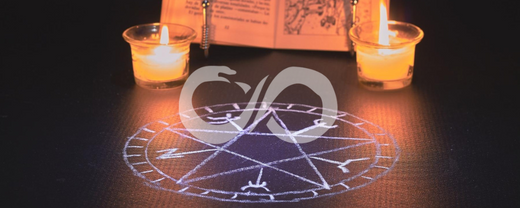
As a guide, you can also use the witches' wheel, which will make it easier to draw your sigil.

Once you have "worked on" your intention phrase (only a few letters should remain), begin by drawing a small circle around the first letter, then connect it with a straight line to the second letter, followed by a second line, and so on, carefully following the order of the letters in your phrase.
If you do not yet feel comfortable creating your own sigil, you can of course use a symbol that resonates strongly with you, such as a pentacle, for example. However, be sure to understand the meaning of the seal you are reusing to avoid disappointment or even an unwanted backlash.
4.1.2. The spontaneous drawing method
This approach is more intuitive. It involves focusing on the intention while letting your hand spontaneously draw a sigil, without a preconceived plan. This method is particularly appreciated for its ability to bypass the inhibitions of the conscious mind, allowing direct expression of the unconscious. It is often used in Chaos magic practices and can result in very personal and, above all, unique sigils.
4.2. Activating and forgetting a sigil
This is the part that may seem frustrating, but is nevertheless necessary. In fact, activating a sigil involves... forgetting it. That is why writing the intention and creating the sigil are the most important phases for its effectiveness, since you will no longer be able to act on it afterward.
4.2.1. Visual technique
Visual activation of a sigil involves focusing intensely on the symbol, often staring at it until the details of the sigil begin to blur and disappear. This process can help imprint the sigil on the unconscious. Meditating on the sigil allows you to charge it with personal energy while deeply aligning the intention with the subconscious.
4.2.2. Physical techniques
These methods use physical elements to activate and sometimes release or dissipate the sigil's energy. Depending on your intention, you use the appropriate element:
-
By Earth: grounding, connection to nature, household energy, or prosperity.
-
By Water: Intuition, emotions, dreams, sadness, cleansing, renewal, sleep, psychic abilities, healing, or mental health.
-
By Air: communication, ideas, creativity, memory, spirituality, happiness, or learning.
-
By Fire : passion, love, sex, desire, ego, bravery, strength, courage, anger, or leadership.
5. Using a magical sigil
There are several possible uses for a sigil. The first is, of course, the sigil itself, which you will charge and then activate as we saw above.
However, a sigil can also be used to strengthen or complement a magical working. Indeed, another common use is as a sealing stamp to increase the power of an incantation or spell in a ritual. It can also prove very useful if you make a spell jar (or witch bottle) and want to seal it.

You will of course need sealing wax and a seal suited to your intention. I would also like to mention that we make our own exclusive seals at Aeternum. You can find them here.
In general, a sigil can accompany all your workings by strengthening and sealing them. If you would like to deepen your knowledge of sigils, I recommend the book Magical Sigils by Laura Tempest Zakroff available in our online esoteric shop.
6. The final word
This concludes our exploration of the world of sigils. Of course, this is a broad introduction, as there are many sigils with very specific, sometimes complex meanings. But you already have the basics to create your first seals. Remember: your intention is what matters! A sigil does not need to be overly complex to fulfill your will. Believe in yourself and the power of your subconscious; you may well be surprised by the result...

Par Olivier of Aeternum
Passionate about esoteric traditions and the history of the occult from the earliest civilizations to the 18th century, I share some articles on these topics. I am also co-creator of the online esoteric shop Aeternum.