






























































































In ancient magical texts, certain words immediately give the impression of entering a vocabulary reserved for initiates. Paredros belongs to this category. The term refers neither to a specific demon, nor to a particular deity, nor to a clearly defined type of spirit. It first describes a function: that of “the one who stands beside.” In the Greco-Egyptian magical papyri, this proximity takes on a remarkable ritual significance. The paredros becomes the practitioner's invisible assistant, the one who responds, reveals, intervenes, accompanies, and extends their action in a world where relationships among humans, gods, daimones, and intermediary powers structure the entire practice.
This figure is fascinating because it resists overly simple categories. The paredros may be compared to a familiar spirit, a personal genius, a daimon, or a divine intermediary, but none of these translations is sufficient on its own. The ancient sources instead reveal a wide variety of forms. In one text, the assistant is presented as a daimon; in another, it is linked to Eros; elsewhere, it depends on Selene or receives divine epithets. What unites these figures is not their nature, but the place they occupy: they stand beside the practitioner and become the channels of their action.
To understand the paredros, we must therefore move beyond the modern image of a simple “spirit guide” or benevolent invisible companion. The papyri describe a much more technical relationship. The assistant is acquired, summoned, acknowledged, sometimes named, sometimes bound by an oath or placed under the authority of a higher power. It responds to concrete requests, conveys information, opens passages, intervenes in certain situations, and enables the practitioner to act beyond their ordinary abilities.
The paredros thus brings us to the heart of an ancient magic that does not rely solely on formulas. It relies on bonds, hierarchies, names, material supports, and alliances. Behind this discreet term lies an entire conception of magical art: the magician does not always seek to act alone. They also seek the one who will stand at their side.
Paredros: “the one who stands beside”
The Greek word paredros comes from a very concrete idea: being placed beside someone, sitting at their side, and assisting them in a function. In Greek civic or administrative language, the term could refer to a deputy, assessor, or aide. When this vocabulary enters ritual texts, it retains this fundamental logic. The paredros is the being who stands beside the practitioner and acts with them.
This nuance is essential. Speaking of “the paredros” as though it were a category of spirits comparable to angels, daimones, or genii oversimplifies the sources. Researchers who have studied the Greek magical papyri show that the term appears in several contexts and does not always designate the same type of entity. The assisting function remains constant; the identity changes.
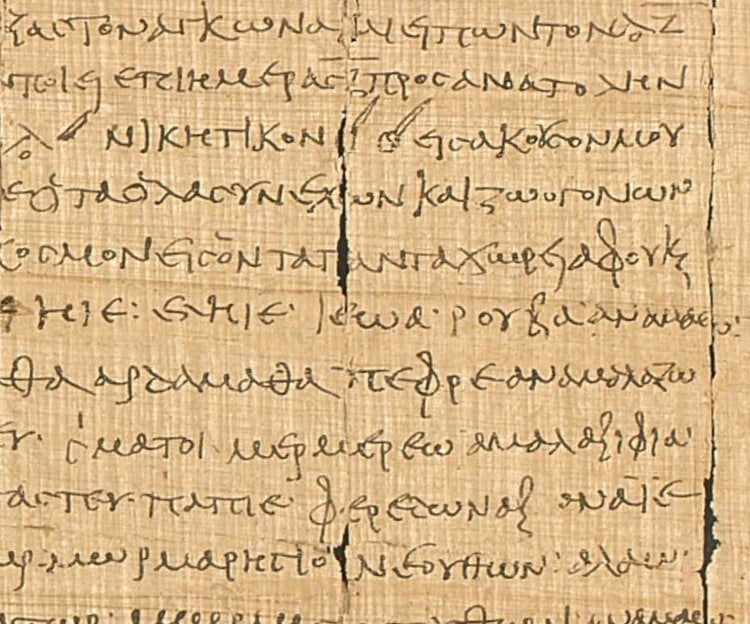
The primary framework is that of the Papyri Graecae Magicae, generally abbreviated as PGM. This modern corpus brings together manuscripts and fragments from Greco-Roman Egypt, written between the Hellenistic period and late antiquity. It contains hymns, invocations, divination operations, protective rites, attraction practices, consecrations, requests for revelation, and numerous prescriptions intended to act upon the visible or invisible world.
It is not a single book. The PGM constitute a collection of documents preserved in several collections. Their richness lies precisely in this diversity. A single text may use the Greek language, preserve Egyptian divine names, use Hebrew words or formulas composed of syllables that are difficult to translate, while also incorporating gestures, materials, and principles drawn from different traditions.
This meeting of several worlds is essential to understanding the paredros. Roman Egypt did not clearly separate what we today call religion, magic, astrology, or theurgy. These fields overlap. The names of the gods, celestial bodies, sacred animals, prayers, fumigations, substances, and written signs could all belong to the same operation.
We have already explored this continuity in The Heritage of Egyptian Magic, as well as the Greco-Roman context in Thessaly, Land of Greek & Roman Magic. The paredros allows us to go even further, because it tells us not only about a tradition or a system. It shows us the personal relationship that certain practitioners sought to establish with an invisible power.
The vocabulary used for this power also calls for caution. The Greek word daimôn, which is often found in these texts, should not automatically be translated with the negative meaning that the word “demon” acquired in medieval and modern Christianity. In antiquity, daimôn could designate an intermediary power, a spirit, a divine agent, or a presence attached to a person, place, or function. Its nature depends on the context.
A paredros can therefore be described as a daimôn without thereby becoming an evil power. It may even receive a divine title. In some texts, the boundaries are flexible: the assistant may be presented as a god, an angel, a spirit, or an intermediary, without the author seeming to perceive the contradiction we would see today.
This flexibility probably stems from the fact that the texts are less concerned with abstract classification than with the effectiveness of the relationship. They want to know which power acts, under whose authority, how to approach it, which name to pronounce, which sign to use, and what it can accomplish.
The paredros is therefore defined above all by its position. It is the one who stands beside the operator. It is not simply present: it becomes available. This proximity constitutes its function and power. The assistant serves as a link between the practitioner and forces that exceed ordinary human action.
This relational model is very far removed from the modern vision of a “spell” conceived as an autonomous formula. In ancient texts, an operation works because it places the operator within a network of authorities. Gods rule over intermediary powers, names provide access to certain entities, hours open certain moments, and materials correspond to particular forces. The paredros is one of the most personal elements of this architecture.
The Ritual of Pnouthios and the Acquisition of an Assistant
One of the most important testimonies concerning the paredros is found in the first papyrus of the PGM corpus. The manuscript, known by the number P. 5025 for its Berlin portion, is a magical roll dating from Late Antiquity. The Berliner Papyrusdatenbank catalogue describes it as a manual containing several operations, including two intended to receive a prophetic spirit during the night, practices of invisibility, a memory exercise, a preparation of ritual ink, and an invocation of a prophetic daimon.
Among these operations is the famous ritual of Pnouthios, preserved in PGM I 42-195. The text is presented as a teaching transmitted by Pnouthios to a certain Keryx. This form is not incidental. It gives the rite the value of knowledge received, preserved, and transmitted. The operation is not presented as an improvisation, but as a method belonging to a chain of knowledge.
The stated goal is ambitious: to acquire a supernatural assistant intended to remain with the operator. The verb “acquire” may sound harsh to our ears, but it should not be understood as the material possession of a being. The rite seeks to establish a lasting relationship. The assistant must not appear only once and then disappear. It must become accessible, recognizable, and capable of intervening again.
This difference is crucial. A one-time invocation calls a presence for a moment. Acquiring a paredros seeks to transform that presence into a stable bond. The expected result is not merely a response. It is a ritual alliance.
The preparations show that this alliance requires precise conditioning. Purification, discipline, preparation of the body, choice of the time, and organization of the space all form part of the rite. The operator does not simply utter a name. They place themselves in a suitable state. Ancient magic places great importance on this prior transformation: the practitioner must become compatible with the power they seek to approach.
The ritual of Pnouthios also has a dimension of hospitality. The assistant is not merely summoned under the force of a formula; it is received. This idea is very important for understanding the ancient logic. The magical relationship can take the form of welcome, exchange, and commitment. The bond is built through a succession of gestures that give the being a place beside the operator.
The question of the name occupies a central position. In many ancient ritual texts, knowing the name of a power means being able to reach it directly. The name does not function like a simple label. It forms part of the being’s identity and presence. In certain rites of paredros, obtaining the name therefore becomes an essential moment: it establishes the relationship and enables the operator to call the assistant back.
This theme directly connects with our article devoted to words of power in grimoires. The long sequences of names, vowels, epithets, and formulas found in ancient texts are not decorative. They constitute a ritual language intended to identify, reach, or compel a power.
Speech therefore does not merely serve to call. It establishes a position. The operator speaks in the name of an authority, cites higher powers, invokes sacred names, and places the assistant within a hierarchy. It is this structure that gives the conjuration its effectiveness.
We explained this logic in What is a conjuration?. In traditional magical texts, a conjuration is not a simple polite request addressed to a spirit. It is a word of authority that defines who is speaking, in what capacity, in the name of which powers, and within what invisible order the summoned being must position itself.
The paredros acquired through the ritual of Pnouthios is then given particularly broad functions. It can transmit information, reveal what remains hidden, facilitate certain actions, free the operator from impediments, open passages, and act in situations where human ability appears insufficient. Some interpretations of the text even emphasize its connection with invisibility or the possibility of going unnoticed.
This is therefore not a symbolic assistant. In the logic of the papyrus, it acts in reality. It becomes an executor, a messenger, a protector, and an intermediary. Through it, the practitioner gains an expanded capacity to act.
The text goes even further by giving this relationship a significance that extends beyond ordinary life. Some passages associate the paredros with the operator's fate after death. This perspective shows that the assistant is not sought solely to solve a specific problem. The connection can take on an existential and spiritual dimension.
The ritual of Pnouthios therefore reveals a remarkable ambition: to change the operator's position in the invisible world. Whoever possesses a paredros is no longer simply someone who knows a formula. They become the one in whose presence a power stands.
Eros, Selene, and the Many Faces of the Paredros
The danger now would be to imagine that there is a single doctrine of the paredros. The papyri show exactly the opposite. The same term can designate assistants of very different natures. The function remains stable, but the identities vary.
In some texts, the paredros is directly linked to Eros. It is then no longer merely a personal spirit obtained to respond to all kinds of requests. The assistance takes place within an operation in which the power of Eros itself becomes the principal agent. The term describes the way in which this power is made available to the operator.
Elsewhere, the paredros is associated with Selene. The goddess retains the higher position in the hierarchy, and the assistant acts under her authority. This structure is particularly important: it shows that a paredros can be sent or delegated by a deity. The operator does not necessarily capture a free power. They may receive an intermediary because a higher power grants one.
This delegation provides a better understanding of ancient ritual thought. The invisible world is not homogeneous. It is organized in degrees. Some powers command, others execute; some are invoked as sovereigns, while others serve as agents. The effective operator must know this organization and understand at what level to intervene.
The paredros occupies an ideal place in this system. It stands close enough to the human to act as an interlocutor, yet remains connected to a broader divine order. It belongs to both dimensions at once: proximity and power.
Some texts also associate the assistant with the realm of the dead or with chthonic powers. This does not mean that every paredros is the spirit of a deceased person. The magical papyri employ the dead in several ways, particularly in operations of coercion, revelation, or attraction. The paredros cannot be reduced to this category. One must avoid merging all forms of supernatural assistance under a single name.
This caution is all the more necessary because the word paredros may describe a function more than a nature. Two entirely different beings can become paredroi if they occupy the same position alongside the operator. It is exactly like in the human world: two people can be “assistants” without sharing the same origin, character, or skills.
This reading also explains why certain modern translations have been misleading. Translating every paredros as “assistant demon” gives the impression of a fixed category. Yet the texts may refer to a god, a daimon, an angel, or an agent dependent on a higher power. The later Christian classification of invisible beings does not correspond exactly to that of Greco-Roman Egypt.
For the contemporary occultist, this observation is particularly instructive. Modern systems favor well-ordered hierarchies: angels, demons, planetary intelligences, genii, elementals, the dead, guides. Ancient texts are more fluid. They are concerned first and foremost with action. Which power must be approached? Which name must be used? Under whose authority can it be contacted? What result can it produce?
The paredros therefore reveals a profoundly relational form of magic. The operator does not simply trigger an impersonal force. They enter an order of beings, names, and functions. Their success depends on their ability to establish the right relationship.
This logic also aligns with the true meaning of the ritual circle. We developed it in On the True Use of the Magic Circle. The circle is not merely a barrier intended to keep spirits from entering. It defines a place, an authority, and an order. It situates the operator. The paredros plays a similar role on a relational level: it situates a power alongside the operator.
Nor should the contemporary image of an inner guide dedicated to encouraging personal development be projected onto the paredros. The papyri ask it to perform concrete actions. It must respond, lead, reveal, protect, deliver, transmit, or intervene. Its function is operative.
This efficacy does not exclude an initiatory dimension. Receiving a power that remains durably beside oneself inevitably transforms the operator’s status. The ritual does not merely provide a tool. It establishes a new relationship with the invisible world.
This aspect explains the comparisons sometimes made with theurgy in Late Antiquity. A distinction must be maintained between the magical papyri and the philosophical systems of Neoplatonic theurgy, but the two worlds share a fundamental question: how does a human being enter into relation with a power that transcends their condition? The answer involves purification, ritual, sacred words, materials, and divine presence.
This is also why the paredros can be compared with certain forms of High Magic, without claiming that a direct line connects the Greco-Egyptian papyri to much later Western systems. The similarity of function is real. Historical transmission, however, must always be demonstrated.
Paredros, familiar spirit, personal daimon, and guardian angel
Modern readers naturally look for equivalents. Does the paredros resemble the familiar spirit of European traditions? A personal daimon? A genius? A guardian angel? The comparison can help with understanding, provided that the differences are not erased.
The familiar spirit is probably the most immediate point of comparison. In some medieval and modern European accounts, a familiar is a spirit attached to a person and capable of helping them. The idea of a lasting invisible presence seems very close to that of the paredros. Yet the context is not the same. Witch trials, Christian theology, and modern representations of the familiar developed much later and within a different religious world.
The term can therefore serve as a comparison, but not as an exact translation. Saying that a paredros is “a kind of ancient familiar spirit” can help visualize its function; claiming that it is the same phenomenon would go too far.
The Greek personal daimon offers another parallel. In Greek philosophy and religion, the idea of a power attached to an individual's destiny or conduct is ancient. Socrates' famous divine sign belongs to this horizon. But the paredros of the papyri is distinguished by its acquired and operative character. It is not simply a presence given with existence. It can be sought through a ritual procedure.
The Roman genius also presents similarities. It can be associated with a person, a place, or a collective. Here too, it is a presence that accompanies and expresses a power of its own. But the rites and meanings do not exactly correspond to those of the paredros.
The comparison with the Christian guardian angel is even more delicate. Some later sources use the vocabulary of the angel, and the Greek word angelos initially means “messenger.” The circulation of vocabulary between traditions is real. But the Christian guardian angel protects by virtue of a providential order, whereas the paredros of the PGM can be obtained through a precise operation intended to establish its assistance.
Western ceremonial magic would later develop another figure: that of the Holy Guardian Angel. The comparison then becomes tempting. In both cases, a personal relationship with a higher intelligence can transform the operator's authority and abilities. However, the texts, centuries, religious frameworks, and objectives differ. It is necessary to speak of analogy, not identity.
This distinction avoids a common pitfall in the history of occultism: seeking a single immutable tradition under different names. Similarities do exist, but they are precisely interesting because they show how each era reformulates the same question.
This question can be phrased as follows: how can one establish a lasting relationship with an invisible power capable of assisting a human being?
The answers vary according to the context. In some systems, the assistant is linked to birth. In others, it depends on a god or a saint. Elsewhere, it comes from an initiation, a consecration, or a prolonged operation. In the papyri, it may be obtained through a procedure combining purification, invocation, recognition, a name, commitment, and the establishment of a relationship.
The paredros therefore makes it possible to distinguish invocation from acquisition. To invoke is to call upon a presence. To acquire a paredros is to make that presence a lasting interlocutor. This change explains why the corresponding rites are more elaborate than a simple one-time request.
This difference also sheds light on certain later practices of ceremonial magic. Behind seals, names, fumigations, and words of power, the aim is not always to “cast a spell.” It is often to establish the proper relationship with a power and define the authority under which that relationship can function.
Ritual objects then take on another meaning. A consecrated image, a lamp, fumigation, or a magical character are not mere decorations. They give the relationship a tangible form. They provide a support, a material presence, a place of manifestation, or a means of recognition.
This is one of the great constants of traditional occultism: matter and the invisible are not separate. Matter serves as a medium. Oil, incense, metal, a drawing, a written name, a lamp, or a stone can participate in establishing a connection. The paredros represents almost the personal culmination of this principle: power is no longer merely associated with an object or a sign; it becomes an interlocutor who stands beside the operator.
What the paredros reveals about ancient magic
The paredros is fascinating because it forces us to reconsider how we imagine ancient magic. It is reduced neither to curses engraved on lead, nor to amulets, nor to spectacular invocations. The PGM also show operations whose aim is to permanently transform the position of the person who performs them.
The ritual of Pnouthios is an excellent example. The operator does not merely ask for a vision or an answer. They want an ally. They seek a power that can remain with them, intervene again, convey information, and act when their own ability is no longer sufficient.
This model reveals a deeply relational conception of magical power. Plants possess affinities, the stars govern certain moments, names open access to powers, gods delegate agents, the dead can serve as intermediaries, and consecrated objects become points of contact. The effective practitioner is the one who understands these relationships and knows how to position themselves correctly among them.
The paredros is the most personal form of this logic. It is the relationship transformed into a presence.
This presence nevertheless remains ambivalent. The assistant is close to the operator, but it never becomes ordinary. The texts emphasize purification, the authority of names, and the seriousness of the commitment. Even when it serves, the paredros belongs to a higher order. The relationship therefore rests on a constant tension between proximity and power.
This is precisely why the word deserves to be retained. “Familiar”, “genius”, “daimon”, or “assistant” each conveys only one aspect. Paredros expresses something simpler and stronger: the one who stands beside someone.
In a ritual universe where position matters as much as nature, this proximity is not secondary. One who stands beside a king shares in his authority. One who stands beside a god can convey his will. One who stands beside the magician becomes the extension of his action.
This idea explains the persistence, in different forms, of the figure of the supernatural assistant throughout the history of occultism. Eras change, names change, systems change, but the question remains: can one establish a relationship with the invisible strong enough that the power called upon is no longer merely passing through?
The Greco-Egyptian magical papyri sometimes answer yes. They describe the means by which a presence can be called, recognized, and integrated into a practice. Their language is ancient, their categories are not ours, but their ambition remains immediately understandable.
The paredros does not simply come to provide an answer. It comes to alter the condition of the one who obtains it. The practitioner is no longer alone before the powers he seeks to reach. An entity now stands beside him, carries his message, performs certain tasks, and opens up new possibilities for him.
This is undoubtedly the best way to understand the term. The paredros is not a unique creature hidden within an ancient hierarchy. It is a ritual function, an organized proximity, an alliance between an operator and an invisible power.
And it is precisely this alliance that makes the subject so important to the history of magic. It shows that ancient occultism did not think only in terms of forces or formulas. It thought in terms of relationships.
Main sources: Hans Dieter Betz (ed.), The Greek Magical Papyri in Translation, University of Chicago Press; Leda Jean Ciraolo, works devoted to the supernatural assistants of the Greek magical papyri; Eleni Pachoumi, The Concepts of the Divine in the Greek Magical Papyri, Mohr Siebeck; Berliner Papyrusdatenbank, P. 5025 A+B, “Magisches Handbuch”; William M. Brashear, “The Greek Magical Papyri: An Introduction and Survey”, Aufstieg und Niedergang der römischen Welt.

Par Olivier of Aeternum
Passionate about esoteric traditions and the history of the occult from the earliest civilizations to the 18th century, I share some articles on these topics. I am also co-creator of the online esoteric shop Aeternum.