































































































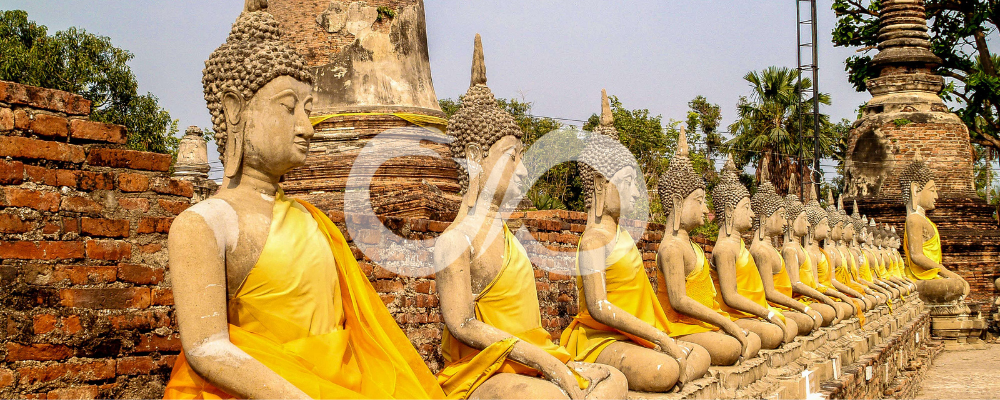
Buddhism intrigues and fascinates many seekers of truth. Surrounded by clichés - sometimes presented as an exotic cult, sometimes as a simple philosophy of well-being - Buddhism is in reality a complex spiritual tradition that originated in India more than 2,500 years ago. So, what is it really? Explore.
Siddhārtha Gautama, the Buddha
The history of Buddhism begins with the life of Siddhārtha Gautama, who became the “Buddha” (meaning “awakened one”). According to tradition, Siddhārtha Gautama was a prince of the Shakya clan, living in the 6th and 5th centuries BCE in northern India. Moved by the suffering of the world he discovered outside his palace (illness, old age, death), he renounced his life of privilege to pursue a spiritual quest. After years of asceticism and meditation, he attained enlightenment (awakening) at Bodh-Gaya, gaining a profound understanding of the human condition and the means of freeing oneself from suffering. From then on, he became the Buddha Shākyamuni (the “sage of the Shakya”) and devoted the rest of his life to teaching this path of liberation to his disciples. His first teachings took place at Sarnath (near Benares), an event that tradition calls “setting the wheel of the Dharma in motion,” or Dharmacakra Pravartana - the beginning of the transmission of the Dharma (Buddhist teachings).
Buddhism arose in a context of growing challenges to the dominant Vedic religion in India at the time. Numerous philosophical and spiritual schools (the śramaṇa movements) offered alternatives to Brahmanical rites, which were considered ineffective for attaining salvation. The Buddha's teachings emerged as one of these new paths. Initially modest in its following, Buddhism remained a relatively minor school in India during its first centuries. However, a decisive turning point came during the reign of Emperor Aśoka (3rd century BCE). Converted to Buddhism after the bloody conquest of Kalinga, Emperor Aśoka embraced the doctrine's principles of nonviolence and became a fervent promoter of the new faith. According to inscriptions found on his edicts, Aśoka spread the Buddha's Dharma throughout his empire and beyond. He is said to have sent Buddhist missionaries to Sri Lanka, Central Asia, Egypt, and the Greek world, thereby spreading the Buddha's teachings widely. Under his impetus, Buddhism became firmly established in South and East Asia, flourishing in regions as distant as Ceylon (Sri Lanka) and the Greek kingdom of Bactria.
After the Buddha’s death, the community of his disciples (the Saṅgha) organized itself and gradually recorded his teachings in the form of texts. Several Buddhist councils were held to recite and establish the doctrine. The canon of ancient texts (in Pāli and Sanskrit) was thus established, laying the common doctrinal foundations shared by all Buddhist schools. Over the centuries, differences in interpretation emerged, leading to the appearance of different schools and lineages within Buddhism (we will return to this). Paradoxically, from the Middle Ages onward, Buddhism gradually declined in its country of origin, India, where it was partly reabsorbed by Hinduism and weakened by invasions. By the 12th to 14th centuries, it had almost disappeared from the Indian subcontinent. In the meantime, however, it had spread widely throughout the rest of Asia: it flourished in Southeast Asia, China, Korea, Japan, and Tibet, becoming one of the continent’s great spiritual traditions. This expansion abroad enabled Buddhism to endure and evolve in various forms, despite its relative disappearance in India.
The Four Noble Truths
The teachings of Gautama Buddha seek to answer a central question: how can we put an end to the suffering inherent in human existence? From his very first sermon, the Buddha set out the Four Noble Truths, which form the heart of Buddhist doctrine. These “truths” are called noble (arya) in the sense of being “worthy of respect” because they provide access to an understanding of reality as it is.
The truth of suffering
All conditioned existence is marked by suffering, dissatisfaction, or frustration. Life, as such, inevitably involves distress: illness, old age, separation, grief, and chronic dissatisfaction are part of every being’s experience. Even pleasures are fleeting and become sources of pain when they end. Nothing we experience provides lasting contentment.
The truth of the origin of suffering
The deep cause of suffering is desire, or more precisely, thirst (tṛṣṇā). Thirst for pleasures, thirst for existence or non-existence. This insatiable desire is rooted in fundamental ignorance of the true nature of reality. Indeed, we fail to recognize three essential characteristics of existence (called “the three marks”): universal impermanence (anicca), the absence of a permanent self (anātman), and the unsatisfactory nature of everything (dukkha). Ignorant of this, we cling to things as if they were permanent, substantial, and capable of fulfilling us, hence suffering. Buddhist teaching thus emphasizes that everything is devoid of an eternal, personal essence: there is no immutable soul (atman), nor any fixed substance; every phenomenon is conditioned, transitory, and empty of inherent existence. This misconception gives rise to unhealthy reactions (the “three poisons”: greed, hatred, and delusion), keeping beings within the cycle of suffering.
The truth of the cessation of suffering
It is possible to put an end to suffering by extinguishing thirst and ignorance within oneself. The state of liberation thus attained is called nirvāṇa, meaning “extinction” (like that of a flame) or the absence of torment. Nirvāṇa represents absolute deliverance, perfect peace when the causes of suffering have been eradicated. It is the culmination of the Buddhist path. The Buddha teaches that every being can, through their own practice, realize this liberating nirvāṇa.
The truth of the path
There is a path to the cessation of suffering: it is the Noble Eightfold Path (āryāṣṭāṅgamārga). This path consists of eight practices or principles to cultivate in one's life, known as: right understanding, right intention, right speech, right action, right livelihood, right effort, right mindfulness and right concentration. These eight aspects of the right way of life are not linear steps to be followed one after another, but rather eight dimensions to develop together in order to progress toward awakening. They can be grouped into three essential trainings: wisdom (right understanding and intention), ethical conduct (right speech, action and livelihood) and mental discipline (right effort, mindfulness and concentration). By practicing this eightfold path, individuals gradually transform their view of the world, purify their ethics and awaken their minds, freeing themselves from the cycle of rebirth (saṃsāra) and suffering.
Through the Four Noble Truths and the Noble Eightfold Path, the Buddha therefore offers a genuine diagnosis of the human condition and a remedy for suffering. This approach, characterized by lucidity and pragmatism, lies at the heart of all Buddhist schools. It should be noted that Buddhism emphasizes personal experience: these "truths" are not dogmas to be accepted blindly, but realities to be verified for oneself through meditative practice and observation of one's mind. Indeed, the Buddha encouraged his disciples not to believe anything out of mere faith, but to experience for themselves the validity of the Dharma. This invitation to a critical and introspective approach partly explains Buddhism's appeal in the modern world: Buddhist doctrine is perceived as grounded in reason and experience, almost like a "scientific" approach to spirituality.
Among the other fundamental teachings is the principle of the Middle Way. Having experienced extremes himself (princely luxury followed by severe asceticism), the Buddha advocated a moderate path, equally distant from hedonism and unnecessary self-mortification. This middle way, based on balance, is precisely embodied by the Noble Eightfold Path. The Buddha also taught dependent origination (pratītya-samutpāda), a law describing how all phenomena arise in dependence on causes and conditions - a key concept linked to universal interdependence. Thus, nothing exists independently or permanently, reinforcing the understanding of impermanence and non-self.
The major branches of Buddhism
Over the centuries following the Buddha’s passing, Buddhism diversified into various schools and traditions. Despite their common doctrinal foundation (the Four Noble Truths, the Eightfold Path, nonviolence), differing interpretations and practices led to the emergence of distinct branches. Three major traditional branches of Buddhism are generally distinguished.
Theravāda or the “Doctrine of the Elders”
It is the oldest school still in existence and the heir to original Buddhism. Theravāda is based on the Pali Canon, written in the language spoken by the Buddha. Today, it is predominant in Southeast Asia (Sri Lanka, Burma, Thailand, Cambodia, Laos). Theravāda emphasizes monastic practice and the realization of individual awakening. The ideal is to become an arhat, that is, a “saint” who has attained liberation for themselves. The focus is therefore on personal development through meditation and strict observance of the precepts, in order to escape the cycle of rebirths. Theravāda followers generally consider their tradition to be the most faithful to the Buddha’s original teachings.
Mahāyāna or the “Great Vehicle”
Appearing a few centuries after the Buddha, Mahāyāna developed mainly in East Asia (China, Korea, Japan, Vietnam). It spread from the 1st century CE onward by introducing new sūtras and enriching the doctrine. Mahāyāna values the ideal of the bodhisattva, the practitioner who aspires to awakening not only for themselves but above all for the salvation of all beings. A bodhisattva, even after reaching the threshold of nirvāṇa, compassionately renounces entering extinction as long as all beings have not been liberated. This branch therefore emphasizes universal compassion (karuṇā) and wisdom (prajñā) as central virtues. Numerous spiritual figures (celestial buddhas and bodhisattvas) populate the Mahāyāna imagination, offering many objects of devotion. Mahāyāna gave rise to a multitude of schools, such as Pure Land Buddhism (centered on faith in Amida), Zen (Chan in China, focused on meditation and the direct experience of awakening), Tendai, and Nichiren. Today, it is the most widespread branch by number of practitioners worldwide.
Vajrayāna or the “Diamond Vehicle”
Also called Tantric Buddhism or esoteric Buddhism, it is a school that emerged within Mahāyāna and developed mainly in the Himalayas (Tibet, Bhutan, Nepal, Mongolia) and Central Asia. Vajrayāna incorporates advanced practices inspired by Tantra. These include the use of rituals, mantras (repeated sacred formulas), mandalas (symbolic diagrams), deity visualizations, etc. The principle of Vajrayāna is to provide accelerated methods for attaining enlightenment, on the understanding that Buddha nature is already present in everyone (the aim is to realize it directly). For example, one considers that it is possible to behave like a Buddha from the outset and thus attain realization more quickly, hence the intensive use of symbols and visualizations. However, these powerful techniques are considered risky without guidance: they require initiation by a qualified spiritual teacher (the lama, in Tibetan) and a secret transmission. Tibetan Buddhism is the best-known example of Vajrayāna. Like the other schools, Vajrayāna also claims to be faithful to the Buddha's original teaching, which it regards as an indestructible "diamond" teaching.
Despite their differences, these three major currents share the same foundations: they all adhere to the Four Noble Truths and the Noble Eightfold Path, and recognize the historical Buddha as the inspiration for the path. No branch is objectively “superior” to the others; each has developed methods suited to different contexts and sensibilities. Furthermore, many exchanges have taken place between these currents over time, and interpenetration can be observed in practice (for example, Japanese Zen, although Mahāyāna, adopted certain aspects of the Theravāda Vinaya for its monastic discipline).
Neo-Buddhism
Finally, it should be noted that in the 20th century, in response to modernity and through contact with the West, new forms of Buddhism emerged. They are sometimes referred to as “Neo-Buddhism” or modern Buddhism. These movements, initiated in part by reformist Asian thinkers, sought to present Buddhism in a more rational light, stripped of superstitions and rituals deemed “decadent.” At the beginning of the 20th century, reformers in Sri Lanka, Burma, and Japan emphasized meditation and study, while adapting Buddhist discourse to scientific or humanist values. This Buddhist modernism - described as “Buddhist Protestantism” - had an important influence on the spread of Buddhism in the West, presenting it as a philosophy compatible with science and reason. It also encouraged Buddhist social engagement and adaptation to contemporary concerns (peace, ecology, psychology,...).
The Key Concepts of Buddhism
Beyond the general principles, Buddhism is structured around several key concepts that should be understood:
-
Saṃsāra (cycle of existence): a Sanskrit term referring to the cycle of conditioned rebirths. Buddhists believe that beings (humans, animals, and others alike) are continually reborn in various realms according to their past actions. This cycle of successive births and deaths is associated with suffering and wandering as long as awakening has not been attained. Saṃsāra is symbolized by a wheel (the Wheel of Life) illustrating the different states of existence, all permeated by dissatisfaction. The Buddha teaches that one can escape saṃsāra by attaining nirvāṇa. In other words, the goal of Buddhism is to free oneself from this conditioned cycle of suffering, rebirth, and death.
-
Karma (law of cause and effect: a Sanskrit word meaning “action.” Karma refers to the principle of moral causality at work in the universe. Every intentional action (physical, verbal, or mental) produces an effect that, sooner or later, will bear fruit for the person who performed the action. Put simply, our actions - good or bad - will sooner or later have consequences for our existence. A positive action, marked by generosity or kindness, generates merit and will lead to positive results (happiness, favorable circumstances). Conversely, a negative, harmful, or selfish action produces demerit and will lead to suffering in return. Karma unfolds over the long term: its effects may mature in this life or in future lives. This process is not deterministic, however, because Buddhism emphasizes the possibility of transforming one’s karma through new virtuous actions and spiritual practice. Each person is responsible for their ethical destiny, and karma ensures the immanent justice of the cycle of existence.
-
Nirvāṇa (liberation): this is the state of ultimate liberation sought through Buddhist practice. The term literally means “extinction” (as when a flame is extinguished) - the extinguishing of the fires of greed, hatred, and delusion. Attaining nirvāṇa means leaving saṃsāra and putting an end to all forms of suffering. Nirvāṇa is described as supreme, unconditioned peace, beyond birth and death. In the Theravāda tradition, a distinction is made between nirvāṇa attained during one’s lifetime (when the liberated person’s physical body remains) and final nirvāṇa at the time of death (when there is no further rebirth). Nirvāṇa is inconceivable to the ordinary mind; it is defined negatively, as the cessation of all suffering and the experience of ineffable, infinite bliss. Nirvāṇa should not be confused with a “paradise”: it is a state transcending all duality, beyond the notions of place or person. The Buddha attained nirvāṇa upon his awakening, and at his death he entered parinirvāṇa (complete nirvāṇa).
-
Anātman (non-self): the fundamental doctrine that there is no permanent “self,” eternal soul, or immutable personal substance within a being. Contrary to the Brahmanical belief in an ātman (metaphysical self), the Buddha taught that what we call an individual is actually an aggregate of constantly changing phenomena (the five aggregates: physical form, sensations, perceptions, mental formations, and consciousness). No fixed entity lies behind these processes. The notion of a “person” is a convention, a temporary combination of conditions. This absence of a substantial self is closely linked to the notion of emptiness (śūnyatā): because all things are interdependent and impermanent, they are empty of intrinsic existence. Deeply understanding non-self frees one from egoic attachment and dispels the fear of death (since there is no fixed “self” to protect). This concept may initially seem unsettling, but it offers great freedom: if the “self” is merely a construct, it is possible to transform it, transcend it, and realize our awakened nature. The Buddha summarized this doctrine as follows: “In every phenomenon, no self can be found.”
-
Anitya (impermanence): a corollary of non-self, impermanence means that everything is constantly changing. Nothing in the conditioned universe escapes the flow of change: the seasons, beings, thoughts, civilizations - everything appears, transforms, and disappears. Becoming aware of impermanence helps reduce excessive attachment to things and situations, and appreciate the present moment. It is because everything is impermanent that change is possible and liberation can be attained (since our mental states, even the most painful ones, can be changed). Buddhists meditate on impermanence to cultivate detachment and wisdom.
-
Karuṇā (compassion): a central virtue of Buddhism, compassion is the altruistic emotion that consists in wanting to relieve the suffering of others. It is intimately connected with wisdom in Buddhist practice. The Buddha taught that all beings, without exception, deserve our compassion, because all experience suffering and aspire to happiness. In Mahāyāna, compassion reaches its highest expression in the ideal of the bodhisattva: the latter vows to liberate all beings and places their welfare before their own. An illustrative example is the bodhisattva Avalokiteśvara (Guānyīn in Chinese, Chenrezik in Tibetan), regarded as the very embodiment of infinite compassion. Legend has it that he renounced entering nirvāṇa as long as a single being remained suffering in saṃsāra. Buddhist compassion is not sentimentality; it is an active force, nourished by the understanding that beings suffer because of ignorance. It is accompanied by loving-kindness (mettā or maitrī), the sincere wish that all beings find happiness and the causes of happiness. To cultivate compassion is to cultivate a heart of boundless kindness, without discrimination. This attitude lies at the foundation of Buddhist ethics (not causing harm, helping others) and devotional practices.
These few concepts form the conceptual framework of Buddhism. Of course, Buddhist thought contains many other important concepts, but they generally revolve around those presented above. A good understanding of these key notions makes it easier to approach Buddhist practice and philosophy with greater peace of mind.
Buddhist Practices and Lifestyle
Buddhism is not merely a theory: above all, it is a path of practice and self-transformation. The Buddha's teachings come to life through a set of spiritual, ethical, and contemplative practices aimed at purifying the mind and developing wisdom and compassion. These practices may vary according to cultures and schools, but their main common areas can be identified: meditation, observance of ethical precepts, and various rituals and devotions.
Meditation
It is the most emblematic practice of Buddhism. There are many forms of it, but all aim to develop an awakened and non-egoic consciousness by training the mind. Buddhist meditation traditionally comprises two complementary aspects: concentration (samatha) and deep insight (vipassana). Practitioners begin with concentration exercises (focusing their attention on the breath) to stabilize and calm the mind. They can then practice mindfulness meditation and penetrating insight into the nature of phenomena (observing thoughts, sensations, and emotions with clarity and equanimity) to develop wisdom. The Theravāda school emphasizes the practice of vipassanā (inner observation) as the heart of the path, while Zen emphasizes silent seated meditation (zazen) or the investigation of paradoxes (kōan). Whatever the specific techniques, meditation aims to pacify the mind and develop mindfulness, concentration, and deep understanding of reality. Its benefits are manifold: stress reduction, increased compassion, and self-knowledge. From a Buddhist perspective, it is through meditation that one can directly experience the nature of the mind and awaken.
Ethics and the Precepts
Buddhist practice also rests on impeccable moral conduct, a prerequisite for all spiritual progress. The Buddha proposed a simple code of ethics for both laypeople and monks, formulated in the Five Precepts followed by all Buddhists. These five precepts consist of refraining from: killing or harming any living being, stealing or taking what is not given, engaging in improper sexual conduct (adultery, exploitation of others,...), lying or speaking false words, and consuming intoxicants (alcohol, drugs) that cloud the mind. These freely undertaken commitments serve as a minimal ethical guide. They cultivate nonviolence (ahimsa), honesty, self-control, and responsibility. Monks and nuns, for their part, follow hundreds of additional precepts (grouped in the Vinaya), including celibacy or voluntary poverty, in order to lead a life entirely devoted to practice. Observing the precepts purifies karma and creates a favorable context for peace of mind. One notable aspect of Buddhism is the importance of intention: the moral value of an act is judged by the intention underlying it. Training the mind in benevolence and uprightness is therefore central. Buddhist ethics is founded on universal compassion and on the understanding that harming others also means harming oneself (since all beings interact).
Rituals, Devotion, and Other Practices
Contrary to a widespread belief, Buddhism is not limited to solitary meditation. It is also a religion with its rituals and ceremonies, especially in the Mahāyāna and Vajrayāna traditions. There are practices of reverence and devotion toward the Buddha and other enlightened beings: Buddhists prostrate themselves before statues of the Buddha, make offerings (of flowers, incense, and lamps) on altars, and recite prayers or mantras. These gestures cultivate humility, gratitude, and spiritual inspiration. There are also Buddhist festivals, the most important of which is Vesak (or Vaishakha), celebrating the Buddha’s birth, awakening, and parinirvāṇa. Buddhists also practice reading sūtras (sacred texts) aloud, chanting devotional formulas, or using prayer beads (mala) to recite a mantra hundreds of times. In Tibetan Vajrayāna, practitioners perform complex tantric rituals involving visualizations of deities and the construction of colorful mandalas. Some Buddhists undertake pilgrimages to holy sites (Lumbini, Bodh-Gaya, Sarnath, and Kushinagar in India, associated with the Buddha’s life, or other sacred sites in Asia). Finally, monastic life itself is a practice: Buddhist monks and nuns lead disciplined lives structured around meditation, study, acts of generosity, and service to the community. They generally live on donations from laypeople, embodying the ideal of renunciation. The monastic sangha forms the third “Jewel” of Buddhism (along with the Buddha and the Dharma) in which Buddhists take refuge.
Buddhism in a Modern World
After the Buddha’s death, Buddhism spread far beyond the borders of India, adapting to the contours of multiple civilizations. The The spread of Buddhism took place through religious missions, commercial exchanges, and syncretism with local traditions.
Historically, several major phases of expansion can be distinguished. The first wave took place under the impetus of Emperor Aśoka in the 3rd century BCE, as mentioned: Buddhist emissaries introduced the doctrine to Sri Lanka (where it took firm root in the kingdom of Anurādhapura), as well as to Central Asia. Subsequently, between the 2nd century BCE and the 2nd century CE, Buddhism spread northward: it followed the trade routes of the Silk Road to reach Central Asia (Bukhara, Samarkand, …), and then China during the Han dynasty. Monks from India or Central Asia translated Buddhist sūtras into Chinese and founded the first monasteries in China in the 1st century CE. As it took root, Chinese Buddhism flourished (especially from the 4th century onward) and in turn gave rise to new schools (Pure Land, Chan/Zen, Tiantai, …). From China, it spread to Korea in the 4th century, and then to Japan in the 6th century (where Buddhism became the state religion under the influence of Prince Shōtoku). At the same time, Buddhism spread through maritime Southeast Asia: it was present in Indonesia and Malaysia as early as the 5th century (as attested by the remains of Borobudur in Java). Around the 7th century, Tibet adopted Buddhism, imported from India and Nepal (the Vajrayāna tradition, notably through the Indian master Padmasambhava). In Tibet, Buddhism merged with elements of the indigenous Bön religion, giving rise to a distinctive Buddhist culture. Thus, from Sri Lanka to Mongolia and from Japan to Afghanistan, Buddhism covered a large part of Asia, becoming one of the world's major religions.
What is striking is Buddhism’s ability to adapt to the different cultures it encountered. Rather than uniformly imposing its ways of thinking, it integrated harmoniously into local traditions. In China, it had to come to terms with Confucianism and Taoism: this resulted in Chan Buddhism (Zen), tinged with Taoist ideas, as well as the adoption of Confucian values (filial piety) by Chinese monks. In Japan, Buddhism coexisted with Shintō: rather than competing, the two traditions became intertwined (Shintō kami were interpreted as manifestations of buddhas or bodhisattvas), to such an extent that Japanese Buddhism incorporated Shintō rites and vice versa. In Southeast Asia, Theravāda Buddhism absorbed local animist beliefs (the worship of nat spirits in Burma, for example). Everywhere, the arts, architecture, and literature were transformed by Buddhist influence: sculptures and statues of the Buddha, the construction of stūpas and pagodas, mandala painting, and edifying stories (Jātaka tales) spread widely through Buddhism. One can say that Buddhism made brilliant artistic civilizations flourish - consider the Greco-Buddhist Gandhāran art that produced the first images of the Buddha in the 1st century, the frescoes in the Dunhuang caves in China, the magnificent temples of Pagan in Burma, or Japan’s Zen prints. Philosophically, Buddhism enriched the thought of many countries by introducing new concepts (emptiness, the momentariness of phenomena, and formal logic developed by the Madhyamaka school). It stimulated intellectual dialogue: in India, it engaged in dialogue for centuries with Hinduism and Jainism; in China, it interacted with Neo-Confucianism; and in Tibet, it structured intellectual life as a whole (monastic schools of philosophy).
In the contemporary era, beginning in the 19th century and especially in the 20th century, Buddhism began to take root outside Asia, particularly in the West. This movement was encouraged by several factors: the Orientalist curiosity of 19th-century European scholars (who translated Buddhist texts), the immigration of Asian Buddhist communities to Europe and America, and the attraction many Westerners felt toward Buddhist spirituality as they sought alternatives to established religions. Today, it is estimated that approximately 7% of the world's population is Buddhist (around 620 million followers), the vast majority of them in Asia. In the West, the number of Buddhists remains relatively modest (only 1 to 2% of the world's Buddhists), but Buddhism's cultural influence far exceeds this figure: the popularization of mindfulness meditation, yoga (of Hindu origin but often associated with Buddhism), and Zen aesthetics has reached millions of people without them necessarily identifying as Buddhist. Buddhist centers have been established in most major Western cities, and Asian teachers (such as the Dalai Lama, Thich Nhat Hanh, and Suzuki Roshi) have traveled and taught in Europe and America, sparking enthusiasm for the Dharma.
Contemporary Buddhism has had to adapt to modern mindsets. Thus emerged a kind of "lay" or secular Buddhism, stripped of its supernatural aspects and retaining only the philosophy and meditative practice applicable to well-being. Mindfulness, taught in hospitals and companies in the West, is one example: derived from Buddhist vipassanā meditation techniques, it has been adapted within a strictly secular and scientific framework to manage stress or pain. Similarly, the term engaged Buddhism refers to the involvement of Buddhists in social, environmental, or political action in the name of compassion. Contact with modernity has also led Buddhists to rethink certain aspects: the role of women in the sangha (with recent efforts to restore the ordination of nuns in the Theravāda tradition), attitudes toward other religions, and the use of digital technologies to disseminate teachings.
It is fascinating to note that, after 25 centuries, Buddhism continues to evolve and travel. From Asia to the West, it has crossed the ages while preserving the essence of its message and adapting with flexibility. This ability to adapt partly explains its longevity. Buddhism today is both deeply faithful to the Buddha's experience and highly diverse in its expressions. It is a living tradition in dialogue with the contemporary world.
Important Figures in Buddhism
Buddhism, while not centered on the worship of a god, places great importance on certain exemplary figures who guide practitioners through their teachings or example. Foremost among them is obviously the historical Buddha, Siddhārtha Gautama, whose life and teachings constitute the foundational model. For Buddhists, Gautama Buddha is the Awakened One par excellence, the one who rediscovered the Dharma and shared it with all beings. He is venerated not as a creator god, but as a spiritual guide and benefactor of humanity. Offerings and prayers are addressed to him as a sign of gratitude and to draw inspiration from his compassion and wisdom. Beyond his historical person, the Buddha is represented symbolically (in the form of meditative statues radiating an impression of peace). Legends attribute to him 32 “major” physical marks of an awakened being, such as a prominent skull and long earlobes, ... which distinguish him in iconography.
In Mahāyāna, the Buddhist pantheon expanded considerably. It includes numerous transcendent buddhas and, above all, bodhisattvas. Bodhisattvas are, as a reminder, beings destined for awakening who vow to remain in the cycle of existence to guide all beings toward liberation. Each personifies a particular virtue and plays a major role in the devotion of the faithful. Among the most revered are Avalokiteśvara, the bodhisattva of great compassion, known in East Asia as Guānyīn (represented in feminine form) and in Tibet as Chenrezik. Avalokiteśvara is regarded as the embodiment of universal compassion; he is invoked to come to the aid of suffering beings. His Sanskrit mantra, “ Om Maṇi Padme Hūm”, is one of the most recited in the world. Another major bodhisattva is Mañjuśrī, associated with transcendent wisdom: he is depicted brandishing a sword that cuts through ignorance. We should also mention Kṣitigarbha (Dìzàng, or Jizō in Japan), the bodhisattva who protects beings in hell and children, depicted as a monk carrying a staff. Maitreya deserves special mention: he is the bodhisattva who will become the next Buddha in the future. Currently in Tushita Heaven, Maitreya is said to descend to Earth when the teachings of Gautama Buddha have disappeared, to restore the Dharma. Many statues depict him seated on a throne, ready to rise.
In the Tibetan tradition (Vajrayāna), a large number of spiritual masters and tantric deities are also venerated. Padmasambhava (Guru Rinpoche) is honored as the founder of Tibetan Buddhism, the one who subdued the demons of Tibet and established the first monastic community in the 8th century. Tibetan schools have their lineages of reincarnated lamas, the most famous of whom is the Dalai Lama, considered a manifestation of Avalokiteśvara. These contemporary figures play both a spiritual and temporal role for their communities.
Moreover, historically, several rulers and scholars have ranked among the prominent figures of Buddhism. We have mentioned Emperor Aśoka for his role as a propagator. We can also mention leading Indian philosophers, such as Nagarjuna (2nd century), who developed the Madhyamaka philosophy of emptiness, or Asanga and Vasubandhu (4th century) for the Yogācāra school, and Dōgen (13th century, Japan) for Zen.
Finally, the Sangha - the community of practitioners - is regarded as an important collective “figure.” Monks, nuns, and even exemplary laypeople are seen as continuators of the Buddha, embodying his teachings in the present world. In each Buddhist country, certain spiritual figures emerge and serve as guides for the community. This was the case, for example, with the 14th Dalai Lama and Thich Nhât Hanh in the 20th century, who gained worldwide stature by spreading a message of peace, compassion, and nonviolence inspired by Buddhism.
The philosophical influence of Buddhism
Buddhism has left a profound imprint on the cultures and thought of the regions where it took root. Its centuries-long spread throughout Asia gave rise to remarkable interactions between Buddhist spirituality and local traditions, producing a rich cultural, artistic, and philosophical heritage.
In the arts and architecture, the impact of Buddhism is considerable. Wherever it has flourished, Buddhism has inspired the creation of sacred images and iconic monuments. The figure of the Buddha, in particular, has been represented in countless forms: serene meditative statues with enigmatic smiles, frescoes recounting his life, and narrative bas-reliefs of the Jātakas (his previous lives). The first anthropomorphic representations of the Buddha, which appeared around the 1st century in India (the Gandhāra and Mathurā schools), testify to a Greco-Buddhist artistic fusion, combining Hellenistic aesthetics with Indian symbolism. Subsequently, each culture depicted the Buddha in its own way: the long, half-closed eyes of Tang Chinese art, the colossal sculptures of Borobudur in Indonesia, the elegant bronze Buddhas of Siam, and the round-bellied laughing Buddha statues (Budai) of China - all iconographic variations arising from different contexts yet all referring to the ideal of awakening and compassion. Religious architecture was similarly transformed: the Indian stūpa (a hemispherical domed monument containing relics) gave rise to tiered pagodas in the Far East, the tall, slender chedis of Thailand, and the chörtens of Tibet. These richly decorated structures shaped Buddhist sacred space and served as places of pilgrimage or ritual. Entire monastic complexes, such as the Buddhist universities of Nālandā in ancient India and Tibet's temple-fortresses (the Potala in Lhasa), attest to Buddhism's enduring physical imprint on the landscape. In East Asia, Buddhism also influenced traditional arts: in Japan, it contributed to the development of nō theater (with Buddhist-themed plays), the tea ceremony (imbued with the Zen spirit of simplicity), and ikebana (floral arrangements combining Buddhist symbolism with refined aesthetics). Zen poetry and painting, with their haiku and minimalist ink works, have had a worldwide impact through their beauty and meditative depth.
In terms of ideas and philosophy, Buddhism introduced innovative intellectual concepts and methods. In India, it stimulated a rich tradition of scholastic philosophy: debates between Buddhists and Hindu philosophers refined logic and epistemology. The Buddhist philosophy of emptiness (Śūnyatā), developed by Nāgārjuna, explored the paradoxes of language and reality in a way that anticipated certain modern philosophical approaches (the relativity of viewpoints, the deconstruction of essences). Philosopher-kings such as the Mughal Akbar and Chinese Tang emperors took an interest in Buddhist teachings, encouraging intercultural dialogue. In China, Buddhism influenced Neo-Confucian thought (notably through the notions of emptiness and universal compassion) and introduced the practice of introspective meditation into a culture primarily oriented toward social harmony. In Tibet, Buddhism virtually shaped the entire worldview: traditional Tibetan medicine, for example, draws in part on Buddhist principles (understanding illness as an imbalance linked to the three poisons of the mind). Cosmology, politics (with the ideology of the chakravartin king, “the wheel-turning king,” that is, protector of the Dharma), literature (tales of miracles, biographies of saints, etc.) - all these spheres were permeated by Buddhist influence.
In the modern era, the West in turn has been influenced by Buddhist thought. As early as the 19th century, European philosophers such as Arthur Schopenhauer and Friedrich Nietzsche showed an interest in Buddhism: Schopenhauer admired Buddhism for its clear-sightedness about desire and suffering, and saw in it a philosophy close to his own metaphysical pessimism; Nietzsche sometimes viewed it as a morality of renunciation, and at other times as a decadent wisdom, in any case reflecting a critical fascination. In the 20th century, psychologists such as Carl Jung examined Buddhist symbols (mandalas) and the meditative experience to enrich their models of the human mind. More recently, the encounter between science and meditation has intensified: neuroscientists have collaborated with Buddhist monks to study the effects of meditation on the brain and consciousness. Interfaith dialogue has also benefited from the Buddhist presence: from world congresses of religions to meetings with the pope, Buddhism has brought a voice advocating tolerance, nonviolence, and the inner search for truth. Its philosophy of interdependence has resonated with contemporary environmental concerns. In the realm of popular spirituality, Buddhism has influenced the New Age movement, which has appropriated certain Buddhist ideas (reincarnation, karma), sometimes in a syncretic and distorted manner – showing both the broad dissemination of these concepts and the risks of simplification they face outside their context.
Buddhism has acted as a cultural and intellectual leaven in the societies that embraced it. It has succeeded in bringing forth richly developed forms of art and thought while adapting to local currents. Perhaps its most universal contribution lies in its humanistic values and its introspective approach to the human mind, in the simple pursuit of happiness.
Sources:
-
World History Encyclopedia – “Buddhism” (historical and doctrinal overview)
-
Encyclopædia Britannica – “Buddhism” (definition, origins, spread)
-
Stanford Encyclopedia of Philosophy – “The Buddha” (biography and philosophical analysis)
-
World History Encyclopedia – “A Short History of the Buddhist Schools” (evolution of the schools)
-
World History Encyclopedia – “Buddhism in Ancient Japan” (regional spread)
-
Stanford Encyclopedia of Philosophy – “Mind in Indian Buddhist Philosophy” (Buddhist psychology and philosophy)
-
Peter Harvey, An Introduction to Buddhism: Teachings, History and Practices (2nd ed., 2013)
-
Rupert Gethin, The Foundations of Buddhism (Oxford University Press, 1998)
-
Paul Williams, Mahāyāna Buddhism: The Doctrinal Foundations (Routledge, 1989)
-
Pew Research Center – “Projected Changes in the Global Buddhist Population” (demographic statistics).

Par Olivier of Aeternum
Passionate about esoteric traditions and the history of the occult from the earliest civilizations to the 18th century, I share some articles on these topics. I am also co-creator of the online esoteric shop Aeternum.