




























































































If there is one cemetery that is both peaceful and mysterious, it is Père Lachaise in Paris. Behind its shady paths lie several figures who shaped esotericism and the occult sciences in France, alongside great thinkers, entrepreneurs, inventors, and philosophers. Strolling through this stone labyrinth means following in the footsteps of those who devoted their lives to uncovering the secrets of the invisible. If you are planning a visit (admission is free), this guide may help you plan your route.
1. The history of Père Lachaise Cemetery
The Père-Lachaise Cemetery, inaugurated on May 21, 1804, is the largest intra-muros cemetery in Paris, covering 44 hectares in the 20th arrondissement. Its creation responded to the need to reorganize Parisian burials, as intra-muros cemeteries were causing health problems. Napoleon Bonaparte, then First Consul, decreed that every citizen had the right to be buried, regardless of religion or origin. Thus, several cemeteries were established at the gates of Paris, including Père-Lachaise to the east, Montmartre to the north, and Montparnasse to the south.

Designed by architect Alexandre-Théodore Brongniart, Père-Lachaise is distinguished by its English-style garden layout (unlike the perfect geometry of French gardens), with winding paths, narrow walkways, varied vegetation, and artistic, sometimes imposing funerary monuments. However, in its early days, the cemetery struggled to attract Parisians, who found it too far from the city center and located in a working-class neighborhood. To remedy this situation, in 1817 the authorities organized the transfer of the remains of famous figures such as Molière, Jean de La Fontaine, and the legendary couple Héloïse and Abélard. This initiative considerably increased the cemetery's popularity, and it quickly became a sought-after burial place and a popular spot for walks.

It currently contains 70,000 graves. It also has a large crematorium (the first in France), but the number of people cremated there has not been precisely documented to date. It is nevertheless said that more than 2 million people rest at Père-Lachaise. Suffice it to say that it is a place extremely charged with energies that will strongly affect the most sensitive people. It is also a very comprehensive showcase of what is known as funerary art, whether unsettling or unusual.
2. Who was Père Lachaise?
The cemetery takes its name from François d'Aix de La Chaise, born on August 25, 1624, at Aix Castle, near Saint-Martin-la-Sauveté (in the Loire). He joined the Jesuits in 1639 and became a professor of philosophy and rector of the Collège de la Trinité in Lyon. In 1675, he was appointed confessor to King Louis XIV, a position he held for thirty-four years. During this period, he exerted a moderating influence on the king, notably tempering his opposition to Jansenism (strict moral rigor and criticism of the Church) by moderating actions taken during the revocation of the Edict of Nantes.

François de La Chaise often stayed in a country house located on Mont-Louis hill, east of Paris. This property, acquired by the Jesuits in 1626, served as a place of rest and spiritual retreat. Thanks to the king's generosity, the estate was expanded and beautified, becoming a popular country retreat. After the Jesuits were expelled in 1762, the property changed hands several times before being acquired by the City of Paris in 1804 to establish the cemetery. Thus, the name Père Lachaise remained attached to the site, in tribute to the Sun King's confessor.
3. How is Père-Lachaise Cemetery organized?
The cemetery is divided into 97 numbered sections, called divisions, which make it easier to locate graves. These divisions vary in size and shape, with some being vast rectangular plots and others more irregular spaces. The main paths, called avenues, run through the cemetery and connect the various divisions. There are also paths and roundabouts (yes, really), forming a complex but organized network. There's no point pretending it's necessarily easy to find your way around, but that isn't necessarily a bad thing: in this very special cemetery, we enjoy getting lost and discovering, with emotion, the memories of those who have passed away.

Père-Lachaise has several entrances:
-
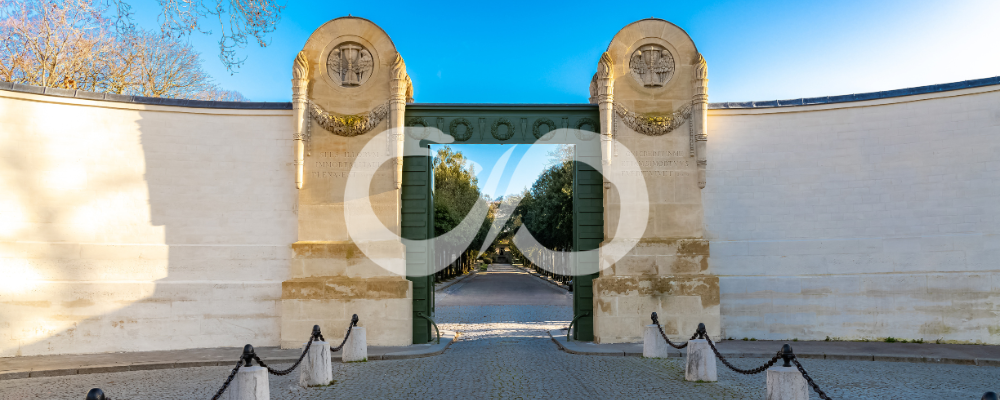
Main entrance: located on Boulevard de Ménilmontant, opposite Rue de la Roquette. It is accessible by car and is near Philippe Auguste metro station (line 2).
-
Porte du Repos: at 16 rue du Repos (you couldn't make it up), near the conservation building. This pedestrian entrance is also served by Philippe Auguste metro station.
-
Porte des Amandiers: on boulevard de Ménilmontant, opposite Père-Lachaise metro station (lines 2 and 3). This pedestrian entrance has a staircase of around thirty steps
-
Porte Gambetta: located on rue des Rondeaux, opposite avenue du Père-Lachaise, near the crematorium. It is accessible by car and close to Gambetta metro station (lines 3 and 3bis)
-
Porte de la Réunion: accessible via a staircase, this entrance is near Alexandre Dumas metro station (line 2)
To find your way around the cemetery, unless you have a keen sense of direction, it is advisable to bring a detailed map showing the divisions, paths, and notable graves. Maps are available at the main entrance and can also be consulted online.
4. The Great Figures of Esotericism Buried at Père-Lachaise
Allan Kardec, whose real name was Hippolyte Léon Denizard Rivail, is considered the founder of Spiritism. A 19th-century French educator and philosopher, he codified the Spiritist doctrine through works such as The Spirits' Book and The Mediums' Book. His tomb, topped with a dolmen, attracts many visitors who leave flowers and messages there, hoping to obtain favors or spiritual answers. Some place their hands on the monument, convinced that this gesture can grant their wishes.
4.2. Éliphas Lévi (Division 15)
His real name was Alphonse Louis Constant, Éliphas Lévi was a 19th-century French writer and occultist. He played an essential role in the revival of occultism in Europe, particularly through his work on Kabbalah and ceremonial magic. His book Dogma and Ritual of High Magic influenced many esotericists. His grave, although modest, is a place of remembrance for those interested in occultism.
4.3. Papus (Division 90)
Gérard Encausse, known by the pseudonym Papus, was a French physician and occultist. Founder of the Martinist Order, he contributed to the dissemination of esoteric teachings in France. His works on theurgy and tarot remain references in the field. His grave, adorned with esoteric symbols, is located in the cemetery's 90th division.
4.4. Joséphin Péladan (Division 19)
Joséphin Péladan was a French writer and occultist, and the founder of the Catholic Order of the Rose-Cross. He sought to merge art and esotericism, organizing art salons to promote this vision. His grave is located in Père-Lachaise's 19th division.
4.5. Stanislas de Guaita (Division 36)
French poet and occultist Stanislas de Guaita had a notable influence on the occult sciences of the 19th century. He is particularly known for his ideological duel with Papus over certain esoteric doctrines. His grave, located in the 36th division, is a point of interest for occultism enthusiasts.
4.6. Jean-Julien Champagne (Division 92)
Engineer and illustrator Jean-Julien Champagne is often associated with the mysterious alchemist known as Fulcanelli. Although his true identity remains a matter of debate, some believe that he may have been Fulcanelli himself. His grave is located in the cemetery's 92nd division.
4.7. Pierre Piobb (Division 49)
Pierre Piobb was a French Hermeticist and author of works on esoteric symbolism and the Hermetic sciences. He played a role in disseminating occult knowledge in the early 20th century. His grave is located in Père-Lachaise's 73rd division.
4.8. Georges Descormiers (Division 90)
Publisher and occultist Georges Descormiers helped disseminate esoteric works in the 20th century. His influence on the publication of occult texts makes him a notable figure in the field. His grave is also located in the cemetery's 90th division.
5. The Legendary Tombs of Père-Lachaise
In addition to these occult figures, Père-Lachaise is also a place with many legends.
5.1. Victor Noir: the tomb with fertility powers
Victor Noir, a 19th-century journalist, is known for his unusual grave. His bronze statue, depicting his reclining body, features a prominent bulge in the groin area. An urban legend suggests that touching this part brings fertility or good luck in love. As a result, the statue has a different patina in this area, bearing witness to the many visitors who have passed by.
5.2. Félix de Beaujour: the mysterious column
Félix de Beaujour, a 19th-century diplomat, lies beneath an imposing 20-meter-high column, the tallest in the cemetery. This monumental structure intrigues visitors with its unusual grandeur for a burial site.
5.3. Countess Elizaveta Demidoff: the "Vampire of Père-Lachaise"
Elizaveta Alexandrovna Demidoff, née Stroganoff, was a Russian aristocrat who died in 1818. Her grave, located in the cemetery's 19th division, is the source of a persistent legend. According to the story, she left a fortune to anyone willing to watch over her grave for 365 consecutive days. This offer fueled speculation, with some seeing it as an attempt to recruit a guardian to contain her supposed vampiric spirit.
5.4. The "Duke" tomb: Dracula?
Another legend concerns a tomb bearing the inscription "Le Duc." Some esotericism enthusiasts claim that it could be the burial place of Vlad the Impaler, better known as... Dracula. It is said that the spirit of a bat reigns over its roof, visible only to those who know how to look closely.
6. Freemasonry at Père-Lachaise
You have certainly noticed that many tombs and commemorative plaques contain the symbol of Freemasonry.
First, it is important to understand that Freemasons view death as a passage to another state of existence. Masonic funerary symbolism reflects this initiatory vision of the afterlife, in which earthly life is seen as a trial leading to spiritual elevation. Some Masons therefore chose to incorporate these references into their graves to signify their membership in the Order and their commitment to its values.
The cemetery itself is not connected to this society, but it is the final resting place of figures who made their mark on politics, culture, and science, many of whom were affiliated with Masonic lodges. In addition, some lodges ensure that their members' memory is honored by funding or maintaining their graves.
And that concludes this tour of this famous cemetery. I encourage you to visit it, especially since it is completely free and easily accessible. For more information, click here.

Par Olivier of Aeternum
Passionate about esoteric traditions and the history of the occult from the earliest civilizations to the 18th century, I share some articles on these topics. I am also co-creator of the online esoteric shop Aeternum.