


















































































































Are you hesitating between a tarot deck and an oracle deck, looking for your first pendulum or unsure which holder to use with your incense? When choosing from an esoteric shop, start with the intended use, then compare the material, size and necessary accessories. This guide explores Aeternum's main categories to help you assemble equipment suited to your practice, without buying a set you do not need.
A deck accompanied by its guidebook, resin with a compatible censer, or an oil intended for a specific holder: the right criteria vary from one category to another. Here you will find selection guidance, links to the collections and examples of sets to put together. To discover the shop's team and services, see the presentation of Aeternum and its commitments.
What equipment should you choose for your practice?
Aeternum is a French company, with a team and inventory based in France. Our project grew out of an interest in occult arts and their transmission. Reading texts, discovering materials and understanding the place of objects in ritual all inform our selection. You will find this approach reflected in the collections as well as in the site's articles.
We value the connection between study and practice. A reference to incense takes on a different meaning when you can distinguish resin from a stick. A book on divination becomes more accessible with a deck suited to its method. A talisman invites reflection on its symbol, material and the function you want to give it. At Aeternum, the product is not separate from its use.
This approach leaves room for different sensibilities. You can follow a tradition, explore a divination art or look for an object for your time of contemplation. You may also enjoy minerals or antique books without practicing a ritual. Our role is to offer you understandable choices, not to impose a path on you.
The shop thus caters to two complementary needs: finding what is missing from a specific practice and discovering a category of objects that you are not yet very familiar with. A purchase prepared with a product sheet, a guide and a few comparisons gives your equipment a lasting place, beyond the appeal of first impressions.
Which category should you start with?
Our catalog is organized around six main worlds. Each offers an initial exploration, followed by a more precise choice based on shape, material, practice or subject. You can start with whatever attracts you: a stone, a fragrance, a divination method or a book.
| Aeternum Universe | What you will find there | A starting point |
|---|---|---|
| Minerals & Stones | Tumbled stones, pebbles, rough stones, points, spheres and collector's pieces. | Choose a material and shape for your personal use or altar. |
| Incense & Fumigation | Sticks, cones, resins, plants for fumigation and suitable accessories. | Prepare for a time of prayer, a ceremony or a scented moment. |
| Divination Arts | Tarot decks, oracles, pendulums, runes, mirrors, crystal balls and other tools. | Discover a divination method and the equipment that accompanies it. |
| Magick & Rituals | Candles, tools, talismans, altar objects and selections by tradition. | Give an intention a concrete form or prepare a ritual space. |
| Apothecary | Herbs, roots, seeds, oils, waters, salts and powders. | Find the ingredients of a preparation and their specific uses. |
| Esoteric Bookshop | Introductory books, historical studies, occultist texts and practical manuals. | Understand a tradition or work with a method using a reference book. |
You do not have to explore all these worlds at once. A specific question is enough to get started: which deck should you learn, which resin should you use, what shape of stone should you set up, or which book should you read? The categories then help you compare items that meet the same need.
Which tools should you choose to discover divination?
Tarot and oracle decks for working with images
Our divination tarot decks let you compare several systems and graphic universes. The Marseille, Rider-Waite, Wirth and Crowley traditions each have their own reading cues. The right starting point depends on the book or method you want to follow, but also on how much you enjoy looking at and handling the cards.
Our oracles open up other possibilities: Lenormand, Belline, botanical, mythological or astrological themes. Read the deck description, the indicated language, the contents of the box and the information about the booklet. An appealing visual world also deserves a format you can use comfortably. A large card is suitable for a reading on a table; a compact deck fits more easily in a bag.
A cloth, a box, and a notebook can complete your set. Their function is practical: defining the space, protecting the cards, and preserving observations from a session. Our tarot guide expands on choosing a deck with explanations of the arcana and their interpretation.
Pendulums and Boards for Structured Readings
The divination pendulums collection brings together wood, metal, and stone, with conical, drop, sephoroton, Merkaba, Egyptian, and witness forms. Compare the body, attachment, stated weight, and reading point. The comfort of your hand matters more than a silhouette chosen solely for its complexity.
Boards and charts feature inscriptions or symbols to organize a consultation. A simple board is suitable for learning yes/no conventions; a themed board supports an ongoing study. Our practical pendulum guide explains how to get started, questions, exercises, and storage.
Runes, Mirrors, and Crystal Balls
Rune sets invite you to work with symbols rather than illustrated scenes. Choosing wood or stone gives your practice a tangible material, while studying the names and meanings provides reference points for readings. You can start with a set, a cloth, and our rune guide.
Scrying mirrors and crystal balls offer a different approach, centered on observing a surface and contemplation. Choose a size suited to your table and provide a stable stand. These are tools for divination, not measuring devices or guarantees about the future.
How do you find a stone that suits your needs?
Start with the shape
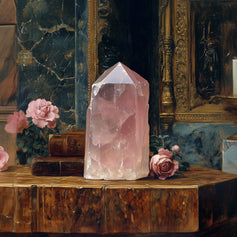
The same material can play several roles in your daily life. Tumbled stones and pebbles offer a smooth surface for a small pouch or a moment of quiet reflection. Raw minerals highlight the material’s texture. Towers and points create a visual focal point for an altar, while a sphere calls for a suitable stand.
For a collection or a gift, check the dimensions before choosing. An enlarged photograph alone does not show the object's scale. The detail of an inclusion, the distribution of colors, or the polish may then guide your preference. Shape is not only used for classification: it also determines how to place, hold, and store the stone.
Connecting the material to an intention
Amethyst, labradorite, clear quartz, obsidian, carnelian, or lapis lazuli: the materials in the catalog have different histories and esoteric associations. Our intention-based selections notably allow you to explore protection, grounding, love, or divination. These correspondences give the choice a symbolic direction without reducing the stone to a promise of results.
The Mineral Grimoire helps you understand what distinguishes these materials and place their uses in context. You can start with a stone you like, read its product page, and then decide where to place it. The beauty of the object and knowledge of its use can come together without any need to assemble an entire collection.
Finally, plan for its care. Stones, their settings, and their finishes do not all tolerate the same handling. Our guide to cleaning and recharging your stones complements this introduction with suitable methods, from everyday pebbles to altar objects.
Which incense should you choose for your spiritual practice?
Choosing incense begins with its format. Incense sticks allow for simple setup with a suitable incense holder. Cones require their own holder. Resins offer a different relationship with the material: you choose the quantity and the heating method specified for the product. Frankincense, myrrh, or benzoin can thus find their place in a ceremony or a time of prayer.
Aeternum also offers incense families by tradition and purpose: Japanese, Indian, Tibetan, religious, planetary, or dedicated to sabbats. These categories help you find a fragrance profile or a reference for the work you have planned. Compare the listed composition and format rather than focusing solely on the name of the intention.
For herbal fumigations, the sage bundles and other preparations in the catalog have their own instructions. Choosing the incense holder or censer is part of the set: it must be suitable for the material used, collect residues, and rest on a stable surface.
Preparing your home? Our house purification guide helps you choose a smoke-based or smoke-free approach. You can enjoy ritual fragrances without unnecessarily extending the burning time. A small quantity, the product instructions, and suitable ventilation provide a simple framework for this moment.
How do you combine candles and anointing oils in a ritual?
A candle provides duration, color, and a focal point for the work. Our world of esoteric candles brings together tapers, candles colored throughout, pillars, beeswax, dagydes, and preparations intended for particular intentions. Their selection depends as much on the planned process as on the symbol sought.
Ritual candles help prepare a session centered on a color and a dedication. Novena candles fit into a prayer cycle according to the reference and your practice. A compatible candle holder completes the purchase: check the diameter and base, not just the aesthetic match with the altar.
The magical oils offered by Aeternum are anointing oils. Their role is to prepare a compatible ritual medium: a candle, a talisman, a sachet, or a petition paper, depending on the product details. Protection, Love, Wealth, Clairvoyance, or road opening help define the focus of the work.
To assemble a set, start with an intention and a medium. A candle dedicated to protection may receive a light anointing before being lit, within the framework described in the product details. A talisman may require a different application method depending on its material. Our anointing oils guide explains these practices, the quantities, and the closing procedure.
These preparations retain their ritual purpose: they are not intended as body fragrance, bath products, or diffuser liquid. This distinction makes the choice clearer. You will find a formula for a defined practice, with its accessories and instructions for use.
What can you find in Aeternum’s magical apothecary?
Plants, flowers, and roots for your preparations
Magical herbalism is one of the catalog’s main sections. Dried herbs, flowers, bark, roots, seeds, and berries allow you to search by material. You can find an ingredient named in a text or compare the forms offered for a sachet, vial, or ritual preparation.
The part of the plant matters. A whole root, a dried flower, and a powder are not handled in the same way. Read the name, packaging, and stated use before completing your supplies. The presence of a plant in an esoteric apothecary does not mean it is intended for tea or bodily application.
Our Botanical Grimoire connects ingredients with their references. It allows you to study combinations before preparing a blend, choose a plant for a specific reason, and discover the place of plants in the occult arts. At Aeternum, this connection between matter and interpretation is an integral part of the shop experience.
Salts, powders, waters, and lotions for distinct uses
Magical salts and powders offer other forms of work: preparing a base, marking out a space, or making a sachet, depending on the product. The references are not interchangeable. A protection salt and a powder associated with an intention each have a specific purpose that the product description helps clarify.
Ritual waters and lotions also bring together several families, including lustral waters, holy waters, and Vo-Dù lotions. They are not chosen as if they were a single type of fragrance. The tradition referenced, the available composition, and the application instructions help you find the preparation you are looking for.
Bach flowers occupy a distinct place in this world. Their range of emotional profiles and labeling do not follow the conventions of anointing. Our Bach flower guide presents the Gaïalab range, the differences between the references, and guidelines for making a personal choice.
How do you set up an altar with the shop’s tools?
An altar can fit on a small table or an available shelf. Its coherence comes from the space given to the objects. A support for light, a vessel for an offering, a book, and a chosen representation already create a clear space. Start with the intended use before trying to fill the entire surface.
Our magical tools include athames, bolines, bowls, chalices, cauldrons, wands, and bells. Inks, quills, grimoires, and parchment accompany writing work. Each family corresponds to a different action: drawing, placing, ringing, writing, or reserving a container for practice.
Statues and devotional objects give a visual presence to the figures to which you wish to dedicate the space. Choose the image, but also its size and stability. A small representation placed well may suit your space better than a piece that is too large for the other elements.
Amulets and talismans can remain on the altar or accompany personal use, depending on their form. A box protects the supplies between sessions; a cloth defines the space without occupying it permanently. These accessories make the practice easier to resume and simpler to integrate into an inhabited home.
How can you find products related to your tradition?
Wicca, witchcraft, and seasonal celebrations
The Wicca and Witchcraft collections offer starting points for finding books, altar objects, candles, and ingredients. You can begin with the method you are studying, then complete your supplies according to the gestures it calls for. Choosing a tool is more meaningful when you already know its role.
To prepare for Yule, Imbolc, Ostara, Beltane, Litha, Lughnasadh, Mabon, or Samhain, our Wheel of the Year connects the celebrations with their symbols and practical suggestions. Sabbat incense can accompany this journey. Preparing the space, the readings, and the chosen objects together give the celebration its identity.
Ceremonial magic, pentacles, and ritual writing
For ceremonial work, the working text remains the best starting point. Our selection of planetary pentacles, altar tools, and apothecary supplies then makes it possible to find the supports you are looking for. You can study a symbol before choosing its representation and how to preserve it.
Inks, quills, and parchment are particularly suited to the desire to give writing a place in ritual. The notebook holds your readings, correspondences, and prepared steps. A structured practice does not depend on the number of objects, but on the harmony between the text followed, the intention, and the materials.
Prayers, saints, and personal devotion
The Saints' Magic section makes it possible to search for references related to prayer and devotion. Candles, novenas, rosaries, religious representations, and holy water find extensions in the other departments. You can bring together a reading and an object of devotion without adding a protocol that does not correspond to your path.
The shop also welcomes a simple search: preparing a prayer corner, finding a religious incense, or giving an object that carries a shared meaning. Staying true to your path matters more than the number of traditions represented on the altar.
Hoodoo, Voodoo, and Santería
Our Hoodoo, Voodoo, and Santería categories point to distinct references and practice contexts. A similar name or a shared material is not enough to give them the same function. Browse the product pages according to the preparation you are seeking and the teachings you follow.
Charms and mojo bags, powders, oils, and roots allow you to compose or complement a specific working. The shop provides objects and reading materials; the traditions specific to each path retain their place. This way of choosing respects differences instead of reducing them to a decorative assortment.
Can you choose your products directly by intention?
You know your goal, but not yet the material or tool? Our intention-based selections offer another path. Protection brings together supports for guarding a place or for personal dedication. Purification lets you explore space preparations and transitional practices.
The Love, Prosperity, and Success sections offer other ways to connect materials. Intention helps identify a product family; the product page then explains how to use them. An oil, a candle, and a talisman can share a theme without requiring the same action.
Phrase your search in one sentence. "Prepare my workspace", "Devote an object to protection", or "mark the beginning of a project" provide a clearer starting point than a very general request. Then choose the medium that suits you and the amount of time you want to devote to it.
These categories describe ritual purposes. They allow you to build a personal practice without promising an outcome in advance. Your decisions, actions, and respect for others retain their full place alongside the ritual.
Which creations and exclusives give Aeternum its personality?
Our identity also comes through objects developed for the shop. Aeternum creations and artisan collaborations make it possible to explore forms designed for a specific use, with their inscriptions, materials, and presentation. They bring something more to the catalog than simply a name change on an accessory.
The Consilium pendulum board offers the answers "Yes", "Maybe", and "No", around a starting point. The Futhark pendulum board opens up work with runic signs. These Aeternum wooden boards are made in France and laser-engraved. Their value is both visual and practical: they provide reference points for the session and a place for the symbols being studied.
The Originel rosewood pendulum illustrates another approach. Crafted by hand in Brittany from wood offcuts, it was designed exclusively for Aeternum. The featured item has its own photograph and comes with a linen pouch. The wood grain and the craftsmanship behind the material play a full part in choosing the object here.
Our anointing preparations also carry this identity. The Dragon's Blood magical oil presents its reference material and the purposes for which it is intended. The formula is discovered through its listed composition and use, rather than through its name alone. Find these creations throughout the categories and among our new arrivals.
Why give books a place in your supplies?
A book can be your first esoteric tool. It provides vocabulary, context, and a process that you can reread. You can browse our bookstore by subject, practice, author, and publisher: you can search for an introduction, an ancient text, or a deeper exploration of a field you are already familiar with.
The high magic books stand alongside works on divination, astrology, alchemy, botany, prayers, and the history of magic. The selections of guides and books for beginners offer a more gradual introduction. Start with the subject you genuinely want to work on, then consider the author’s approach and the edition’s presentation.
The Ars Vetus editions hold a place in this selection, with reissues of occult heritage works, including Les Miroirs magiques. They make it possible to discover texts beyond introductory manuals alone. Historical reading and practical learning complement each other, without requiring every old prescription to be put into practice.
Pairing a book with an object can guide an order. A tarot deck with a book on the chosen method, a notebook with a study of the symbols, or a resin with a book devoted to ritual fragrances form coherent sets. The accessory finds its context; the text finds an extension in the gesture.
Which free guides and tools accompany your visit?
Aeternum is not limited to catalogue listings. The Aeternum Journals feature articles on practices, occult figures, and objects. The thematic guides let you return to a plant, stone, rune, or card without starting your entire search again.
Calendar tools address another stage: organizing when to perform the work. The lunar calendar shows the phases, while the planetary hours calculator helps you find times for a practice that uses these correspondences. This allows you to connect a reading, materials, and a chosen appointment.
This continuity is useful after receiving a product. You chose a pendulum: return to the exercises. You discover a resin: reread the information in the guide. You are preparing for a sabbat: consult its page before setting up the altar. The content remains a resource to revisit throughout your experience, not merely an introduction before purchase.
Which sets should you put together to get started at Aeternum?
Your first divination table
Choose a tarot or oracle deck, a cloth suited to the surface, and a notebook. Check the deck's language and whether the booklet is included, then prepare a space where you can leave the cards laid flat. The notebook will preserve the question, the cards, and the session notes. You can complete this set with a book once your method becomes clearer.
A smoke-free meditation corner
A chosen representation, a bell, and a book of prayers or meditation can give structure to a small space. Place them on a stable surface and keep their storage simple. The bell marks the opening and closing; the reading gives the moment its content. This choice also suits a room where fragrances and burning materials have no place.
A protection working on a surface
Start with a suitable candle, its candle holder, and an anointing oil connected to your intention. Read the instructions before preparing, and reserve the session for a time when the flame can remain supervised. A petition paper can specify the dedication. You do not need to add every material classified in the same category to give meaning to the work.
An introduction to magical herbalism
Choose a plant whose references you would like to study, a small pouch intended for this purpose, and a notebook. Start with its botanical profile, then note the tradition and purpose you have chosen. This approach allows you to learn one material at a time. You can then enrich your preparations with ingredients whose role you understand.
These sets are suggestions to assemble with the items you like, not imposed kits. Objects you already own can be part of them. The goal is to bring together what is needed for a complete use, from preparation to storage.
How do you choose an esoteric gift from Aeternum?
Start with what the person already likes. A mineral enthusiast may appreciate a shape or material they do not own. Someone who reads cards may prefer a box, cloth, or book to a deck chosen without knowing their method. For a devotional practice, the meaning of the symbol deserves as much attention as its appearance.
A beautiful object can also make a gift without assuming there is a problem to fix. A stone given for its color, a book for a shared subject, or a bell for a new space expresses simple thoughtfulness. The best presentation explains why you thought of the person without assigning them a spiritual need they have not expressed.
Finally, check the exact contents of the product: whether a holder is included, pouch, booklet, and dimensions. The storage and accessories categories can help complete the gift with a genuinely useful item. A harmonious set is based on the person’s intended use, not on the number of items in the package.
How should you prepare your order and communicate with our team?
Before confirming, reread the contents of each product. An illustration may show a staged presentation; the product description specifies what is sold. Check the dimensions, packaging, material, and necessary accessories. For a candle or incense, consider the holder. For a pendulum or a deck, consider storage.
Our team can answer questions about Aeternum products. Indicate the reference name, the intended use, and the specific question: format, compatibility with a support, or the contents of a set. The Contact us page allows you to send us these details. Conversations concern the catalog and its use; the shop does not offer psychic readings.
Orders are shipped in discreet packages, with neutral outer packaging. Delivery methods and their terms depend on the destination and the order. Check the options offered for your address at the time of purchase, rather than choosing a delivery time based on an example that does not correspond to your shipment.
You can discover the manufacturers and publishers represented on the Our brands page. The shop brings together its own creations, collaborations, and products selected from other companies. This distinction helps you know what you are choosing and find a range you enjoyed on a future visit.
Questions to ask yourself before choosing
Is the shop suitable for someone who is just starting out?
Yes. You can start with a single practice and a few easy-to-identify objects. A pendulum with its guide, a deck accompanied by its booklet, or a first book are accessible starting points. The categories help refine your choice; they do not require you to know everything before your visit.
Do you need to follow a specific spiritual path to place an order?
No. Aeternum welcomes religious approaches, magical practices, divination arts, and curiosity about objects or texts. You can choose a stone for its beauty and a book for your personal knowledge. When an object is connected to a tradition, its presentation helps you better understand that context.
Are all the products made by Aeternum?
No. The catalog brings together Aeternum creations, artisan exclusives, and products from other brands. The Consilium and Futhark plaques illustrate our creations; the Originel pendulum illustrates an exclusive collaboration. Check the brand and the description of the item to find this information.
Can you find the supplies and explanations on the same site?
Yes. Product pages, guides, and calendar tools complement one another. You can choose your supplies from a collection, then return to an item to prepare for a session or care for the object. The books in the bookstore let you explore a method or tradition in greater depth.
Do all apothecary products have the same use?
No. A ritual herb, anointing oil, holy water, and floral elixir each have distinct purposes. The name of a plant or an intention alone is not enough to determine how it should be used. The product page and label of the preparation you choose remain your points of reference.
Can you order just one accessory?
You can choose what complements your supplies: a pouch, candle holder, bell, incense holder, or book. An established practice calls for targeted additions, not necessarily a new set. Simply check their size and compatibility with the objects you already own.
How can you keep up with new arrivals?
The new arrivals category lets you find the latest additions to the catalog. You can discover a new book, preparation, or type of mineral, then return to the corresponding category to compare them. New arrivals extend the shop's offerings; they do not require you to replace a tool that suits you.
Putting together your supplies, one choice at a time
Choosing an esoteric item means giving it both a purpose and a place. A deck opens up a method of reading. A resin accompanies a time of prayer. A notebook gathers study notes. An oil prepares a medium. Aeternum brings these possibilities together in one place, with the categories and explanations that make it possible to move from curiosity to a chosen practice.





Join the Aeternum community on our Facebook group: advice, tips, rituals, knowledge, products in a friendly atmosphere!
I'm going!