


















































































































Your deck is open, the cards are in front of you, and you still do not know what to do with them. This is a good time to start simply. Learning tarot involves observing the images, understanding the guidelines of a method, and relating them to one another in a spread. You do not need to recite all the meanings before your first exercise, but you will benefit from progressing with a deck and an accompanying guide rather than with ten contradictory explanations.
The path below offers short exercises, followed by a progression over seven sessions. It is intended for people who already own a deck or are preparing to make their first purchase. To choose a set, consult our first tarot guide. To understand what distinguishes the main traditions, see the comparison of Marseille, Rider-Waite-Smith, and Thoth.
Getting to know the deck before the first spread
Start by checking the contents of the box. Take out the cards, look at their number, and identify the materials provided. A classic 78-card deck divides the arcana into 22 major and 56 minor arcana; some designs adapt this structure. The Grimaud presentation of the Marseille and the table of contents of Waite's book make it possible to identify the groups in their respective systems.
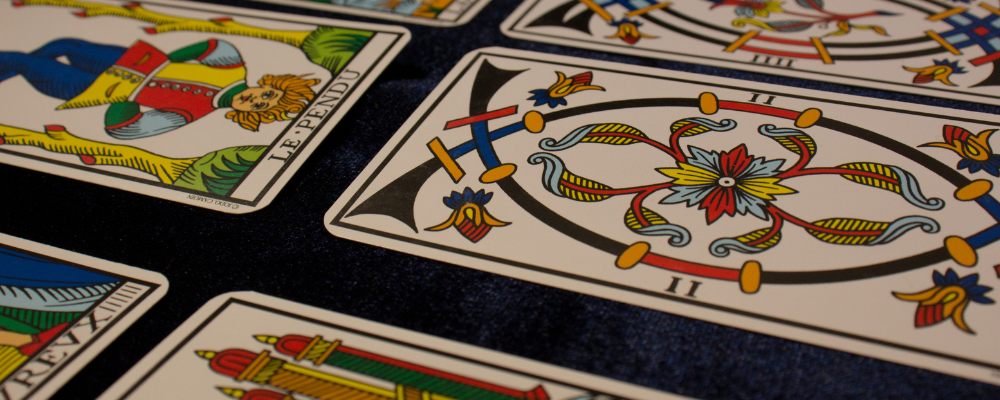
Place your deck on a clean surface that is wide enough to spread out a few cards. Look at the titles and figures without immediately searching for an answer. You can group the major arcana, then the suits of the minor arcana, following the booklet for your edition. This classification familiarizes you with the vocabulary: an arcane is a tarot card, and a suit refers to a family such as Cups or Swords.
Then shuffle in a comfortable way, without bending the cards beyond what their cardstock can withstand. Passing small packets from one hand to the other is enough; you can also move them across a clean cloth before gathering them together. A reading cloth can define the space, but a suitable table and the original box are already enough to work with and store your deck.
Observing a card without immediately looking for its meaning
Choose a card whose image intrigues you. For this exercise, you can deliberately choose it rather than draw it at random. Describe what is visible: the people, objects, dominant colors, and direction of the gazes. With a Marseille deck, you can also count the suit symbols and observe their arrangement. At first, stay close to the drawing.
Then write down a personal impression, separate from the description. “A person is holding an object” describes an image; “this person seems hesitant to me” is already an interpretation. This distinction will help you recognize what you see, what your method explains, and what your own experience adds. All three can contribute to the work without being confused with one another.
Finally, open the booklet to the relevant card. Look for what connects with your observation and what surprises you. There is no need to copy an entire page: a few sentences rephrased in your own words are enough to keep a record. Add the name of the author or booklet so that you know where each interpretation came from when you return to your notes.
Learning meanings without memorizing everything at once
A list of keywords can help you recall an idea, but it does not by itself show how to read a card in a given position. Take the time to connect a visible detail with an explanation from your text. This approach gives a reason for the words you remember. You are building reference points rather than a dictionary to recite independently of the image.
Here is an example using the Eight of Pentacles from the Rider-Waite-Smith. Waite describes a craftsman at work and associates the card with work and skill. Based on this reference point, our exercise is to write a learning question: “What action do I need to practice more?” This question is a proposal for studying the card, not a quotation from Waite or a prediction about your job.
With another system, start with its own commentary. The same number is not enough to make all explanations interchangeable. A divination book devoted to your deck can help you explore this study further. You can consult other authors later, keeping their names in your journal to distinguish between methods.
Formulating a question and understanding the role of a position
Before drawing, write your question in one sentence. To begin, choose a limited, non-urgent subject: organizing a creative activity, stepping back from a habit, or preparing for a study session. A question such as “What aspect of my way of learning can I examine today?” gives you a framework that is easier to follow than a question about your entire life.
The position is the role you assign to a card in the spread. A card placed as a “point of focus” is not read exactly like the same card placed as a “resource.” This role is decided before turning over the cards. It helps you connect the meaning to your question instead of choosing afterward whichever function suits you.
For an important situation, treat the spread as a reading and reflection exercise, alongside concrete information and the necessary conversations. An interpretation cannot establish another person's thoughts or verify a fact. This limit leaves room for a divinatory practice without turning an image into proof.
Starting with one card, then moving to three positions
For your first exercise, define one position: “an aspect to examine.” Shuffle, draw one card, and describe it before consulting the booklet. Then reread your question and formulate an interpretation in a few sentences. Finish with an observation or modest action that you can genuinely put into practice, such as setting aside time to work on a skill you have not yet mastered.
When this approach becomes familiar, move on to three cards. The model proposed here is “observed situation — resource to draw on — point of focus”. It is an exercise for learning and does not claim to be an ancient spread. Write the three roles on a sheet of paper and place each card above its intended role, from left to right.
First read the cards separately, then look for a connection between them: is one figure looking toward another card? Does an object or color appear again? Do the scenes suggest different actions? Treat these connections as elements of a reading to examine using your method, not as an obligation to create a perfectly coherent story.
You can finish even when one card remains difficult. Note what is missing and return to the text after the session. Adding several clarification cards as soon as you hesitate is more likely to multiply the elements you need to learn. Our Tarot Guide presents other spreads when you wish to explore the roles of positions further.
Keeping a journal that genuinely helps you improve
For each session, note the date, the deck used, the question, the positions, and the cards. Add your first observation, followed by the explanation from the booklet. Keeping these two moments separate lets you see how your reading develops. You can photograph the spread to preserve the layout without redrawing every card.
When reviewing your notes, avoid changing your first sentences to make them fit what happened afterward. Add a new note beside them instead. This way, you will keep an honest record of your hesitations, the associations that helped you, and interpretations that were too general. The journal becomes a study tool rather than a collection of successes selected after the fact.
A suggested progression over seven sessions
First and second sessions: recognizing the deck and observing
In the first session, sort the cards with the booklet and identify the suits. In the second, choose an arcane, describe its image, and distinguish the description from your impression. Do not try to do a complete spread yet. Your goal is to become familiar with the object and develop the habit of looking before commenting.
Third and fourth sessions: connecting the image with the text
In the third session, compare your observation with the booklet's explanation, then rephrase it. In the fourth, repeat the exercise with a card from another suit. Keep the same method so you can compare the exercises. You can note the questions the text does not resolve without immediately switching authors to obtain a more comfortable answer.
Fifth and sixth sessions: reading with a position
In the fifth session, do the one-card exercise on a limited subject. In the sixth, use the three positions proposed above, writing down their roles before the spread. Describe the cards, consult the text, and finish with a few sentences. The session is successful when you have followed the steps and identified what you understand, even if the entire interpretation does not yet seem obvious to you.
Seventh session: reviewing and deciding what to do next
Review your notes without immediately doing another spread. Which images have stayed with you? Which step helps you the most? Which difference between observation and interpretation remains difficult? Choose one point to work on in the following sessions. Progress at your own pace: the seven sessions can be spread over one week or a longer period.
Continuing without becoming scattered or discouraged
Keep your work format simple enough that you will want to return to it. For your learning, one card studied carefully is better than a large spread whose positions you can no longer interpret. You can alternate an observation session with a spread session. The first enriches the second without requiring you to draw cards every day.
Reversed cards, astrological correspondences, and comparisons between authors can wait until the foundations of your method become familiar. Introducing them gradually does not deprive you of anything. Simply decide before the session whether you read all cards upright or whether you already use a method that distinguishes orientations.
To continue, keep the connection between the deck, the book, and the practice. Find divination tarot decks, beginner decks, and method books in the shop. The Tarot Guide complements these exercises with spreads that you can explore once you know your cards better.
Sources and reading references
Arthur Edward Waite, The Pictorial Key to the Tarot, particularly the Eight of Pentacles, for the Rider-Waite-Smith reading example. Grimaud–Cartamundi, presentation of the Tarot de Marseille, for the organization of its deck. The exercises, the three-position spread, and the seven-session progression are educational proposals by Aeternum; they are intended to be used alongside the booklet for your edition.





Join the Aeternum community on our Facebook group: advice, tips, rituals, knowledge, products in a friendly atmosphere!
I'm going!