

















































































































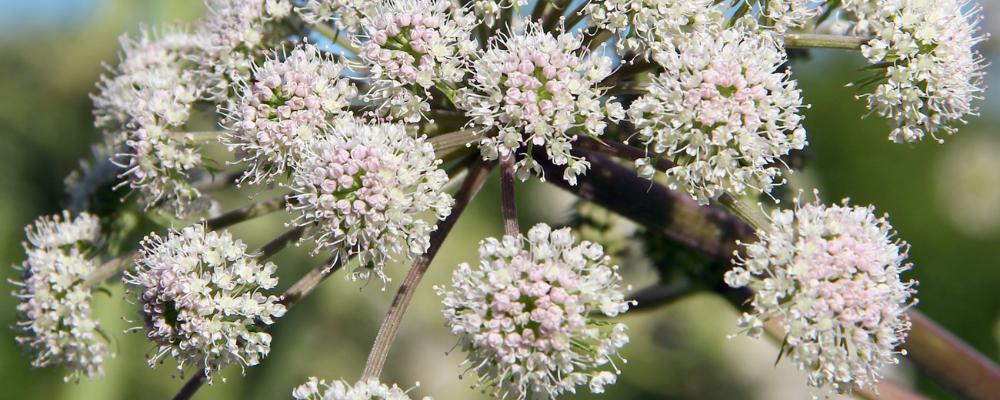
Beneath its pale flowers, Valerian conceals a strongly scented root capable of attracting cats and rats. The old herbals call it Phu, Setewale, or Setwall; Nicholas Culpeper’s plant astrology places it under Mercury.
Its magical identity arises from this contrast. The aerial part appears light, while the root imposes an animal presence, almost unsettling. It calls, sets things in motion, and leads. This power of attraction explains why Valerian belongs as much to charms of approach as to tales of leaders capable of drawing animals along behind them.
Its modern medicinal uses for mild stress and sleep are real, but they do not sum up its ritual history. In the grimoire, the root becomes above all a Mercurial material: it attracts attention, conveys a request, and accompanies the passage from agitation to rest.
The fragrant root of Valeriana officinalis
Valeriana officinalis L. belongs to the Caprifoliaceae family. This perennial has an erect stem, opposite deeply divided leaves, and clusters of small whitish to pinkish flowers. The best-known ritual material is its dried underground part: rhizome, roots, and stolons.
Kew recognizes the species as native to a vast part of temperate Eurasia. It readily grows in cool meadows, ditches, and damp places. Kew, Valeriana officinalis.
Its characteristic scent develops strongly as it dries. Not all humans like it, but some cats react by rubbing against, rolling on, or gnawing the root. The plant thus enters practice through direct sensation: before any symbolic discourse, it already changes the behavior around it.
Setewale in the old herbals
Richard Folkard recalls the ancient names of Valerian: Phu in Dioscorides, then Setewale or Setwall in English. Chaucer mentions Setewale among fragrant herbs, and Gerard reports that people in northern England readily added it to broths and restorative dishes.
The same author emphasizes the attraction the root exerts on cats and rats. This observation has nourished the image of a plant that brings, guides, or draws things along. Valerian is not a delicate perfume intended to seduce from afar: its call is earthy, insistent, and almost wild. Richard Folkard, Plant Lore, Legends, and Lyrics, «Valerian».
Cats and rats give the plant an imagery of guidance: its scent captures attention, provokes approach, and draws movement toward its source. The root thus becomes a guide as much as a magnet.
Valerian under Mercury
Nicholas Culpeper places Valerian under Mercury. The correspondence suits a plant of movement, transmission, and mediation: its root attracts, its scent travels, and its old names pass from one herbal to another. Nicholas Culpeper, The Complete Herbal, «Valerian».
The Mercury of Valerian is not only the Mercury of letters and eloquence. It guides bodies, connects the plant's upper part to its hidden root, and keeps attention flowing. For this reason, the root suits requests that must reach someone, negotiations, and transitions in which the mind must leave agitation behind to find a direction.
Attracting is not holding. Valerian calls and sets things in motion. It is better suited to opening a path, bringing someone to you, or guiding a thought than to exerting control over a person.
From turmoil to rest
The European Medicines Agency recognizes the use of preparations meeting pharmaceutical standards to relieve mild nervous tension and promote sleep. This modern function sheds light on another aspect of Mercury: the messenger must also know how to leave the noise behind and cross the threshold of night. European Medicines Agency, Valerianae radix.
In a ritual setting, the root can mark the transition between activity and rest without becoming something to ingest. Placed in a closed box near the workplace, it receives on a piece of paper the thoughts that keep circling. The box is closed in the evening and reopened the next day, when these questions can become active again.
This gesture respects the plant's double movement: attracting what wanders, then giving it a place to settle. Valerian does not command sleep; it sets a boundary for the time of wakefulness.
Calling and directing a request with Valerian
For a Mercurial working, place a small amount of root in a sealed inner sachet, then slip in a request written precisely. On Wednesday, read the text aloud and name the concrete way the response may arrive: letter, interview, journey, or conversation.
In a reconciliation working, Valerian accompanies an honest invitation, never a constraint. Write the two names on either side of a drawn path, then place the root in the middle as a meeting point. The rite ends as soon as the conversation has taken place, whatever its outcome.
Because it attracts certain cats, any practice must remain in a container inaccessible to animals. The closed container itself becomes an apt image of the plant: a real calling force, kept within a clear boundary.
Historical correspondences
| Reference | Correspondence |
|---|---|
| Botanical name | Valeriana officinalis L. |
| Part used | Dried rhizome and roots |
| Planet | Mercury, according to Nicholas Culpeper |
| Magical domains | Attraction, message, orientation, negotiation, passage toward rest |
| Central mystery | A root whose scent calls animals and sets things in motion |
| Ritual forms | Sealed inner sachet, box, request paper; without ingestion or burning |










