





























































































Black Pepper crossed the Indian Ocean, Arab markets, and European kitchens as a commodity of value. In an Arabic magical treatise attributed to Ṭumṭum al-Hindī, it appears among the substances used in love operations, alongside paper, fire, salt, and aromatics. This genuine presence is more valuable than modern tables that automatically assign it to Mars: historical pepper is a commodity, a burning flavor, and a situated ritual substance.
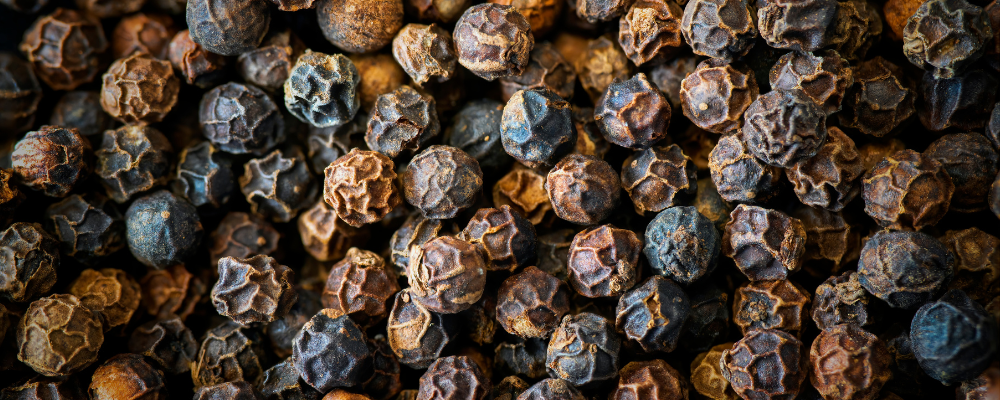
Black Pepper comes from the dried fruits of Piper nigrum L., a woody vine in the Piperaceae family. The green berries are harvested before ripening and then dried, which wrinkles and blackens their outer layer. White pepper comes from ripe fruits stripped of their pericarp.
Its historical magic must remain tied to the texts that name it. The heat in the mouth explains images of ardor, urgency, or conflict, but it does not by itself prove a planetary correspondence. The whole grain is suitable for work involving measurement, price, and sharp speech.
The berry of a tropical vine
Piper nigrum climbs with the help of adventitious roots. Its entire leaves alternate along the stems, while the small flowers cluster on drooping spikes. The fruits, green at first and then red, produce several spices depending on the harvest date and processing.
Kew accepts the species, places it in its native state in Sri Lanka, and points out that black, white, and green pepper all come from the same plant. Kew, Piper nigrum.
The grain's black color is therefore not the color of a fresh fruit. It results from harvesting and drying. The transformation offers a clear magical lesson: the state of a substance also tells the story of the human action that prepared it.
A spice weighed as a value
Pepper traveled along long routes, with taxes, monopolies, imitations, and substitutions. Its small size made it possible to transport great value in a limited volume. The grain thus became a measure, a debt, and a sign of access to merchant networks.
In medieval kitchens, Pepper went into strong powders with other spices. This presence does not automatically make it an ingredient of exorcism: the table, pharmacy, and magic share materials without sharing every use.
The merchant's mystery of Pepper lies in the gap between appearance and price. A wrinkled berry may seem modest, but it condenses labor, distance, and control. In a pact, it reminds us that a promise always has a material cost.
Pepper in the Grimoire of Ṭumṭum
The Arabic magical treatise attributed to Ṭumṭum al-Hindī gives Black Pepper a notable place in love operations. The recipes use it with written materials, fire, and other aromatic or pungent substances.
A presentation of this corpus emphasizes that Pepper appears there more often than in the Greek magical papyri or the earliest Syriac texts, and sees this as evidence of Indian transmission. Presentation of the grimoire attributed to Ṭumṭum al-Hindī.
These historical operations include dangerous or coercive acts that have no place in current practice. Their interest lies in the material trace of a named pepper, situated in a text and linked to a precise cultural chain.
The historical grain derives its meaning from the text, medium, and gesture surrounding it.
Black Pepper and pepper-wort are not the same plant
Modern tables associate Black Pepper with Mars and occasionally cite Agrippa. Yet Agrippa's English translation speaks of “pepper-wort root” among Saturn's fumigations: the editorial note identifies it instead as costus, not Piper nigrum.
Agrippa reserves other materials for planetary fumigations and places cinquefoil among those of Mercury. Agrippa, De occulta philosophia, Book I.
This confusion shows how a vernacular name can shift a correspondence from one species to another. Magical rigor begins here with botanical and philological identification, before any interpretation of heat or color.
Weighing sharp words
Draw a scale. In the left pan, write the sharp sentence you wish to say. In the right pan, place its possible cost for the relationship, work, and your own safety.
Add five drawn peppercorns beneath the scales. Each bears a verb: check, measure, defer, rephrase, respond. Circle the verb that restores balance without erasing the disagreement.
End with a short version of the sentence that is firm and non-coercive. Keep the real Pepper in its culinary container or original packet: no peppercorn needs to be burned, thrown, or placed on the skin.
Historical correspondences
| Reference | Correspondence |
|---|---|
| Botanical name | Piper nigrum L. |
| Family | Piperaceae |
| Part used | Dried fruit before maturity |
| Magical text | Treatise attributed to Ṭumṭum al-Hindī |
| Magical domains | Price, ardor, measure, and speech |
| Safe form | Drawn scales and peppercorns |
Find Black Pepper at Aeternum
The Black Pepper essential oil is currently available in limited quantities. For protection or banishing workings, also compare the supplies in the Protection and Banishing collections.