






























































































The Walnut appears in Roman marriage ceremonies at the moment when a child leaves one status to enter another. Walnuts thrown during weddings made noise, attracted attention, and marked the transition. Their Latin name, nux iuglans, was also understood as Jupiter’s acorn. Beneath its hard shell, the divided fruit carries a nourishing reserve. Its mystery brings together closure, sharing, fertility, and change of age, far from the modern shortcuts that see a brain in every kernel.
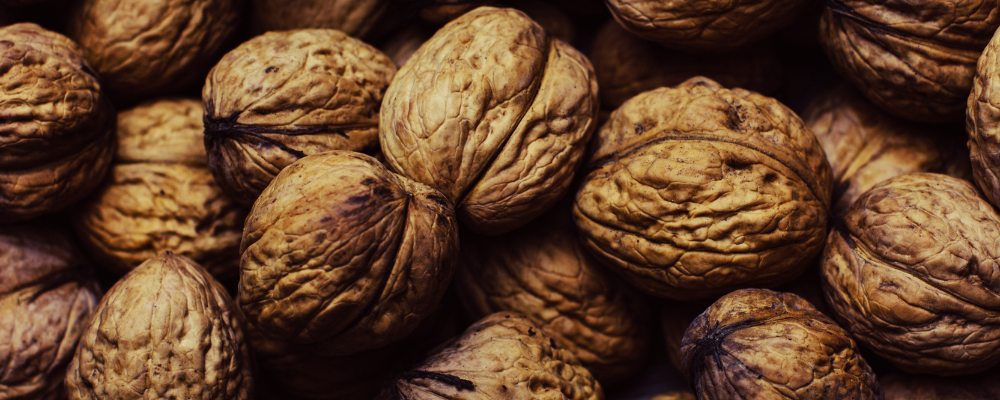
The Walnut discussed here is the fruit of the common Walnut, Juglans regia L., Juglandaceae. Botanically speaking, the green, fleshy husk surrounds a lignified shell. The part consumed is the seed, divided into folded cotyledons.
This entry follows the detached fruit, offered, thrown, or shared. The Walnut as a tree, a site of stories, and a territorial presence has its own entry. The magic of the Walnut works with dowry, passage, and reserve, through a fruit drawn rather than cracked, eaten, or burned.
Husk, shell, and seed
The young fruit has a green husk rich in coloring substances. At maturity, this husk separates from the hard shell, formed of two fused valves. Inside, the seed fills several chambers.
Kew accepts Juglans regia and places its native range from Xinjiang to the western Himalayas. Cultivation has carried the tree far beyond this range. Kew, Juglans regia.
Husk, shell, and seed form three levels of protection. Reserve magic can draw on this structure: outer boundary, durable container, and inner resource.
The shape of the kernel resembles a brain to the modern eye, but this resemblance is not enough to establish a historical connection with intelligence. The sources considered here speak instead of weddings, Jupiter, and fertility.
Jupiter’s acorn
The name Juglans comes from the Latin expression interpreted as Jovis glans, Jupiter’s acorn. The fruit thus receives a name of majesty and divine nourishment.
A historical study of Mediterranean nuts recalls this etymology, their culinary uses, and their symbolism of fertility. Cambridge University Press, history and symbolism of Mediterranean nuts.
Jupiter is not assigned here according to a modern table. He is present in the Latin name transmitted by authors and botanists. This linguistic trace connects the fruit with authority, the banquet, and regulated generosity.
The mystery of the name lies in its survival. A religious formula becomes a genus name, then continues to carry a memory that scientific language does not immediately make visible.
The name of the fruit preserves an offering made to Jupiter.
Walnuts thrown at Roman weddings
Roman texts mention Walnuts thrown during weddings. Their sound accompanies the procession and marks the change in the groom’s status, as he leaves behind the games of childhood.
A British botanical history brings together the testimonies of Catullus, Virgil, and Pliny concerning this custom. The Trees of Great Britain & Ireland, chapter Juglans.
The throwing disperses a reserve fruit at the moment of the union. This public gesture combines wished-for abundance, fertility, and a break with a bygone period.
The Walnut thus becomes a threshold object. It does not bind two people by force: before witnesses, it marks the beginning of a new responsibility.
The mystery of the divided shell
The shell protects as long as it remains closed. Once opened, it divides into two halves that retain the shape of the whole fruit. This symmetry suits pacts in which each person keeps a share of the common memory.
The seed fills almost the entire inner space. The reserve is not a guarded void: it has a nourishing purpose. Every protection therefore receives a condition for opening.
In a passage working, the two valves represent what is left behind and what is beginning. The invisible hinge becomes the decision that connects the two states.
The sound of the wedding adds the witness. A lasting change benefits from being named before the people who can support it and remind you of its commitments.
Opening the Walnut of a passage
Draw a Walnut opened into two valves. In the left half, write three habits, privileges, or burdens left behind.
In the right half, note three new responsibilities. For each one, add the date of the first act and the name of a consenting witness.
In the center, draw the kernel as four quarters. Place in them the resources that will nourish the passage: money, time, learning, and support.
Symbolically close the Walnut with a circle drawn around the illustration. Leave an opening at the bottom of the circle to recall that the reserve must be shareable.
Historical correspondences
| Reference | Correspondence |
|---|---|
| Tree of origin | Juglans regia L. |
| Family | Juglandaceae |
| Structure | Husk, two-valved shell, and seed |
| Latin correspondence | Jovis glans, Jupiter’s acorn |
| Magical domains | Passage, marriage, reserve, fertility, and responsibility |
| Safe form | Drawn open walnut |