















































































































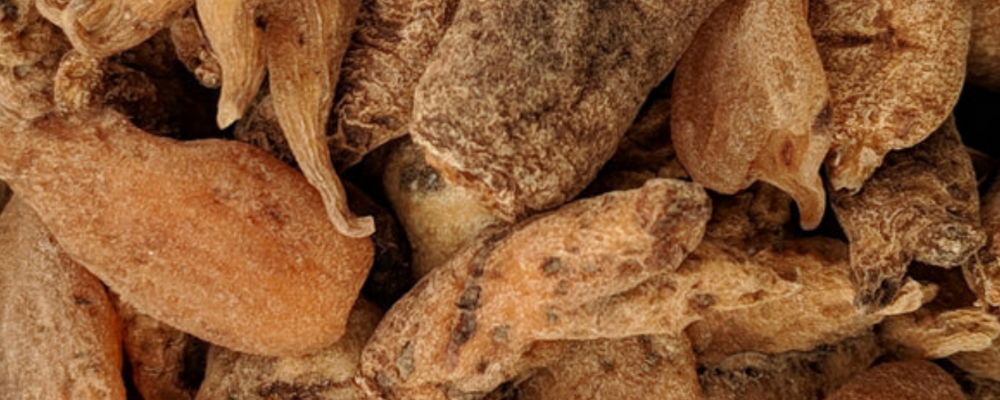
Lucky Hand Root is not a reliable name for a botanical species. In the trade of ritual curios, it refers to orchid tubers whose divisions resemble fingers. This form has nourished a practice of sympathetic magic: a plant hand can seize an opportunity, hold on to a gain, or carry a charm in a sachet. Its history belongs primarily to African American hoodoo and should be approached through its name, context, and limitations.
Objects sold under the names Lucky Hand Root, Salep Root, or “Lucky Hand” may come from several terrestrial orchids with divided tubers. Identification based solely on their dried appearance remains unreliable. Attributing all these roots to Orchis mascula would therefore be misleading.
The resemblance to a hand explains the ritual function better than a planetary correspondence. The tuber “takes,” “holds,” and “keeps” through its shape. In hoodoo, it may be added to a mojo intended for gambling, work, or material luck. Describing this use requires distinguishing cultural history from commercial recipes.
One Trade Name, Several Orchids
Terrestrial orchids store reserves in underground tubers. In some species, these organs divide into thick lobes that can resemble a small palm. Once dried, their color, surface, and size change, making identification even more difficult.
Orchis mascula is a tuberous orchid native to Europe, North Africa, and western Asia. Kew presents its taxonomy and names associated with salep. Kew, Orchis mascula. This species can help clarify the form without becoming the automatic identity of every curio.
Dactylorhiza hatagirea, a tuberous Himalayan orchid, displays a different finger-like structure. Kew, Dactylorhiza hatagirea. Botanical diversity means keeping the trade name as a ritual category, not as a scientific identification.
The Hand in Hoodoo
Hoodoo developed among African American communities, combining African knowledge, the American botanical environment, the Bible, commerce, and practices of protection or success. "Hand" can refer to a mojo bag as well as to an object whose form works through analogy.
The five volumes collected by Harry Middleton Hyatt between 1936 and 1940 bring together thousands of testimonies from African American practitioners. Introduction to the Hyatt Collection. This body of work shows a living, local, and variable ritual world, far from a universal list of ingredients.
In this context, the hand-shaped root can be used in workings for gambling, job hunting, or luck. Its function rests on the image of grasping and on its incorporation into a prepared object. Removing the root from this context to sell it as "orchid magic" would erase its history.
The ritual name describes a function and a form; it does not guarantee a botanical species.
Grasping, Holding, and Not Coercing
The hand is a symbol of action before it is an abstract emblem. It takes a tool, signs an agreement, pays, gives, and protects. A finger-shaped root concentrates these gestures in a small object that can be carried.
Sympathetic magic through form establishes a visible relationship: what resembles a hand supports the act of grasping an opportunity. This resemblance does not justify seeking to control a person. Material luck remains linked to one's own work, choices, and consensual agreements.
Contemporary commerce also offers treated, scented, or uncertainly identified roots. Their appearance may be beautiful without revealing their provenance. The object's power must therefore be separated from a botanical certainty that the label cannot provide.
The Hidden Cost of Wild Orchids
Many terrestrial orchids depend on soil fungi to germinate and live in vulnerable habitats. Uprooting the tuber kills the plant and removes its storage organ. A ritual demand can therefore place real pressure on wild populations.
The dried hand then tells of two opposing acts of taking: the one promised by the charm and the one carried out by commerce against the soil. Responsible practice requires legal provenance, a cultivated species when this information exists, and refusal to harvest personally.
This question fully belongs to the magic of luck. A gain built on a threatened resource shifts the cost onto a distant environment or community. The right hand does not merely grasp: it also knows how to release and give back.
Drawing the hand of opportunity
Place the packaged root beside your page without opening it if you are concerned about its identity or fragility. Trace the outline of your own hand. In the palm, write the exact material objective: amount, position, contract, or deadline.
Assign an action to each finger: search, ask, compare, negotiate, and preserve. Under each word, write a dated action. The root serves as a visual reminder, but the drawn hand remains the active support of the work.
Close the practice by writing down what you refuse to take: someone else’s money, a deceptive commitment, an illegal resource, or control over another person. Store the page with your practical steps and keep the root dry in its container.
Historical correspondences
| Reference | Correspondence |
|---|---|
| Commercial name | Hand of Luck root |
| Botanical nature | Fingered orchid tuber, variable species |
| Cultural context | African American Hoodoo |
| Historical principle | Sympathetic magic through form |
| Magical domains | Material luck, games, employment, and preservation |
| Safe form | Drawn hand and root kept dry |










