

















































































































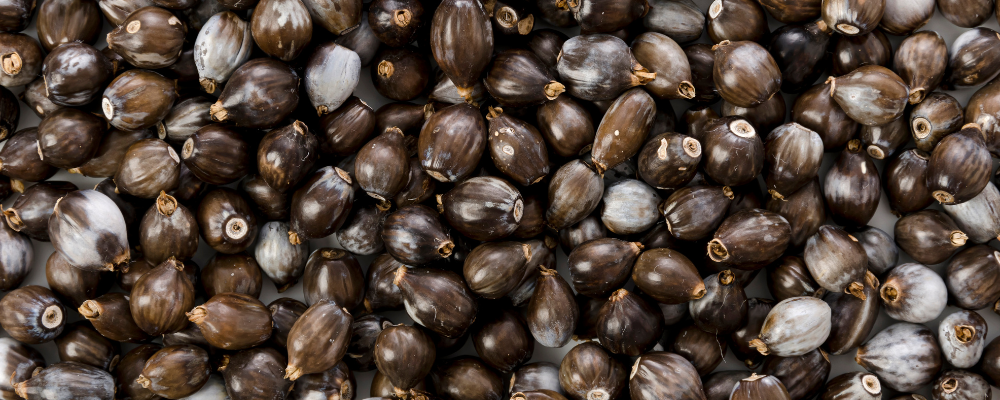
Job's Tears are not biblical seeds found in the Book of Job. They are the hard, glossy involucres of Coix lacryma-jobi, an Asian grass whose shape evokes a tear and whose natural opening allows it to be strung. Necklaces discovered in a cemetery in Xinjiang dating back approximately two thousand years attest to this use of plant beads. The European name later associated the plant with the tears of the suffering righteous and with prayer objects.
Job's Tears is Coix lacryma-jobi L., a large tropical Poaceae species related to other cultivated grasses. The hard object used as a bead is an involucre, a transformed bract that surrounds the female part of the inflorescence and the fruit.
The plant therefore brings together three threads: a naturally stringable architecture, an archaeological history of jewelry, and a biblical name constructed by analogy. This entry weaves them together without guaranteeing protection, healing from grief, or the granting of a number of wishes. The practice counts steps on a drawing; commercial beads remain closed and are neither ingested nor worn by a child.
A bract turned into a bead
Coix lacryma-jobi is a robust grass with broad leaves. Its inflorescences bear visible male parts and female parts surrounded by an involucre that hardens at maturity.
Kew accepts the species and places its native range from the Indian subcontinent to Taiwan and Peninsular Malaysia. The involucre may be white, gray, or bluish, bony, and glossy. Kew, Coix lacryma-jobi.
Two openings are found in the mature structure, facilitating the passage of a thread. The object resembles a prepared bead, even though it comes directly from the inflorescence.
This architecture supports a magic of counting and linking. Each unit retains its shape, but the thread gives it a place in a larger sequence.
The Cemetery Necklaces of Sampula
Archaeobotanists studied remains of Coix lacryma-jobi from the Sampula cemetery in Xinjiang. The context dates to approximately two thousand years ago.
Three sets of necklaces combined Job's Tears involucres with glass beads. One of the necklaces was still around the neck of a buried person. Archaeobotanical study of Job's Tears at Sampula.
The discovery proves a lasting ornamental use and places the plant bead in a funerary context. Researchers are also examining a possible connection with the region's Buddhist culture.
The thread survives in the order of the beads. Even when the organic material disappears, the arrangement of the involucres preserves the trace of a gesture, a body, and a community.
Job's name and the tears of ordeal
The biblical Book of Job does not name Coix lacryma-jobi. It recounts the ordeal of a man who loses his possessions, children, and health, then debates with relatives whose words add to his pain.
In Job 16, his face is reddened by weeping and his eyes pour out tears before God as he calls for justice. Job 16, tears and a call for a witness.
The plant's name later brings the shape of the involucre closer to these tears. It creates a Christian or biblical reading of a grass native to Asia.
The magic of the name works through endurance, the expressed lament, and the need for a witness. It does not make Job a plant deity or turn the bead into a promise of victory.
Necklaces, bracelets, and prayer beads
The material's hardness and the thread's natural passage led several communities to use the involucres for necklaces, bracelets, clothing, and prayer beads. Each object derives its meaning from the group that makes it and the use associated with it.
The British Museum holds a 19th-century Iban child's bracelet made of coix seeds grown in the Baram River region of Malaysia. British Museum, Iban coix bracelet.
The French National Museum of Natural History also presents Job’s Tears necklaces associated with fish scales and notes that plant necklaces may serve for adornment, celebrations, or rituals. MNHN, seed necklaces and ritual uses.
The same material therefore does not carry a fixed worldwide meaning. The thread, the number, the neighboring materials, and the person who receives the object together shape its function.
Drawing a thread of complaint and response
Draw ten forms of Job’s Tears in a line. In the first three, name the facts that cause distress without turning them into a judgment about yourself.
In the next three, write down the possible witnesses: a person, service, community, or text capable of receiving the complaint.
Set aside three forms for concrete answers already available. In the last one, place the question that remains open and the date of its next reading.
Draw a continuous thread through the ten forms. Place the closed sachet on the left side of the page. Read the rest aloud in a low voice, then communicate at least one request to the witness named instead of keeping the entire thread silent.
Historical correspondences
| Marker | Correspondence |
|---|---|
| Botanical name | Coix lacryma-jobi L. |
| Family | Poaceae |
| Nature of the “seed” | Hard, glossy, naturally perforated involucre |
| Historical markers | Sampula necklaces and museum objects |
| Magical domains | Counting, complaint, testimony, endurance, and memory |
| Safe form | Thread drawn in ten forms |










