






























































































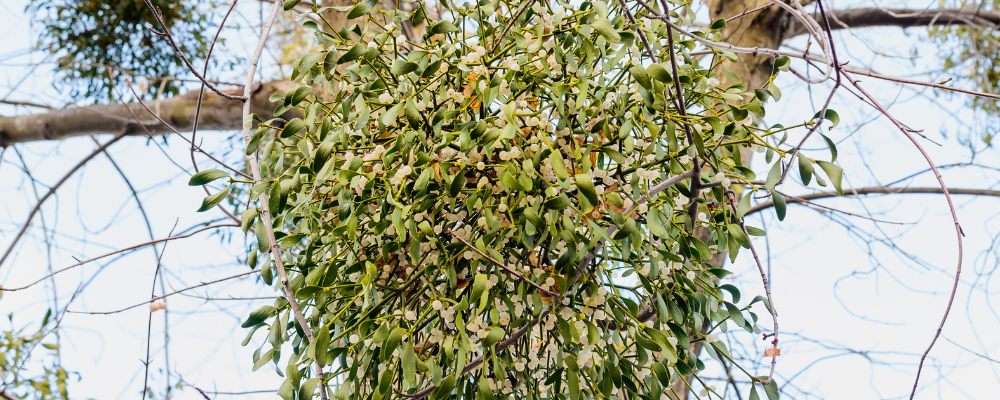
Mistletoe never touches the ground. It is born on the branch of another tree, remains green in the heart of winter and lets translucent berries hang when most foliage has disappeared. This suspended life has given it a singular place in European rites, myths and talismans.
Pliny the Elder describes the Druids' harvest of Oak Mistletoe on the sixth day of the moon: a priest dressed in white, a golden sickle, a white cloth and two bulls. Nordic tales, by contrast, make Mistletoe the unexpected weapon that kills Baldr. Between universal remedy and fatal projectile, the plant bears an ambivalence that its actual toxicity makes impossible to forget.
French customs involving New Year's Mistletoe, hanging branches and talismans said to open locks extend this mystery: Mistletoe protects because it remains above the ground, between tree and sky, at the very place where ordinary categories become uncertain.
A plant suspended in the trees
White Mistletoe, Viscum album L., belongs to the Santalaceae family. It is a hemiparasitic shrub: its green leaves carry out photosynthesis, but a haustorium penetrates the host branch and draws out water and mineral salts. Its stems divide into regular forks, and its white fruits contain a viscous pulp.
Kew places the species from Europe to temperate Asia. Mistletoe grows on many trees, including apple trees, poplars, lindens and hawthorns. Its presence on an Oak is much rarer, which helps explain the exceptional importance Pliny attributes to it. Kew, Viscum album.
Birds help disperse it by carrying the sticky seeds from one branch to another. Mistletoe therefore lives through relationships: it depends on a host, animal passage and an elevated position. Its magic should preserve this reality rather than turn it into an independent plant.
The Druidic harvest according to Pliny
In his Natural History, Pliny the Elder states that the Druids consider Mistletoe growing on an Oak particularly sacred. On the sixth day of the moon, they prepare a banquet and a sacrifice beneath the tree. A priest dressed in white climbs up to cut the plant with a golden sickle; the Mistletoe is received in a white cloth so that it does not touch the ground.
Two white bulls are then sacrificed, and a prayer asks that the divine gift be favorable to those who receive it. The ceremony takes place on the sixth lunar day. Its calendar, rare Oak, and sacrifice belong to Pliny’s precise account. Pliny the Elder, account of the gathering of Mistletoe.
The white cloth reveals the heart of the rite: the plant must not fall into the ordinary world. It remains suspended even during its harvesting. The precious metal, the garment, and the white animals prolong this separation.
The branch that kills Baldr
In Norse mythology, Frigg obtains from almost all things an oath that they will not harm her son Baldr. Mistletoe, judged too young or too insignificant, remains outside the oath. Loki turns it into a projectile and guides the hand of the blind god Hödr: Baldr falls.
The tale overturns the image of a purely benevolent plant. What grows on the margins, forgotten by the inventory of powers, becomes the decisive instrument. Richard Folkard then links the hanging of Mistletoe and the kiss of peace to its return under Frigg’s control, in a later tradition that seeks to transform the weapon into a sign of reconciliation. Richard Folkard, Plant Lore, Legends, and Lyrics, “Mistletoe”.
The mystery of Mistletoe lies in this power of exception. A small branch excluded from the oaths is enough to break invulnerability. Any protection placed under its sign must therefore examine what has been forgotten, neglected, or left outside the boundary.
New Year’s Mistletoe and locks
Folkard reports that in France, during the 15th and 16th centuries, large popular gatherings were associated with the “New Year’s Mistletoe.” The Oak branch remained a talisman there, and the seasonal cry has passed through the centuries in various forms.
Other beliefs grant Mistletoe the power to open locks. Albertus Magnus attributes this virtue to it alongside other wondrous plants. In Holstein, a branch carried in the hand was called a “specter’s wand” and was supposed to make it possible to see ghosts and then compel them to speak.
These uses bring together opening and passage. The suspended Mistletoe guards the door of the year, loosens what was closed, and makes visible what remains between worlds. Its power is never domestic in the tranquil sense: it works within the interval.
That which does not touch the ground opens a passage. Mistletoe lives in the in-between: neither tree nor ground herb, dependent and evergreen, hoped-for healer and fatal weapon. Its power comes from this position, impossible to reduce to a single nature.
Keeping the threshold of the year with Mistletoe
At New Year, place a small branch in a closed container and suspend it up high, away from contact with food. Write down what you wish to keep closed behind you and what should open in the new year. The next day, separate the two requests: destroy the first paper and keep the second beneath the container.
For a protection working, first examine the forgotten exception. List the people, places, or habits that your boundary does not yet protect. Mistletoe then guards not through direct force, but by revealing the breach through which Loki's dart might pass.
An old branch must be removed before it deteriorates. Wrap it and dispose of it with household waste, without composting or placing it in nature. Ritual use remains entirely external and suspended.
Historical correspondences
| Reference | Correspondence |
|---|---|
| Botanical name | Viscum album L. |
| Nature | Hemicryptophytic shrub living on the branches of a host tree |
| Ritual times | The sixth day of the moon according to Pliny; the threshold of the New Year in French customs |
| Stories | Druidic gathering, death of Baldr, Mistletoe at New Year, opening locks |
| Magical domains | Threshold, protection through exception, opening, passage, reconciliation, remembrance of the dead |
| Ritual forms | Enclosed and suspended branch; no ingestion, fumigation, or contact with food |