





























































































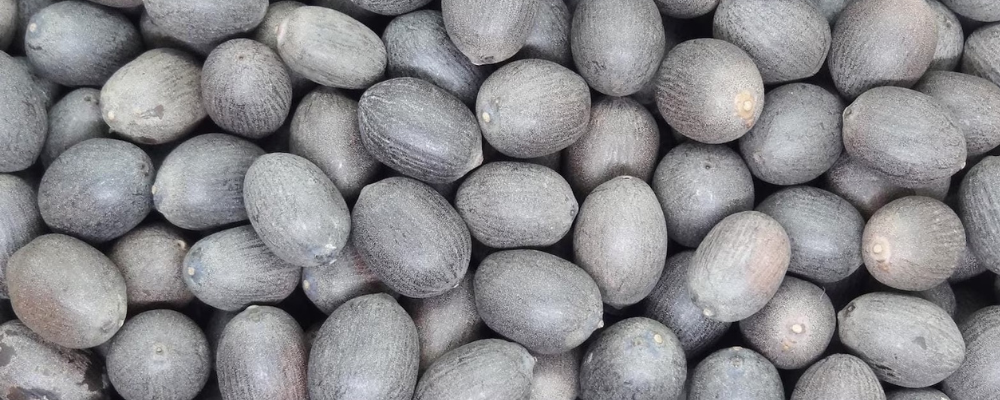
The Lotus Seed possesses a lifespan that seems to defy the human scale. Fruits of Nelumbo nucifera exhumed from the dried bed of a Chinese lake germinated after several centuries, and one directly dated specimen approached 1,300 years. This genuine endurance gives the seed a magic of reserve and renewal. It connects with the lotus of Buddhist and Hindu arts, without automatically transferring every meaning carried by the flower to the seed.
The Sacred Lotus is Nelumbo nucifera Gaertn., a perennial aquatic plant in the Nelumbonaceae family. Its rhizomes take root in the mud, its round leaves emerge from the water, and its sprinkler-head-shaped receptacle houses hard fruits, each containing a seed.
The fruit's longevity, the flower's rise above the water, and its presence in Asian religious imagery provide the reference points for this page. The “Egyptian lotus” belongs to water lilies of the genus Nymphaea. Current practice works with dormancy on paper; the product remains closed, without ingestion, improvised planting, or perforation.
A hard fruit in a receptacle
Nelumbo nucifera is a rhizomatous aquatic plant. Its peltate leaves may float or rise above the water. The large flowers produce an enlarged receptacle, each cavity bearing a fruit containing a seed.
Kew accepts the species and describes a vast native range extending from Eastern Europe and Iran to Japan, tropical Asia, and northern Australia. Kew, Nelumbo nucifera.
The hard pericarp limits water entry and contributes to prolonged dormancy. Inside, the embryo and its reserves remain protected until favorable conditions arise.
The seed becomes a time capsule. Its magic does not lie in remaining closed forever, but in preserving an ability and then recognizing when resumption becomes possible.
The Thirteen-Century-Old Seed
A study published in the American Journal of Botany reports the germination of a sacred lotus fruit from the dried-up bed of a lake in Pulantien, northeastern China.
Radiocarbon dating gave an age of approximately 1,288 years, with a margin of uncertainty. The fruit germinated before it was directly dated. Study on the longevity of the sacred lotus.
Later research examined the pericarp and protective proteins of these fruits. Their preservation results from biological architecture, not from a suspension outside time.
Dormancy preserves a possibility, not a result. Awakening requires an intact covering, reserves, water, and an environment capable of supporting growth.
The Lotus in the Religious Images of Asia
The Muséum national d’Histoire naturelle presents the sacred lotus as a major plant in the arts and architecture of Asia. It is emblematic of Buddhism and appears as an attribute or seat of deities in Hinduism.
The flower rises above the water while its rhizome remains in the mud. This relationship nourishes images of purity, awakening, and blossoming. MNHN, Sacred lotus and Asian symbolism.
The seed has a different place. It preserves the future form before the stem, leaf, and flower appear. It therefore represents the transmission, latency, and continuity of a teaching.
A respectful approach distinguishes religious iconography from a commercial object. A seed placed on a table does not become a divine throne or a sign of enlightenment merely because of a similarity in name.
Nelumbo and the Egyptian lotuses
Common usage calls several aquatic plants “lotus” even though they do not belong to the same genus. The sacred lotus of Asia is Nelumbo nucifera, recognizable by its peltate leaves and perforated receptacle.
The Muséum clarifies that the Egyptian lotus probably corresponds to Nymphaea lotus, a water lily. MNHN, distinction between the Oriental lotus and the Egyptian lotus.
The blue and white flowers of pharaonic iconography therefore do not allow their uses to be attributed to a seed of Nelumbo nucifera. The shared name conceals two botanical structures.
This separation becomes an exercise in precision. Before inheriting a symbol, the object must be identified by its species, location, and the plant part actually shown by the source.
Preparing a dormancy chamber
Draw a Lotus receptacle with eight compartments. In the center, write the capacity you wish to preserve during a waiting period.
In four compartments, note what must remain intact: knowledge, money, relationship, and access. In the other four, place the conditions necessary for resumption.
Draw an envelope around the receptacle and write its opening date. Add a criterion that will authorize opening it: threshold reached, response received, location available, or rest completed.
Place the closed sachet to the left of the page. On the appointed date, reread each compartment. Open the project only if the central conditions are met; otherwise, set a new date and name the missing resource.
Historical correspondences
| Reference | Correspondence |
|---|---|
| Botanical name | Nelumbo nucifera Gaertn. |
| Family | Nelumbonaceae |
| Part | Hard fruit containing a long-lived seed |
| Scientific reference | Germination of a fruit directly dated to approximately 1,300 years ago |
| Magical fields | Dormancy, reserve, transmission, and resumption |
| Safe form | Receptacle drawn with eight compartments |
Find the Lotus Seed at Aeternum
The Lotus Seed is available in our Ritual Seeds & Berries collection. Use its product page to check stock and size before purchasing.