



























































































Damiana entered Western books in the 19th century with an already loaded reputation: an aromatic Mexican leaf, a tonic sold by pharmacies, a liqueur ingredient, and a promise of desire. Occult catalogs later transformed this commercial success into a universal plant of love. Its real history speaks less of an old grimoire than of a disputed botanical name, a commodity, and a modern erotic imagination.
The plant selected is Turnera diffusa Willd. ex Schult., a small shrub from the dry regions of the Americas. It has also circulated under the name Turnera aphrodisiaca, created after the Mexican drug entered American medical collections.
This fact sheet traces the birth of this reputation and its transition into love magic. The Aeternum product remains sealed: no tea, elixir, wine, smoking, or skin contact accompanies the proposed practice.
The small aromatic shrub of Mexico
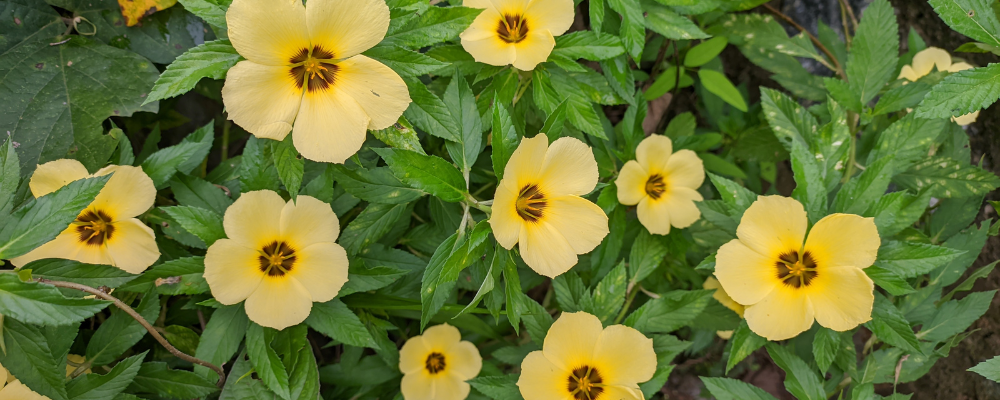
Turnera diffusa belongs to the Passifloraceae family. The shrub bears small, toothed leaves covered with aromatic glands, along with yellow flowers with five petals. Its woody branches and scent help distinguish it from plants sold as “false Damiana.”
Kew extends its native range from southern Texas to Central America, the Caribbean, and eastern Brazil. Kew, Turnera diffusa.
The trade long hesitated between several names and origins. An isolated dried leaf is difficult to identify. The supplier’s label, origin, and botanical name must accompany the sachet, especially when the market associates Damiana with smoking blends.
Entry into 19th-century pharmacy
In 1872, Mexican leaves reached physician F. O. St. Clair through the American consul in Cabo San Lucas. Lester F. Ward examined them and proposed the name Turnera aphrodisiaca in 1876. The plant then made its way into dispensaries and medical journals across the United States.
King’s American Dispensatory recounts this introduction, reproduces the material received, and highlights the botanical uncertainties of the period. King’s American Dispensatory, “Damiana”.
Elixirs, tonic wines, and patented preparations amplified the aphrodisiac promise. The strength of the narrative comes as much from advertising, the Latin name, and the staged Mexican origin as from the plant’s local use.
From Love Tonic to Charm
When a substance sold for desire enters an occult shop, its medical indication can become a magical correspondence. Damiana thus joined attraction sachets, love blends, and altars devoted to sensuality during the 20th century.
This passage does not come from a medieval manuscript. It follows a modern chain: aromatic leaf, pharmacy, liqueur, advertising, and then ritual commerce. Understanding this chain gives the plant a more solid history than the automatic addition of Venus, Friday, and astrological signs.
Desire was inscribed in the name. Aphrodisiaca turned reputation into a botanical characteristic, and the market then transformed that characteristic into a promise.
Liqueur, Fragrance, and Regional Identity
In the Baja California Peninsula, Damiana found another life in regional liqueurs. The bottle, fragrant leaf, and discourse of love created a tourist identity that should not be projected onto the whole of Mexico’s pre-Columbian history.
The Mexican medicinal uses cited for Turnera diffusa concern several disorders and vary by region. They do not establish a uniform Mayan cult of Damiana. The grimoire’s account therefore retains the most firmly established date: its entry into North American pharmacy beginning in the 1870s.
Its fragrance nevertheless remains a relevant ritual language. An aromatic material kept in a sachet can mark attention to the body, consent, and loving communication without claiming to provoke another person’s desire.
Writing a vow of mutual desire
Keep the Damiana sachet closed and place it to the left of a blank sheet of paper. Write two sentences: what you wish to offer in a relationship, then what you agree to receive. Both formulations must leave the other person’s freedom intact.
Fold the paper in half and place the phrases facing each other. Place an untied ribbon on top. For seven minutes, reread the text and remove any term implying coercion, control, or possession.
Store the paper and ribbon with the sealed product. The work focuses on reciprocity, availability, and clarity of desire. It uses no drink, smoke, oil, or ingestion.
Historical correspondences
| Reference point | Correspondence |
|---|---|
| Botanical name | Turnera diffusa Willd. ex Schult. |
| Historical name | Turnera aphrodisiaca Ward, now a synonym |
| Historical turning point | Introduction into American pharmacies starting in 1872 |
| Magical context | Modern love magic and twentieth-century ritual commerce |
| Areas | Desire, reciprocity, communication, and consent |
| Safe form | Sealed product, written paper, and untied ribbon |