





























































































Anise carries its fragrance in small, ridged fruits commonly called seeds. In the 1st century, Pliny reported that Pythagoras praised the plant and recommended cultivating it near the house. He also attributed to it a strange protective power when held in the hand. Behind these prescriptions emerges a domestic magic of fragrance: making a place recognizable, watching over rest, and maintaining a presence within reach.
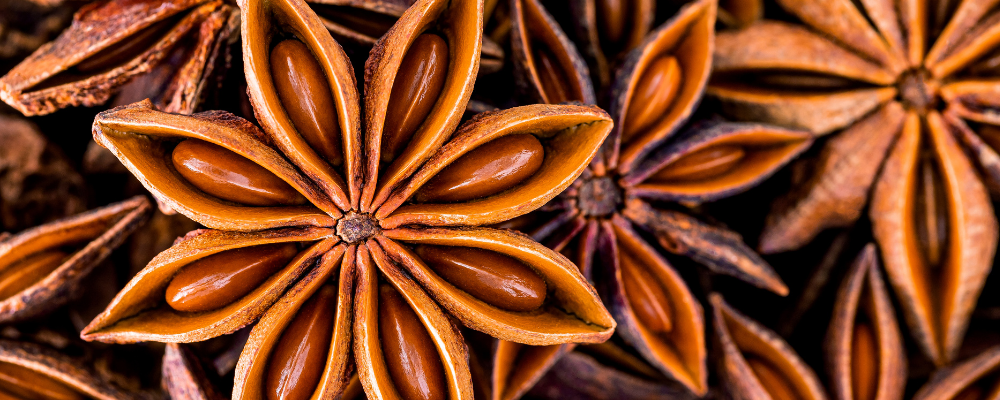
Green Anise is Pimpinella anisum L., an annual plant in the Apiaceae family. It differs from Star Anise, the fruit of an Asian tree called Illicium verum. The names and aromas are similar, while the plants, organs, and risks differ.
The main source is Book 20 of Pliny’s Natural History. The author brings together culinary knowledge, medicine, and claims attributed to Pythagoras. Current practice retains the hand, the house, and the fragrance as images, with the sealed product to the left of the drawing.
An umbellifer with fragrant fruits
Pimpinella anisum forms a slender, branched stem. The lower leaves are rounded, while the upper leaves divide into narrow segments. The small white flowers are grouped in umbels.
The dry fruit separates into two mericarps and contains aromatic oil rich in trans-anethole. Kew accepts the species and places its native range from southeastern Turkey to central Israel, including Cyprus. Kew, Pimpinella anisum.
The word “seed” commonly refers to the whole fruit sold as a spice. This detail matters for a grimoire entry: the aromatic object brings together the husk, fruit, and seed in a very small unit.
The umbel distributes the flowers around several rays, then each fruit concentrates the scent. Expansion into the air and concentration in the fruit form the two magical movements of Anise.
Anise Held in the Hand According to Pliny
Pliny devotes two chapters to Anise. He presents it as a plant praised by Pythagoras and used in food, bread, and wine. The text already associates fragrance, the table, and everyday life.
A statement attributed to Pythagoras declares that an epileptic seizure does not occur as long as Anise is held in the hand. Pliny adds that this reputation supposedly led people to plant as much of it as possible near the house. Pliny, Natural History, Book 20, Chapters 72-73.
This medicine no longer has clinical authority. Its historical interest lies in the form of the gesture: holding, planting near the hearth, and making fragrance a continuous presence.
The hand guards what the house cultivates. In Pliny’s account, Anise connects the body, the threshold, and the nearby garden.
The fragrance suspended near sleep
Pliny also reports that Anise was suspended from the pillow, within the sleeper’s reach of smell. The fragrance was supposed to promote sleep. The text continues with numerous medical and obstetrical recipes that remain tied to ancient knowledge.
The suspended object creates a paradoxical watch: a scent remains present while the person falls asleep. The guardian does not wake them; it maintains continuity around rest.
The fragrance has a spatial limit here. It acts near the bed and does not require filling the entire house with smoke. The material remains suspended, visible, and localized.
In a contemporary practice, a scented word can replace the plant. Writing down what must watch over sleep is enough to preserve the historical structure of the gesture without exposing the airways.
A nearby house and a recognizable presence
Planting near the house establishes a circle of familiarity. The plant belongs to the everyday landscape, accompanies comings and goings, and returns with its season. It is not transported from an abstract place at the last moment of the rite.
The hand, the pillow, and the garden form three distances. The hand touches the decision, the pillow protects rest, and the garden marks the perimeter. A complete protection can distribute its means according to this scale.
Anise also helps recognize a place by its smell. Olfactory memory quickly associates a scent with a room or a person. This ability gives fragrance evocative power, without attributing automatic supernatural action to it.
The most faithful magical domain therefore remains domestic continuity. What is maintained, suspended, and cultivated establishes a lasting presence around the home.
Drawing the three circles of the home
Draw three concentric circles. In the center, draw an open hand. Write in the palm the decision you must be able to uphold today.
In the second circle, draw a pillow and write what must remain calm during your rest. Add a concrete action: turn off a notification, close a door, or set a time.
In the outer circle, draw eight umbel rays. On each one, place a condition that protects the home: access, rhythm, person, maintenance, speech, light, silence, and assistance.
Place the closed product to the left of the page. Do not open it. Review the center in the morning and the circle of rest in the evening for eight days. On the last day, keep only the conditions that produced a real effect.
Historical correspondences
| Reference | Correspondence |
|---|---|
| Botanical name | Pimpinella anisum L. |
| Family | Apiaceae |
| Part called the seed | Aromatic dried fruit |
| Ancient source | Pliny, Book 20, words attributed to Pythagoras |
| Magical domains | Home, watchfulness, sleep, and continuity |
| Safe form | Three drawn circles and closed product |