



















































































































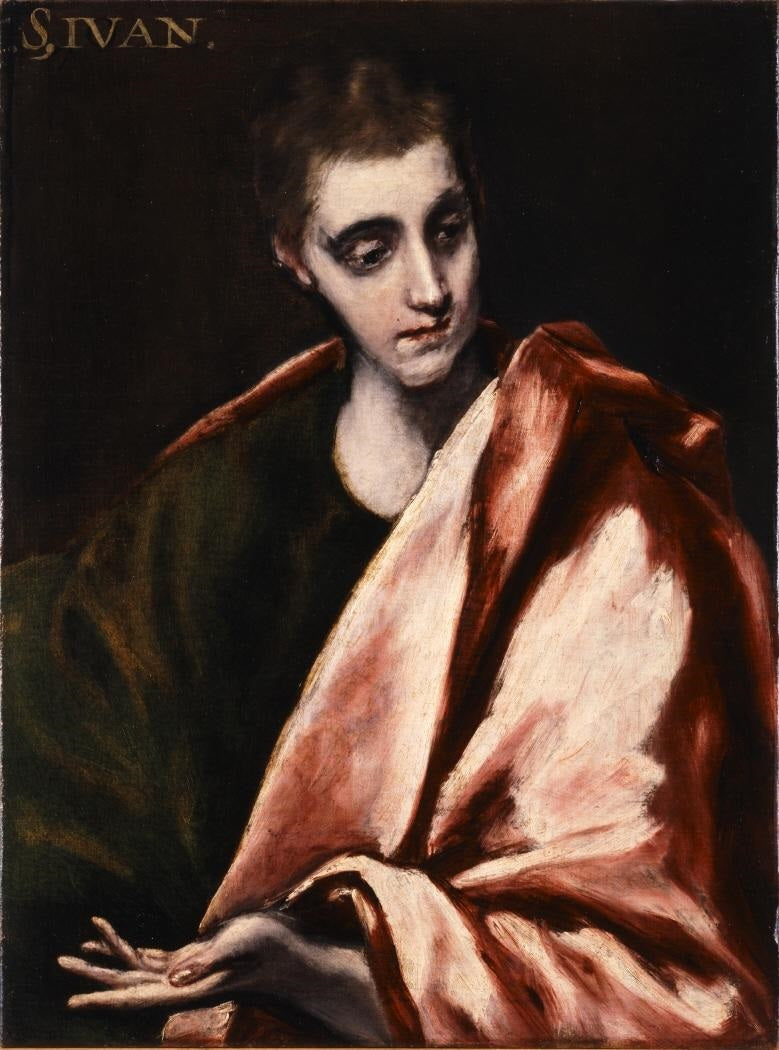
The apostle John, son of Zebedee and brother of James, belongs to the group of disciples most present during the decisive events of Jesus’ ministry. The Synoptic Gospels show him on the mountain of the Transfiguration and in the Garden of Gethsemane; Acts later presents him alongside Peter in Jerusalem. Christian tradition has also associated him with the fourth Gospel, three epistles, and Revelation, forming a body of immense theological significance. This attribution must be approached precisely: the authors of these texts do not all explicitly identify themselves as the son of Zebedee. John’s story thus connects the first disciples, the memory of the communities of Asia Minor, and the transmission of the Johannine writings.
| Name | John, son of Zebedee and brother of James |
|---|---|
| Background | Fishermen from the Sea of Galilee |
| Episodes | Transfiguration, Gethsemane, Acts 3–4 |
| Literary tradition | Gospel, three letters, and Revelation of John |
| Place of remembrance | Ephesus according to ancient traditions |
| Attributes | Cup, book, and eagle in Johannine iconography |
Two brothers called by the lakeshore
John and his brother James are working with their father Zebedee when Jesus calls them in Mark 1. Their life initially unfolds in the world of Galilean fishermen, where work is organized within the family. The narrative places them alongside Simon and Andrew, who are likewise called to leave their occupation to follow Christ. The first members of the apostolic group therefore did not all come from Jerusalem’s scholarly institutions.
Mark 3 gives James and John the nickname Boanerges, traditionally understood as “sons of thunder.” This name is not a detailed psychological biography, but it echoes certain episodes in which the two brothers take a forceful role. Their journey shows how Jesus’ teaching transforms the desire for greatness and recognition into a mission of service.
John alongside Peter and James in the major episodes
Along with Peter and James, John belongs to the small group that accompanies Jesus in several scenes selected by the evangelists. Mark 5 places him near Jairus’s daughter, restored to life. Mark 9 places him on the mountain of the Transfiguration, where Moses and Elijah appear beside Christ. Mark 14 then shows him in Gethsemane, when Jesus asks his disciples to keep watch during his prayer.
The combination of these three episodes has important narrative significance. John sees Jesus’ power, witnesses a revelation of his glory, and then experiences the disciples’ weakness at the time of the Passion. Physical closeness to the master is therefore not enough to provide a complete understanding of what he announces. The evangelists present men who gradually learn the meaning of Christ’s mission.
John’s presence in this restricted group should not be confused with that of the Twelve as a whole. Each evangelist constructs his narrative from a selection of events, and the roles given to the disciples serve to express the stages of their formation.
The question of first places and refused hospitality
In Mark 10, James and John ask Jesus for places of honor in his glory. Their request prompts teaching about authority: whoever wants to be great must become a servant. The episode shows that the disciples can continue to reason according to the criteria of prestige even though they have been called to follow a master who announces his Passion.
Luke 9 also reports that James and John want to call down fire from heaven on a Samaritan village that refuses to welcome Jesus. He rebukes them. The scene is instructive because it contrasts the disciples’ zeal with the way Jesus conducts his mission. Their devotion to their master still has to learn not to become a desire to punish those who reject him.
These two episodes give John’s figure a human reality that it would be reductive to erase behind his association with love in the Johannine tradition. The texts show a disciple in formation, not a character who possessed from the first call all the qualities that would later be attributed to him.
John and Peter in the Acts of the Apostles
After the Resurrection, Acts presents John alongside Peter. In chapter 3, the two apostles go up to the Temple and encounter a man who cannot walk. Their intervention leads to a gathering and interrogations. Chapter 4 shows them before the authorities in Jerusalem, defending their right to proclaim Christ despite opposition.
The association of Peter and John also appears in chapter 8, when they travel to Samaria to visit people who have received the Gospel. This journey reveals the collective dimension of the apostolic mission. The two men are sent from Jerusalem to meet a new community, in a context where the relationship between Jews and Samaritans has a long and complex history.
Acts does not, however, tell a continuous biography of John through the end of his life. The book’s silence leaves room for later Christian traditions, several of which associate him with the churches of Asia Minor and particularly with Ephesus.
John, the beloved disciple, and the fourth Gospel
The fourth Gospel gives a distinctive place to a disciple identified as “the one Jesus loved.” This figure appears notably at the Last Supper, at the foot of the cross, and in the Easter narratives. Church tradition identified him with John, son of Zebedee, but the book does not explicitly state this equivalence. Biblical studies therefore distinguish the literary figure of the beloved disciple, the witness to whom the book appeals, and the history of its composition.
John 19 recounts that Jesus entrusts his mother to the disciple present at the cross. The scene has played a considerable role in Christian memory and Marian devotion. It does not, however, by itself provide a named identification of the disciple with the son of Zebedee. The tradition that brings the figures together must therefore be distinguished from the text’s own formulation.
The fourth Gospel is known for its great discourses on life, light, truth, and love, as well as for the way it recounts Jesus’ signs. Its composition belongs to the history of a Christian milieu whose characteristics differ from those of the three Synoptic evangelists.
Do the epistles and Revelation belong to the same author?
Three letters are transmitted under John’s name. The first develops the themes of brotherly love, truth, and the link between confessing Jesus Christ and the life of the community. The other two are shorter and refer to an author who presents himself as “the Elder.” Their vocabulary’s closeness to that of the fourth Gospel explains why people speak of a Johannine corpus.
Revelation is also associated with the name of John, but its author presents himself as a seer named John on the island of Patmos. Scholars debate his identification with the apostle and the relationship between the literary traditions. The difference in language, genre, and context requires a separate study. It would therefore be inaccurate to present the five writings as the assured work of a single hand without mentioning these questions.
The fourth Gospel, the epistles, and Revelation nevertheless nourished a Christian memory gathered around the name of John. Their place in the New Testament explains the strength of the eagle symbol, which traditionally designates the evangelist.
Ephesus, the book, and the eagle in tradition
Irenaeus of Lyon and other ancient authors associated John’s figure with Ephesus and the Christian communities of Asia Minor. These testimonies occupy an important place in the history of tradition, even though interpreting them requires distinguishing the different people who bore this name. Asia Minor thus became one of the principal places of Johannine remembrance.
In iconography, John appears as a young man beside Christ or as an older writer holding a book and accompanied by an eagle. The eagle belongs to the tradition of the four living creatures associated with the evangelists. A cup from which a serpent sometimes emerges comes from a later legend concerning a poisoned drink; it is not described in the Gospels.
The feast of the apostle and evangelist is celebrated on December 27 in the Roman calendar. His story invites readers to study the Synoptic accounts of the disciple and to examine the Johannine works separately, whose theological influence far exceeded the biographical information preserved about the son of Zebedee.
Sources and references
Mark: chapter 1, calling; chapter 9, Transfiguration; chapter 10, service.
Acts, chapter 3 and chapter 8, John alongside Peter.
John, chapter 19, beloved disciple; Revelation 1, John of Patmos.
Benedict XVI, general audience of July 5, 2006 and audience of August 9, 2006, John son of Zebedee and the Johannine writings.
Historical illustration: El Greco, portrait of the apostle, circa 1590, Oviedo cycle, Museum of Fine Arts of Asturias, public-domain work.










