



















































































































The rosary belongs to the great Marian prayer practices of Catholicism. It combines repeated prayers with contemplation of scenes from the life of Christ. The simplicity of its material form conceals a tradition of meditation whose vocabulary and forms have evolved over the centuries.
A Meditation on the Life of Christ
The rosary combines repeated prayers with contemplation of the mysteries of Christ's life with Mary. A standard rosary contains five decades. Each decade is based on a mystery, with one Our Father, ten Hail Marys, and a doxology. Opening and closing prayers may vary according to local custom.
The Four Series of Mysteries
The Joyful Mysteries cover the Annunciation, the Visitation, the Nativity, the Presentation in the Temple, and the Finding of Jesus. The Luminous Mysteries contemplate his Baptism, Cana, the proclamation of the Kingdom, the Transfiguration, and the institution of the Eucharist. The Sorrowful Mysteries follow the Agony, the Scourging, the Crowning with Thorns, the Carrying of the Cross, and the Crucifixion. The Glorious Mysteries evoke the Resurrection, the Ascension, Pentecost, the Assumption, and the Coronation of Mary.
An Accessible Practice
Announce the mystery, optionally read a few verses or a brief meditation, then pray the decade without seeking speed. A single decade can constitute a complete time of prayer. The material aid helps with counting; its material does not add power to the prayer. The rosary does not replace Mass or the full reading of the Bible.
Guidelines and Freedom
The Luminous Mysteries were proposed by John Paul II in 2002. The customary distribution of the series across the days is a practice, not a condition for the prayer to be acceptable. Some Marian mysteries rely on Catholic doctrine and tradition rather than on the explicit account of a biblical scene. Orthodox and Protestant Christians do not all share this Western practice in the same form.
The Mysteries of the Rosary and Their Organization
The Joyful Mysteries evoke, among other events, the Annunciation and Jesus's childhood; the Sorrowful Mysteries follow the Passion; the Glorious Mysteries turn toward the Resurrection and its consequences. In 2002, John Paul II proposed the Luminous Mysteries, devoted to several stages of Jesus's public ministry. The rosary usually consists of five decades during which vocal prayer accompanies meditation. The aim is not to count for the sake of counting, but to maintain attention on the Gospel events.
The history of the rosary is linked to the spread of the Marian psalter, confraternities, and the Dominican Order, without a current form having been established in full from the earliest centuries. Local variations and added prayers bear witness to its vitality. The rosary remains an optional devotional practice, distinct from the sacraments and the Church's liturgical prayer.
From the Fifteen Traditional Mysteries to the Twenty Current Mysteries
The classic form of the rosary brings together fifteen mysteries from the lives of Jesus and Mary. The five Joyful Mysteries lead from the Annunciation to Jesus found in the Temple; the five Sorrowful Mysteries pass through the Passion; the five Glorious Mysteries associate the Resurrection, the Ascension, and Pentecost with the great Marian traditions of the Assumption and the Coronation. These groups provide a structure for meditation and make it possible to journey through a large part of salvation history.
In 2002, John Paul II proposed adding five Luminous Mysteries devoted to Christ's public life: Baptism in the Jordan, the wedding at Cana, the proclamation of the Kingdom, the Transfiguration, and the institution of the Eucharist. The letter Rosarium Virginis Mariae presents this addition as a possibility offered to personal and communal prayer, without removing the freedom to retain the fifteen traditional mysteries. The current series of twenty mysteries preserves this Christ-centered orientation.
The weekly distribution of the series gives a rhythm to those who wish to follow it. It is not a rule whose slightest variation would invalidate the prayer. The mysteries may also be chosen in relation to the liturgical calendar or a circumstance of life.
The History of the Hail Mary
The Hail Mary brings together words taken from the first chapter of Luke and a request for intercession that developed within Catholic prayer. The greeting addressed to Mary by Gabriel and Elizabeth's words belong to the accounts of the Annunciation and the Visitation. The second part of the formula, which asks the Mother of God to pray for the faithful, belongs to the liturgical history of later centuries.
The presence of this prayer at the heart of the rosary explains the relationship between Mary's name and the life of Christ. The biblical words return to the moment when she welcomes the Incarnation; meditation then continues with the events of his public life, the Passion, and the Resurrection. The title Mother of God gives meaning to this relationship, without the prayer turning Mary into an independent deity.
Repeating the greeting can help maintain attention on an episode. Its purpose is not to accumulate words like points won, but to let the Gospel text nourish the prayer.
The Dominican Tradition and Confraternities
The rosary developed particularly in the circle of the Dominicans and prayer confraternities. At the end of the Middle Ages, preachers encouraged the recitation of series of Marian greetings associated with meditations on Christ. Images and books spread this form of devotion and made it a familiar heritage in parishes and Christian homes.
A later tradition attributes to Saint Dominic the reception of a rosary given directly by the Virgin. The earliest sources on his life do not describe the handing over of an object identical to the one used by the faithful today. It is therefore preferable to distinguish the actual role of the Dominican family in spreading the prayer from the literary development of this account.
Confraternities carried out a large part of its transmission, notably by organizing meetings and processions. Their history shows how an individual practice can become a shared language of meditation.
The Cross, Medals, and Beads
Rosaries are made from various materials, from wood and pits to glass, metal, or stone. Objects may bear a cross, a Marian medal, or the image of a shrine. Their appearance reveals a history of craftsmanship and a connection to regional devotions. The beads primarily serve as markers for following the decades, while the other elements recall the Passion of Christ or the memory of Mary.
This use must be distinguished from a supposed power attached to the material. In Catholicism, the rosary belongs to prayer and not to a technique that guarantees the outcome of a request. The object may be blessed, but its blessing does not replace the attention, faith, and commitments of the person who carries it.
The shrines of Lourdes and Fátima have given the rosary a particular place in their pilgrimage life. This continuity explains the wide circulation of rosaries throughout the Catholic world.
The Rosary at Home and in Celebrations
The rosary may be recited alone, with family, or in a community. The faithful may meditate on a single decade, a complete rosary, or several series according to their time and disposition. Gospel readings, moments of silence, and personal intentions give the repetition of the words a direction that goes beyond simple counting.
This practice remains a free devotion, distinct from Mass and the sacraments. The recitation of the Our Father also recalls its relationship to the prayer taught by Jesus. The rosary is not an obligation imposed on all Christians in the same form, but a method that Catholic tradition offers for deepening contemplation of Christ.
Reading John Paul II's 2002 letter helps clarify its center: the events of Christ are meditated on with Mary, in a journey of faith that does not replace the Word of God but leads back to it.
Sources and References
Catechism — prayer with Mary, nos. 2673–2679
John Paul II — Rosarium Virginis Mariae, 2002
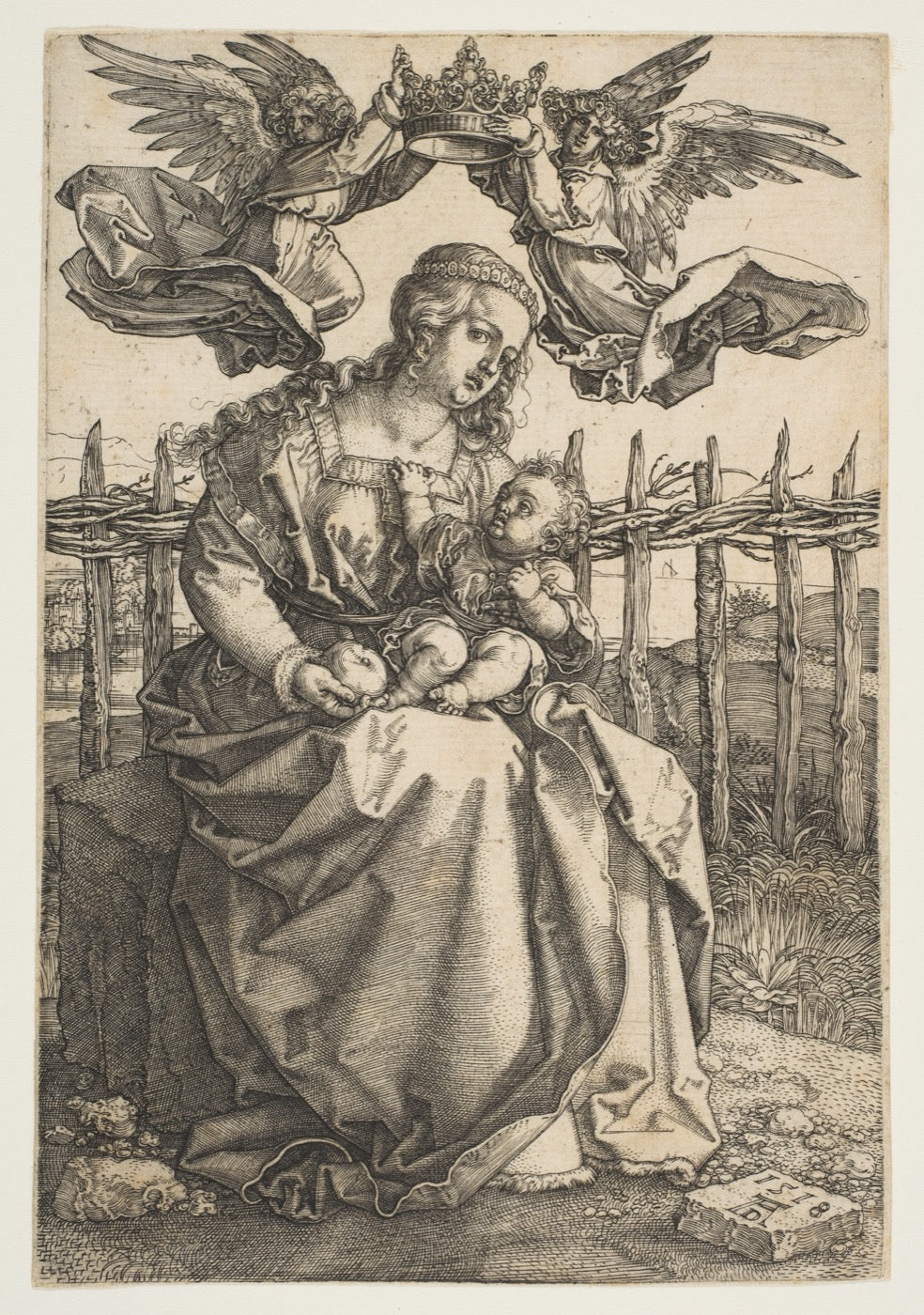
Illustration: Caravaggio, Our Lady of the Rosary (1607), public domain reproduction.










