




























































































F.-Ch. Barlet is one of the most discreet yet most central figures in French occultism at the end of the 19th century. Behind this pseudonym was Faucheux, a Registration civil servant, astrologer, theorist, translator, and tireless organizer of esoteric societies. Where Papus occupied the stage, published tirelessly, and established one organization after another, Barlet worked more behind the scenes in structures, councils, correspondence, and journals. His influence can be found in nearly all the major French occultist networks of his time.
He was involved with the Theosophical Society, the Hermetic Brotherhood of Luxor, the Independent Group for Esoteric Studies, the Kabbalistic Order of the Rose-Cross, the first Supreme Council of the Martinist Order, the Gnostic Church, and Max Théon's Cosmic Movement. This institutional activity was accompanied by considerable work on astrology, the synthesis of the sciences, planetary cycles, and the relationships between ancient traditions and the modern world.
His discretion nevertheless blurred even his civil identity. The Bibliothèque nationale de France currently records Alfred Faucheux as his real name, whereas several occultist sources from the 20th century and even the funerary inscription reproduced in L’Initiation give Albert Faucheux. Rather than making an artificial choice, it is more rigorous to retain the name under which he actually published and was known: F.-Ch. Barlet.
1838, the birth of a future occultist who first pursued a career in administration
F.-Ch. Barlet was born in Paris on October 12, 1838. The BnF records his death in the same city on October 29, 1921. His life presents a striking contrast between a highly regular administrative career and esoteric activity of exceptional scope.
Biographical notices show him obtaining his baccalaureate late, in 1864, and then studying law in Dijon. He obtained his degree in 1867 and subsequently joined the Registration administration. His appointments took him notably to Corsica and then to several cities in mainland France. He ended his career in Abbeville at the end of the 19th century, holding important responsibilities in this administration.
This professional life should not be regarded as mere background. Barlet was neither a bohemian, nor a professional mage, nor a lecturer living off occultism. For decades, he pursued a career as a civil servant alongside an increasingly extensive esoteric research program. This dual existence partly explains the very distinctive tone of his writings: he sought ordered systems, verifiable correspondences within their own logic, and structures capable of linking seemingly distant fields.
His contemporaries emphasized his erudition and his lack of interest in showmanship. Victor-Émile Michelet, who knew him in Hermetic circles, described him as a man who deliberately remained in the shadows despite the considerable authority accorded to him. This reputation as a discreet adviser explains why his name appears behind so many initiatives without becoming as famous as those of Papus or Stanislas de Guaita.
The Theosophical Society and the choice of Western occultism
Barlet belonged to the Theosophical Society’s first French circles. In the 1880s, the theosophy of Helena Blavatsky attracted many French seekers with its ambition to unite religions, Eastern philosophies, and occult doctrines. Papus himself passed through this movement before distancing himself from it.
Barlet took part in this first French establishment but soon distanced himself from it. The break did not mean a rejection of Eastern traditions. Rather, it reflected opposition to the idea of placing India and Eastern doctrines above all Western traditions. Several French occultists then sought to reconstruct a path specific to the West, based on Hermeticism, the Kabbalah, Martinism, the Rosicrucian tradition, and European initiatory traditions.
It was in this context that Barlet met Gérard Encausse, the future Papus. Their age difference was significant: Barlet was nearly twenty-seven years older. Papus had the energy of a founder and promoter; Barlet brought broad learning, experience with networks, and a capacity for synthesis that young occultists respected.
This relationship was never that of a disciple submitting to a master. Barlet maintained his independence. He supported several of Papus’s projects, took part in his organizations, and wrote for his journals, but he also rejected certain directions when they seemed artificial or overly institutional to him. This trait remained constant until the end of his life.
The Hermetic Brotherhood of Luxor and practical occultism
One of Barlet’s most important affiliations was the Hermetic Brotherhood of Luxor, generally referred to by the initials H. B. of L. In the 1880s, this international organization offered practical occult teachings that differed greatly from those of the Theosophical Society.
René Guénon, who knew Barlet personally, devoted an entire article in 1925 to his relations with initiatory societies. He confirms there that Barlet joined the H. B. of L. even before the French occultist movement fully developed. More recent historical studies of the Brotherhood also identify Barlet as the head or provincial grand master of the French section.
The teachings of the H. B. of L. combine astrology, magic, psychic development, ceremonies, and the theory of correspondences. The organization claimed to transmit a very ancient Western Hermetic tradition. Its origin stories obviously cannot be taken literally as established historical facts, but they help explain what its members sought: a practical initiation distinct from mere philosophical study.
Barlet retained the organization's documents for many years and played a decisive role in their circulation in France. The Papus collection at the Municipal Library of Lyon still preserves several items associated with this milieu, including texts by Barlet and documents related to Trithemius's planetary intelligences.
This experience left a lasting mark on his thinking. Astrology would never be an isolated technique for him. It belonged to a science of the relationships between human beings, cycles, and cosmic powers. Likewise, magic was not separate from cosmology: to act, one must first understand the order in which the action must take place.
The Independent Group for Esoteric Studies, Papus, and the Construction of the French Occultist Milieu
In the second half of the 1880s, a network took shape in Paris that would give form to the grand French occultism of the Belle Époque. Barlet held a leading position within it. He took part in the Independent Group for Esoteric Studies, generally associated with Papus, alongside figures such as Joséphin Péladan, Sédir, Lucien Chamuel, Augustin Chaboseau, and Guaita.
The group's principle was characteristic of the period: to make the occult sciences studyable, transmissible, and organized. Meetings, courses, and publications aimed to make occultism a coherent field encompassing Kabbalah, astrology, magnetism, Tarot, alchemy, symbolism, and the history of traditions.
When these organizations evolved into the Hermetic School and then the Faculty of Hermetic Sciences, Barlet was among the advisers who guided the work. He did not seek to transform occultism into university science in the modern sense; rather, he sought to give it a method, a vocabulary, and a hierarchy of knowledge.
This desire also explains his presence in journals. Barlet contributed to L’Initiation, founded by Papus in 1888, and to several spiritualist and astrological periodicals. The journal was then a true intellectual laboratory: doctrines, experiences, translations, and controversies circulated there long before being compiled into books.
The milieu was far from united, however. French occultists shared certain references but differed over theosophy, Freemasonry, practical magic, Eastern traditions, and forms of organization. Barlet navigated these conflicts with a rare ability to maintain relationships between groups that eventually came to oppose one another.
The Kabbalistic Order of the Rose-Croix and Martinism
In 1888, Barlet joined the Kabbalistic Order of the Rose-Croix, founded around Stanislas de Guaita and several figures from the Parisian occultist circle. The Order sought to provide a higher structure for the study of the Kabbalah, the Rosicrucian tradition, and the occult sciences.
Upon the death of Stanislas de Guaita in December 1897, Barlet succeeded him at the head of the organization. The BnF explicitly records this role in its authority record. The succession was significant: the man who worked in the shadows officially became one of the principal leaders of the French occultist Rose-Croix.
Yet he did not seek to turn this presidency into personal power. Accounts from the milieu even show that he was reluctant to support certain attempts at reorganization. His conception of initiatic societies seems to have been less administrative than Papus's: an organization was of interest only if it genuinely transmitted something and did not merely maintain titles.
Barlet was also a member of the first Supreme Council of the Martinist Order in 1891. He therefore stood at the heart of the two principal institutional structures associated with Papus: the Kabbalistic Rose-Croix and modern Martinism.
Nevertheless, it would be misleading to reduce Barlet to a man of orders. His career proves precisely the opposite. He joined, worked, advised, and then withdrew as soon as an organization ceased to correspond to what he was seeking. For him, societies were instruments of transmission, not a definitive identity.
Astrology as a science of synthesis
If one seeks the field in which Barlet left the most personal mark, one must turn to astrology. The BnF preserves numerous texts that demonstrate the continuity of this work: studies of the zodiac, forecasting articles, reflections on cycles, Astrology and War in 1918, and The Planetary Genii, published in abridged form in 1921.
Barlet contributed to the revival of French astrology at a time when it was largely rejected outside the scientific sphere. His ambition was not solely divinatory. He wanted to show that celestial cycles could be understood as manifestations of a broader order connecting nature, history, and human psychology.
This orientation appears particularly clearly in La Science astrale. Between 1904 and 1906, Barlet developed a unified vision of the sciences there. Jean-Pierre Laurant, in his lectures at the École pratique des hautes études, emphasized the importance of this attempt and its relationship with Max Théon’s Cosmic Philosophy.
Barlet’s astrology was therefore based on a simple but ambitious idea: the sky is not a catalogue of arbitrary omens. The planets represent functions, rhythms, and powers that participate in the organization of the cosmos. The astrologer must understand their relationships before claiming to interpret their effects.
This interpretation explains his interest in the “planetary genii.” The term should not be reduced to minor spirits assigned to each planet. It refers to a long tradition in which the celestial spheres possess intelligences or principles governing their influences. The texts associated with Trithemius preserved in the Encausse collection show that Barlet worked directly on this literature.
His astrology therefore remained linked to hermeticism. The natal chart, collective cycles, and magical correspondences belonged to the same architecture. It was this ability to connect several levels that explains the importance later French astrologers would attach to his work.
Max Théon, the Cosmic Movement, and the Search for a Universal Doctrine
His relationship with Max Théon constitutes one of the most complex chapters of his life. Théon, a deliberately enigmatic figure, became associated with the Hermetic Brotherhood of Luxor and with the development of a teaching called Cosmic Philosophy or the Cosmic Movement.
Barlet became one of the main French conduits for this movement. Sources on the Kabbalistic Order and research devoted to the H. B. of L. indicate that he went to Tlemcen, Algeria, where Théon resided, in 1900 and again in 1901. He subsequently directed La Revue cosmique from 1901 to 1903 and participated in publishing the first volumes of La Tradition cosmique.
The project of the Cosmic Movement corresponds perfectly to a concern that was already longstanding for Barlet: finding a general structure behind religions and individual sciences. Cosmology must explain humanity, visible nature, and the invisible planes within a single system.
This research is not without ambiguities. Much of the cosmic teaching depends on texts produced within the very closed circle of Théon and his wife. The initiatory claims of these groups are not always supported by documentation sufficient to establish their historical origins.
Barlet nevertheless remained a major figure in this circulation. His interest was not limited to a secret organization; it concerned the possibility of constructing a “synthetic science” capable of linking the data of the modern world to an esoteric cosmology.
This research also explains why Barlet could move from one circle to another without seeming to constantly change his doctrine. What he pursued remained the same: a sufficiently broad principle of synthesis to integrate astrology, psychology, sociology, initiatory traditions, and cosmology.
The Gnostic Church, journals, and parallel networks
The BnF still mentions Barlet as a bishop of the Gnostic Church founded by Jules Doinel. This participation shows the extent of his network. The Gnostic Church of the late 19th century attempted to reconstruct a form of esoteric Christianity based on references to the ancient Gnostics, Catharism, and the initiatory tradition.
Barlet also contributed to spiritualist publications and directed or edited several journals. L’Écho de l’au-delà et d’ici-bas, followed by La Revue spiritualiste illustrée, La Science astrale, La Revue cosmique, and later L’Étoile d’Orient, demonstrate the diversity of his interests.
In 1908, his involvement with the Centre ésotérique oriental came to an end when its founder, Albert de Saràk, was publicly discredited. This new episode is revealing: Barlet could place his trust in a system, then withdraw from it when the facts contradicted his expectations.
We should therefore not imagine an occultist indiscriminately joining every society of his time. His path consisted of affiliations, investigations, disillusionments, and breaks. He remained committed to research while refusing to turn every affiliation into a lifelong allegiance.
This mobility would be precisely one of the subjects that René Guénon would take an interest in after his death. Guénon saw Barlet as a key witness to several organizations whose archives had already become difficult to access by the early 1920s.
René Guénon, the final years and the memory of a man in the shadows
Barlet belonged to a generation before René Guénon, but their paths crossed in the early years of the 20th century. Guénon was then involved in several occultist circles before developing an increasingly radical critique of modern occultism.
After Barlet’s death, Guénon published an article in Le Voile d’Isis entitled F.-Ch. Barlet et les sociétés initiatiques. The text is particularly valuable because it mentions organizations whose members Barlet had known directly and whose documents he had preserved, notably the H. B. of L.
This transmission accounts for part of his historical importance. Barlet stood between several generations: he knew the first French Theosophists, worked with Guaita and Papus, moved in Martinist and Rosicrucian circles, joined Théon's networks, and later encountered Guénon's generation. His life spanned almost the entire formation of modern French occultism.
He died in Paris on October 29, 1921, at the age of eighty-three. An article published in 1974 in L’Initiation notes his grave in the Parisian cemetery of Bagneux and reproduces the inscription “Albert Faucheux dit F. Ch. Barlet 1838-1921,” one of the reasons why the first name Albert continues to be used despite bibliographical entries giving Alfred.
His death did not provoke the same response as Papus's. This is consistent with his entire life. Barlet had done little to cultivate his public persona and let others occupy the stage. His influence is better understood through the organizations in which he participated, the men who consulted him, and the documents he transmitted.
Victor-Émile Michelet would sum up this impression by describing a personality who remained in the shadows despite his immense culture. This portrait is not neutral: it comes from a friend and fellow member of the Hermetic milieu. But it corresponds fairly well to what the archives show. Barlet was everywhere in the occultism of his time without seeking to place himself at the center.
Why F.-Ch. Barlet Is Essential to Understanding French Occultism
F.-Ch. Barlet helps us understand that French occultism cannot be reduced to a few charismatic figures. Behind Papus, Guaita, and Péladan stood an entire world of advisers, translators, administrators, astrologers, and researchers who made journals, study groups, and initiatory transmissions possible.
Barlet is one of the best examples of this intellectual infrastructure. He participates in French Theosophy and then distances himself from it, directs the French branch of the H. B. of L., works with the Independent Group for Esoteric Studies, holds positions in Martinist organizations, succeeds Guaita in the Kabbalistic Order of the Rose-Croix, explores Gnosticism, joins the Cosmic Movement, and devotes a considerable part of his work to astrology.
None of these affiliations is enough to define him. What gives coherence to his career is the search for a synthesis: behind the schools and symbols, Barlet seeks to rediscover general laws linking humanity to the cosmos.
This ambition also explains its limitations. By seeking a universal science, occultists of his time could bring very distant traditions closer together and mistake what was more likely symbolic correspondence for historical continuity. Contemporary scholarship now makes it possible to distinguish more clearly between the history of doctrines and esoteric constructions.
But this difference in method does not make Barlet a secondary figure. On the contrary, it makes it possible to place him precisely in his era. He belonged to the generation that sought to give the occult sciences a modern intellectual organization without abandoning the Hermetic heritage.
In this respect, F.-Ch. Barlet was less the founder of a school than the privileged witness of an entire world. To understand how astrology, Rosicrucianism, Martinism, Theosophy, Hermeticism, and secret societies could come together in Belle Époque France, one must go through him.
Sources and reference points
The Bibliothèque nationale de France dates Barlet’s birth to October 12, 1838, in Paris, and his death to October 29, 1921, in the same city. Its entry describes him as an occultist and member of the Theosophical Society, the Supreme Council of Martinism, the Hermetic Brotherhood of Luxor, and the Gnostic Church, as well as grand master of the Rosicrucians from December 1897 onward. The BnF currently lists Alfred Faucheux as his civil name.
The university project FamiliLettres, supported in particular by the Familistère de Guise, CNAM, and the EMAN project, documents Barlet’s exchanges with Marie Moret as well as his career in the registration administration. This source also mentions Alfred Faucheux.
In his work for the École pratique des hautes études, Jean-Pierre Laurant emphasizes the leading role played by Barlet in the transformation of French occultism and analyzes the unified vision of science that he developed in La Science astrale between 1904 and 1906.
In 1925, René Guénon published F.-Ch. Barlet et les sociétés initiatiques, a key document concerning his relations with the H. B. of L. and the esoteric organizations of the late 19th century. His testimony should be read within the context of Guénon’s critique of occultism, but it retains information drawn directly from Barlet and from documents he had been able to consult.
Gilles Bucherie’s work, initially devoted to La vie et l’œuvre de F. Ch. Barlet : un occultiste entre science, astrologie et religion au tournant des 19ème et 20ème siècles, and later published in biographical form as F.-Ch. Barlet, fragments d’une histoire secrète, renewed the study of this figure through archives that had long been dispersed.
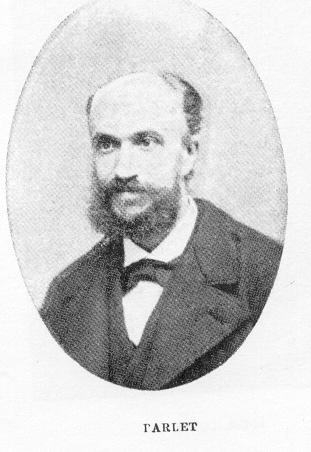
The photograph used on the cover is an authentic historical portrait of F.-Ch. Barlet, now in the public domain on Wikimedia Commons. Another late photograph was also reproduced in the journal L’Initiation in 1974 on the occasion of the rediscovery of his grave in the Bagneux cemetery in Paris.

Par Olivier of Aeternum
Passionate about esoteric traditions and the history of the occult from the earliest civilizations to the 18th century, I share articles exploring these subjects. I am also a co-founder of Aeternum, the online esoteric store.