
































































































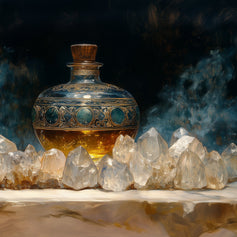














The twenty-first rune of the Elder Futhark, Laguz bears a name linked to water, the lake, and the sea. The rune poems describe an apparently endless ocean, a vessel rolling beneath the waves, a waterfall falling from the mountain, and boiling water where fish live.
In a contemporary reading, Laguz speaks of currents, change, sensitivity to one’s surroundings, and navigating a shifting situation. It may represent an actual crossing, an emotional climate, information that is still fluid, or a transformation that requires following the movement without losing sight of the course.
Laguz’s water is neither docile nor inherently pure. In the English poem, the “sea-horse,” that is, the ship, no longer responds to its bridle, and the waves frighten people. The rune therefore does not promise automatic harmony. It shows a mobile force that must be navigated.
Laguz in the Elder Futhark
Laguz, written ᛚ, occupies the twenty-first position in the Elder Futhark. Its phonetic value is l. Its reconstructed name, *laguz, refers to water or a lake. Later forms include Old English lagu, “sea, ocean,” and Old Norse lögr, “water.”
The rune remains present in the Anglo-Frisian futhorc and the Younger Futhark. Its shape varies, but its value and lexical field retain a strong continuity. This linguistic link is more solid than the occult correspondences added much later. Michael P. Barnes presents the history of the alphabets and rune names in Runes: A Handbook.
Water, the current, and navigation
Water changes shape, follows the slope, carries ships, and resists with a force that cannot be completely controlled. This reality gives Laguz its divinatory coherence. The rune concerns adaptation, but it does not ask you to yield to everything. The navigator observes the current, adjusts the sail, and keeps a destination in mind.
Emotions are a modern extension of this image. They rise, recede, move through the body, and alter perception. Laguz may then show a feeling that rightly informs a decision or, conversely, a wave that makes any measure difficult. The reading must distinguish sensitivity from being overwhelmed.
The sea in the English poem does not respond to a bridle. This formula strips human beings of the illusion of total mastery. Laguz invites us to recognize the forces already at work: a group’s mood, a project’s development, the weather, distance, fatigue, or an outside event.
The heart of Laguz: water moves according to its bed and its power. The rune asks us to read the current, protect the vessel, and keep a course flexible enough to navigate change.
The three runic poems
The Norwegian poem defines lögr through the waterfall, a river falling from the mountainside, then contrasts this water with golden ornaments. The Icelandic stanza describes boiling water, a wide geyser, and the land of fish. These images do not present a motionless surface: they depict falling, bubbling, and aquatic life.
The Old English poem portrays the human ordeal of the sea. The ocean appears endless to those who venture out in an unstable vessel; the waves terrify them, and the ship, called the “horse of the waves,” pays no heed to its bridle. The crossing brings together movement, fear, and loss of control.
Bruce Dickins publishes the three poems in Runic and Heroic Poems of the Old Teutonic Peoples. They form the basis for interpretations involving currents, passage, and adaptation. They assign Laguz neither a planet, nor a zodiac sign, nor a defined psychic function.
Meaning of Laguz in a reading
Laguz announces a changing situation whose outcome depends on how one navigates it. It may signal a change already underway, a journey by water, an intense emotional climate, a creative phase, or information that becomes clearer over time. Resisting without understanding the current is exhausting; surrendering to it without direction exposes one to danger.
For work and money, Laguz shows a fluctuating context, an evolving project, or a decision related to transport, the public, or the circulation of resources. It advises keeping a reserve, monitoring fluctuations, and avoiding commitments that cannot be reversed.
For relationships, the rune speaks of sensitivity, attraction, unspoken matters, and emotional rhythm. It may accompany a lively relationship, but also a period when reactions overflow beyond words. Naming what is happening makes it possible to take back the helm.
As advice, Laguz asks you to observe before acting. You need to identify the direction of the current, what it carries, and where it leads. Useful adaptation changes the route without abandoning the destination or safety limits.
Reversed or challenged Laguz
The rune poems provide no reversed meaning. The sign ᛚ changes orientation when turned; a contemporary method may therefore use a reversed position, provided the same convention is maintained throughout the reading.
Reversed Laguz may indicate drifting, emotional overwhelm, fear of change, or a misreading of the current. The person follows an impulse without knowing its destination, struggles against an inevitable development, or lets the environment decide in their place.
In a challenging reading, water can also evoke obstructed flow: withheld words, a stalled project, creativity without an outlet, or an emotion going in circles. The response is to restore a passage, establish a bank, or wait for the waters to recede before resuming the crossing.
Laguz with other runes
These associations belong to current divinatory practices. They relate runic images to one another without forming combinations inherited from the poems.
Raido and Laguz combine the road with the current. A journey, transition, or undertaking moves forward through changing conditions. The route must be able to adapt without losing sight of its purpose.
Ehwaz and Laguz bring together transportation and moving water. This combination favors travel or change supported by cooperation. It calls for checking the vehicle’s reliability and ensuring that the travelers are in agreement.
Isa and Laguz pit the stillness of ice against the movement of water. A movement is suspended, an emotion freezes, or a pause protects against an overly strong current. Resumption will come when conditions allow the thaw.
Hagalaz and Laguz show water churned by hail or a storm. Together, they announce a disruption in the flow, a strong reaction, or a transformation that is difficult to contain. Protection takes priority before any attempt to steer.
Sowilo and Laguz bring light and direction to the crossing. A confusing situation becomes clear, or a course reveals itself amid change. Clarity must guide emotion without denying it.
Working with Laguz in magic
The Sigrdrífumál mentions “sea runes” to be carved on the prow, rudder, and oars to protect a ship. The poem attests to a category of signs associated with navigation, but it does not identify these marks with the Laguz rune alone. A commented translation of the text appears in the edition of The Poetic Edda published by Open Book Publishers.
In a contemporary practice, Laguz may accompany a crossing, a change, work on emotions, or a search for flexibility. The intention must define the current concerned, the shore sought, and the boundaries that prevent drifting.
The rune may be drawn near a vessel of water, a map, or a text that names the transition. The concrete act remains decisive: checking the weather, preparing the route, expressing an emotion, setting aside a reserve, or opening a channel of circulation. Laguz accompanies navigation; it guarantees neither the journey nor safety.
Correspondences and references for Laguz
| Reference | Correspondence |
|---|---|
| Sign | ᛚ |
| Alphabet | Elder Futhark; rune retained in the Anglo-Frisian futhorc and the Younger Futhark |
| Position | Twenty-first rune; third ætt |
| Phonetic value | l |
| Reconstructed name | Common Germanic *laguz |
| Attested forms | Old English lagu; Old Norse lögr |
| Primary meaning | Water, lake, sea |
| Images from the poems | Ocean, waves, unbridled ship, waterfall, geyser, land of fish |
| Favorable reading | Favorable current, adaptation, crossing, sensitivity, transformation, circulation |
| Challenging reading | Drift, submersion, fear, loss of direction, blocked circulation, instability |
| Question asked | What current runs through the situation, and how can you follow it without surrendering your course? |
| Attributions set aside | Moon, Neptune, Cancer, Pisces, willow, aquamarine, and the High Priestess of the tarot: the poems do not establish these equivalences. |
Reading guide: Laguz does not command the water. It teaches you to recognize the current, hold the helm, and cross what will not remain still.





)