
















































































































The Egg of Life appears in contemporary sacred geometry literature as an intermediate figure between the network of circles and the representation of volumes. Its most common volumetric version brings together eight equal spheres in a cubic arrangement. Planar representations vary more from one author to another. The name evokes birth and the early divisions of the embryo, a recent interpretation that should not be confused with a scientific description of human development.
| Common name | Egg of Life |
|---|---|
| Common volumetric representation | Eight spheres of the same size |
| Interpretation | Modern association with birth and growth |
| Framework | Contemporary sacred geometry |
| Historical status | No established ancient tradition under this name |
How is the Egg of Life represented?
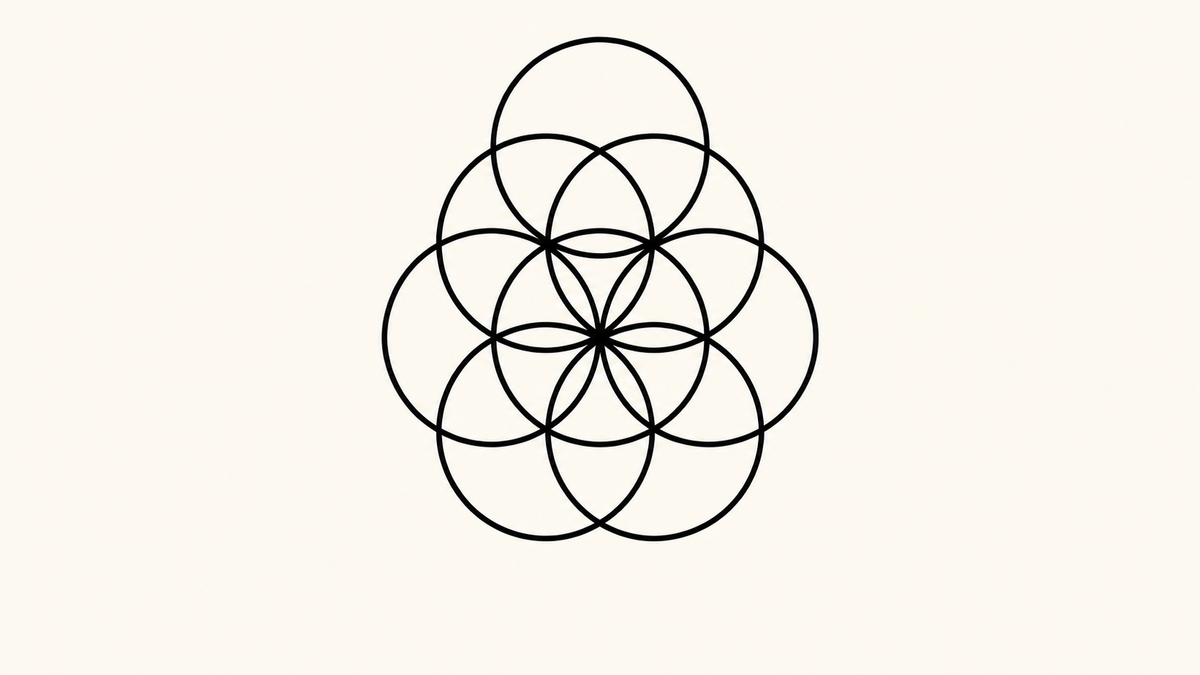
A widespread depiction shows eight spheres associated with the eight vertices of a cubic structure. Some two-dimensional drawings instead use selected circles from the Flower of Life's grid.
These differences indicate that there is no single ancient canonical model common to all versions. To compare the figures, it is necessary to specify whether one is referring to disks on a plane, circles drawn with a compass, or spheres in space.
Why is this symbol called the Egg of Life?
The name refers to the idea of a form that contains the potential for new development. Contemporary authors readily associate the figure with the early stages of embryonic life.
The analogy has symbolic value, but a real embryo is not a perfect arrangement of equal and synchronized spheres. The pattern should therefore not be presented as the mandatory mathematical structure of all biological development.
What is its relation to the Seed and the Flower of Life?
The Seed of Life is a rosette of seven circles. The Flower extends this system according to a triangular grid. The Egg, in contemporary narratives, marks the transition from a plane drawing to volumes.
This sequence is useful for comparing constructions, but it does not come from a known ancient treatise that named the three figures in this order.
What does the arrangement of eight vertices actually reveal?
Eight points can define the vertices of a cube. Moving to a spatial model makes it possible to study edges, faces, diagonals, and rotational symmetry.
It is a verifiable geometric property. However, the representation does not demonstrate the existence of a secret biological structure common to all cells and living beings.
Why does this figure feature in current sacred geometry?
The Egg of Life introduces the idea that a pattern of circles can suggest a three-dimensional form. This transition naturally leads to tetrahedra and other regular solids.
Its power as an image comes from the association between regularity, birth, and construction. Its history must remain dated: the name and the interpretive system are contemporary.
Sources and historical reference points
Wolfram MathWorld, “Seed of Life” and “Flower of Life” help document historical plane figures. The names Egg, Seed, and Fruit of Life are treated as contemporary categories; their volumetric definition does not come from a known ancient source.










