




























































































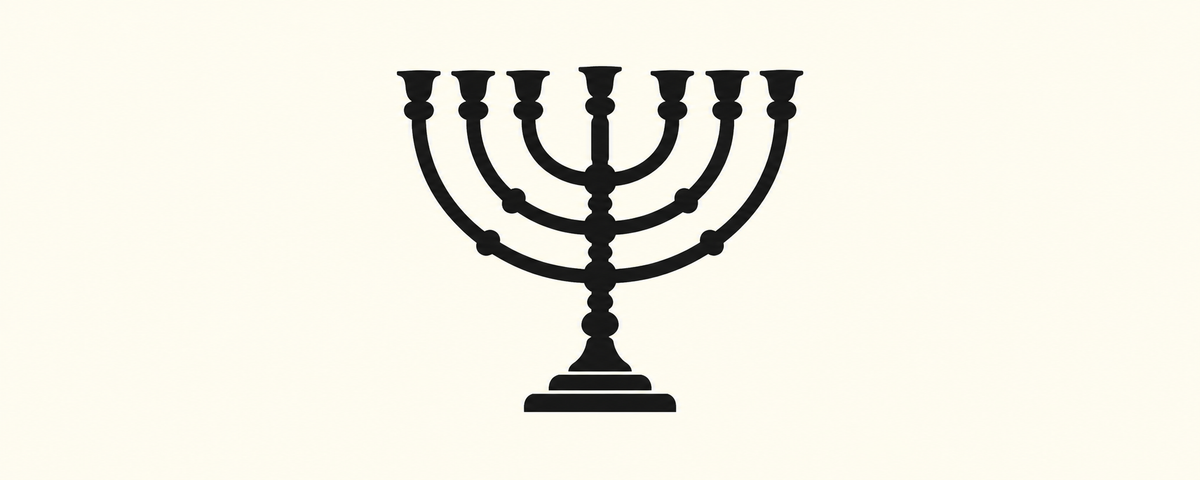
The Menorah is the seven-branched lamp described in the Hebrew Bible for the sanctuary and later associated with the Temple of Jerusalem. After the destruction of the Second Temple in 70 CE, its image became one of the most enduring emblems of Judaism. It appears in synagogues, Jewish catacombs, lamps, seals, mosaics, and manuscripts. One distinction is essential: the Temple Menorah has seven branches. The Hanukkah lamp used today has eight main lights and one auxiliary light, and is more precisely called a hanukkiah.
| Form | Chandelier or seven-branched lamp |
|---|---|
| Original context | Tabernacle, then the Temple of Jerusalem |
| Emblematic development | Very widespread in Jewish art after the destruction of the Second Temple |
| To distinguish | Hanukkah hanukkiah: eight lights plus the shamash |
| Associated ideas | Temple, light, ritual presence, and Jewish identity |
What is the biblical origin of the Menorah?
The Torah describes a seven-branched lamp intended for the sanctuary. The design was connected to Israelite worship long before the Menorah became a general symbol of Judaism.
The Metropolitan Museum notes that the large golden Menorah was part of the sacred furnishings of the Temple of Jerusalem. Medieval manuscripts continued to depict this lamp based on biblical descriptions and rabbinic commentaries.
The famous scene on the Arch of Titus in Rome, showing the Temple spoils after the destruction of Jerusalem in 70 CE, also helped establish the image of the Menorah in historical memory.
Why is the number seven fundamental?
The Temple Menorah has a central branch and three branches on each side, making seven lights in total. This structure immediately distinguishes it from the Hanukkah lamp.
Interpretations of the number seven are numerous in Jewish tradition: the seven-day week, the rhythm of the Sabbath, and sacred cycles. However, it would be reductive to explain the Menorah solely through general numerology. Its form was first prescribed in a specific ritual context.
Ancient representations are not perfectly identical. The branches may be curved, straight, or stylized depending on the period and region. The seven-light structure remains the main distinguishing feature.
How did it become an emblem of Judaism?
After the destruction of the Second Temple, the image of the sacred furnishings acquired particular significance. The Metropolitan Museum emphasizes that the Menorah became a major emblem of the Jewish religion in Late Antiquity and the Byzantine period.
It appears on sarcophagi, terracotta lamps, glassware, seals, and synagogue mosaics. In some contexts, its presence alone is enough to identify a monument or owner as Jewish.
This emblematic function can be compared to the Chi-Rho in early Christianity: a religious motif becomes a visual marker of belonging in public and funerary spaces.
Why should it not be confused with the hanukkiah?
The hanukkiah is used for the festival of Hanukkah. It has eight holders corresponding to the eight days of the festival, plus an auxiliary light called shamash used to light the others.
The Met explicitly recalls this difference between the Temple’s seven-branched Menorah and the nine-light Hanukkah lamp.
In everyday language, the word “menorah” may be used in English to refer to a Hanukkah lamp, which causes confusion. For a historical page in French, maintaining the distinction between the Menorah and the hanukkiah is much more precise.
What does the Menorah still represent?
The Menorah remains one of the best-known symbols of Judaism today. It appears in particular on the emblem of the State of Israel, where it refers to the history of the Temple and the continuity of the Jewish people.
In synagogues and contemporary art, it can evoke light, memory, and the hope of restoration. Its precise meanings depend on the context.
The symbol remains deeply rooted in history: it is not simply a “seven-branched candle” that became spiritual by analogy. Its power comes from its connection with the Temple, the Scriptures, and a long history of communal representation.
Historical sources and reference points
The Metropolitan Museum of Art traces the spread of the Menorah as an emblem of Judaism after 70 CE. The museum also distinguishes the nine-light Hanukkah lamp from the Temple’s seven-branched Menorah.