






























































































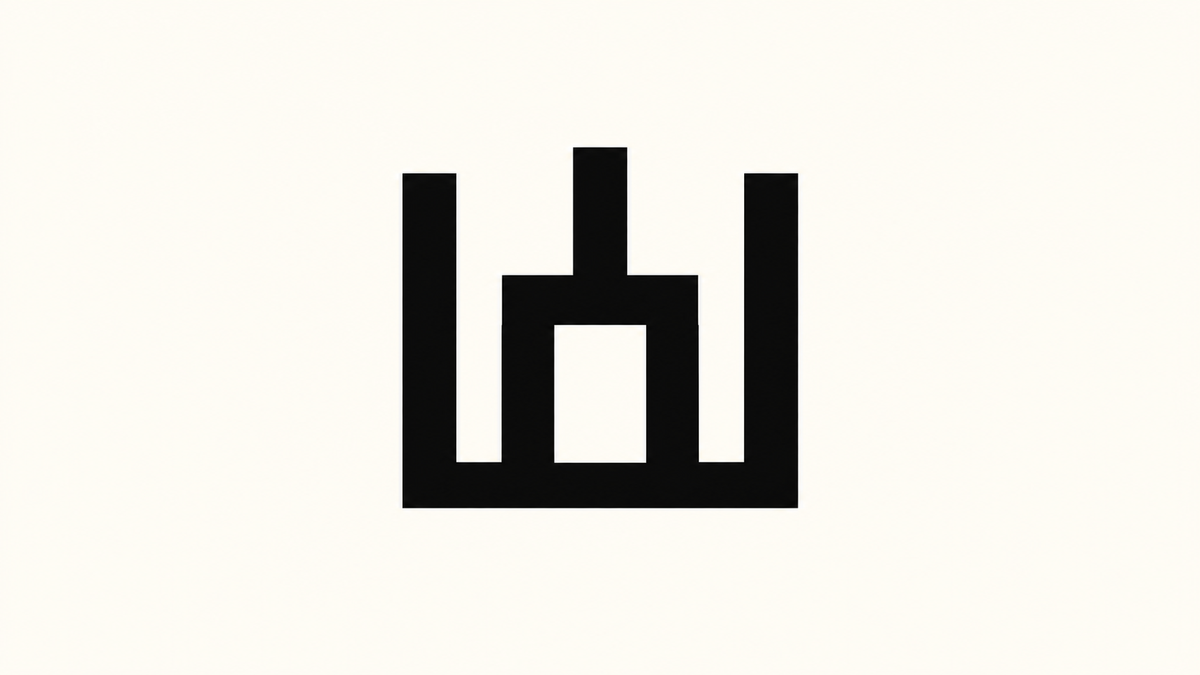
The Columns of Gediminas are a Lithuanian geometric emblem formed by vertical and horizontal lines evoking a structure or a stylized gateway. The Lithuanian Parliament classifies them among the historic symbols of the Republic. Their use is firmly attested from 1397 on the arms of Grand Duke Vytautas, before becoming a sign of the dynasty and, later, of the Lithuanian state.
| Name | Columns of the Gediminids / Gediminaičių stulpai |
|---|---|
| Form | Linear geometric emblem |
| Attestation | Arms of Vytautas from 1397 |
| Use | Dynasty, army, state, resistance |
| Status | Historic symbol regulated by Lithuanian law |
How can the Columns be recognized?
The design resembles a structure made of uprights and crossbeams, with a horizontal base and several vertical elements.
The Lithuanian Parliament specifies that the symbol is depicted in gold or yellow, on a red field or without a shield.
What is the earliest solid attestation?
The Seimas places an indisputable attestation in 1397 on the arms of Grand Duke Vytautas.
A related form may have been used by his father Kęstutis, but the evidence is less direct.
This distinction avoids artificially pushing back the symbol’s origin.
Why is the name Gediminas used?
The sign belongs to the great dynastic family descended from Gediminas. The successors of the Kęstutis branch used it, and it later spread throughout the dynasty.
In the 16th century, chronicles began calling it the “Columns,” giving the design its modern name.
How did the symbol become a sign of resistance?
After the restoration of Lithuanian independence in the 20th century, the Columns appeared on uniforms, aircraft, decorations, and public institutions.
The Soviet authorities subsequently banned the emblems of the independent state.
The Seimas notes that Lithuanian partisans nevertheless continued to use the Columns on their uniforms and weapons between 1944 and 1953.
What is its official status?
Lithuanian law now regulates the symbol, and its standard form is approved on the recommendation of the Heraldry Commission.
It continues to be used by institutions and organizations as a direct reference to the history of the state.
The sign therefore functions both as a medieval dynastic mark and a modern national emblem.
Historical sources and landmarks
The Seimas of the Republic of Lithuania traces the history of the Columns of Gediminas from their attestation under Vytautas in 1397 to their current status as a historic symbol of the state.