






























































































Elder grows near houses, hedges, and disturbed ground. Its hollow wood becomes a whistle or tube, its white flowers cover the shrub, and then its black berries feed birds. Around it, European customs established a rule of neighborliness: protect the house with Elder, but do not treat it like ordinary wood. In Ireland, burning its branches could bring misfortune.
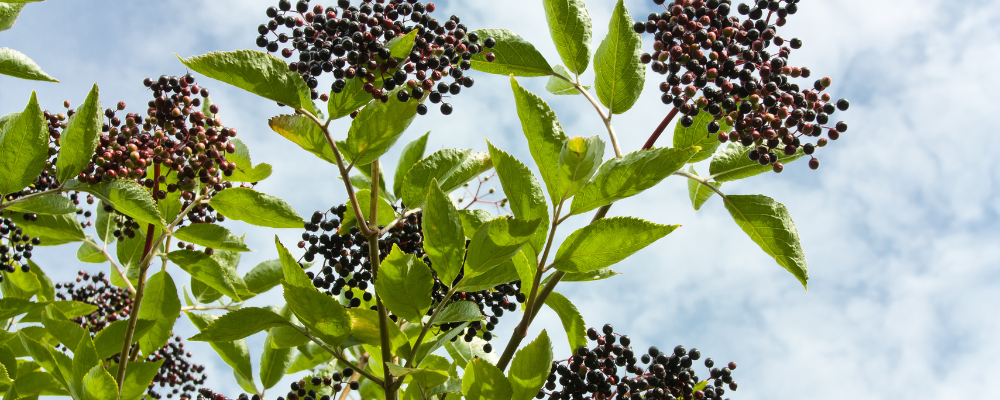
Black Elder is Sambucus nigra L., a member of the Viburnaceae family. It forms a shrub or small tree with opposite leaves composed of toothed leaflets. Its broad corymbs of small cream-colored flowers produce clusters of dark fruit. The young branches contain abundant pith and become hollow once it is removed.
Its historical magic stands at the domestic boundary. Planted near the house, it protects and provides flowers, fruit, wood, and color. Yet its leaves, bark, and raw fruit are not innocent materials. Ritual respect here goes hand in hand with very practical botanical caution.
A threshold shrub with hollow wood
Sambucus nigra bears leaves divided into five to seven leaflets. The flat inflorescences appear at the beginning of summer. The ripe fruits are black to purplish, but their stalks remain colored and must not be confused with the berry itself.
Kew accepts the species and describes its pale wood, pith-filled branches, flowers, and fruit. Kew, Sambucus nigra. The page also recalls the presence of toxic compounds in several raw parts.
The hollowed branch was used to make whistles, simple flutes, and tubes. This cavity offers a magical image of passage: the wood does not retain the voice; it gives it form. Elder is therefore suited to thresholds, messages, and the boundaries of the home.
The guardian of the home
The Woodland Trust brings together several British customs associated with Elder. The shrub planted near the house is associated with protection, while cutting or damaging the tree calls for particular precautions.
The same resource describes its leaves, flowers, fruits, and ecological importance. Woodland Trust, natural history and customs of Elder. The proximity of humans, birds, and hedgerows explains the density of these domestic tales.
Elder protects less through an abstract force than through its position. It marks a boundary, offers living cover, and transforms the edge into a habitat. In a magical reading, the best threshold is not a dead wall: it is a space watched over, nurtured, and acknowledged.
Elder guards the door because it lives on the boundary, not because it erases the outside world.
The wood that is not burned
The Irish Schools’ Collection preserves a clear prohibition: Elder wood must not be put on the fire, or misfortune will be brought into the house. The prohibition gives the shrub a status different from that of ordinary fuel.
The collection is available on Dúchas. Dúchas, prohibition against burning Elder. This twentieth-century testimony records an oral rule that is still present in local memory.
Contemporary magical practice can honor this gesture without explaining it through literal fear. Not burning Elder protects the indoor air, avoids handling a toxic plant through combustion, and maintains the ethics of the threshold: this guardian does not enter the hearth as fuel.
The mystery of the hollow branch
An Elder branch appears solid as long as its pith fills the center. Once removed, it reveals a regular channel. This hidden passage made the sound instrument possible and nourished the image of a plant traversed by breath.
The hollow must not become an invitation to make an object from a fresh branch. The symbolism is enough: a word passes more effectively through a clear frame. A protected house keeps openings, but each has a purpose, a schedule, and a responsible person.
Elder therefore connects hospitality and prohibition. Its flowers open widely, its fruits provide nourishment, and its wood lets air pass through; yet not all parts are edible and not every action is permitted. Its magic teaches generosity governed by boundaries.
Writing the threshold rule
Draw a door framed by two Elder branches. On the left branch, write what your space welcomes: people, words, exchanges, or rest. On the right branch, write what it refuses.
Above the door, draw a hollow branch. Inside the channel, place the exact phrase that allows entry or permits someone to request access. Avoid vague formulas: a boundary protects when it can be understood.
Below the threshold, add a revision date and the name of the person who may modify the rule. Keep the page near the entrance or in your household file. The rite uses drawing and speech, without cutting, burning, or ingestion.
Historical correspondences
| Reference point | Correspondence |
|---|---|
| Botanical name | Sambucus nigra L. |
| Family | Viburnaceae |
| Symbolic place | Hedge, door, and household boundary |
| Popular prohibition | Do not burn Elder wood |
| Magical domains | Protection, threshold, word, and hospitality |
| Safe form | Threshold rule on paper |