



























































































Hyssop enters the home through a sprinkling gesture. In the Bible, a bundle of ezov carries blood or water to the threshold, body, and object to be purified. In European herbals, another plant receives the name hyssop: Hyssopus officinalis, an aromatic shrub with blue flowers.
Garden hyssop is known as Hyssopus officinalis L. Recent classifications are not all aligned: Kew’s global reference system now places this name under Dracocephalum officinale, while floras and the horticultural trade retain Hyssopus officinalis.
The ezov of the Hebrew texts was used for sprinkling in rites of passage and purification. Botanical studies identify it instead with a plant from the oregano group, Origanum syriacum, rather than with European hyssop. A grimoire can preserve the gesture and its history, but it does not turn a translation into a botanical identity.
Identifying European hyssop
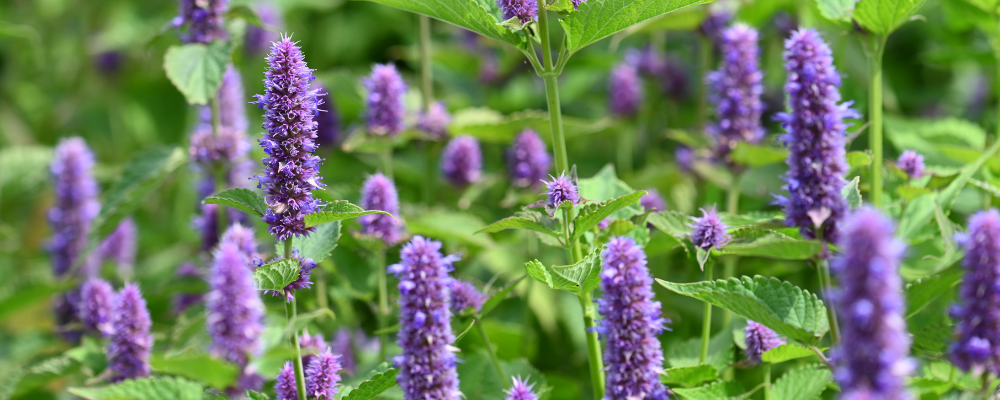
European hyssop belongs to the Lamiaceae family. It forms a small woody shrub at the base, with upright stems, narrow opposite leaves, and two-lipped flowers clustered in spikes. The flowers may be blue, pink, or white. Rubbing the plant releases a pronounced aromatic scent.
Kew’s page dedicated to Hyssopus officinalis indicates that this name is treated as a synonym of Dracocephalum officinale in its current reference system, while also listing authorities that retain it. Kew, status of Hyssopus officinalis.
This classification uncertainty does not change the product sold under the horticultural name hyssop. It simply reminds us that a Latin name depends on a living scientific system, revised as relationships are reevaluated.
The plant has stems firm enough to form a small bundle. This structure explains the comparison with a sprinkling instrument, but the resemblance is not enough to identify the biblical ezov.
The ezov of the biblical texts
In Exodus, Moses asks the families to take a bundle of ezov, dip it in the lamb’s blood, and mark the lintel and the two doorposts. The plant serves as a link between the container, the hand, and the threshold.
Leviticus uses it in purification rites, Numbers with lustral water, and Psalm 51 makes it an image of inner washing. In the Gospel according to John, a sponge is brought to Jesus’s mouth on a stem called hyssop in the translation. Exodus 12 and Psalm 51, biblical text.
The common thread is material: ezov makes it possible to project a liquid and trace a boundary. The plant acts as a ritual tool, not as powder left to chance.
The threshold receives the mark before the crossing. This logic informs practices of separation, preparation, and reintegration: the space is named, the gesture is performed, and then one enters a recognized state.
Why the two hyssops diverge
Greek and Latin translations transmitted ezov in forms that gave rise to “hyssop” in French. When European readers searched for the plant in their own flora, the name became attached to Hyssopus officinalis. The continuity of the word concealed the difference between the plants.
A study by Alexander and Zhenia Fleisher links biblical hyssop to a Levantine oregano, then called Majorana syriaca and now classified as Origanum syriacum. The authors also connect this plant to the culture of zaatar. AGRIS, identification of biblical hyssop.
The same word refers to two plants. One lives in the landscapes and rites of the Levant; the other grows in European gardens and appears in their herbals.
This separation enriches magic. It shows how a translation can carry a gesture and then give it new substance. The reader can work on the threshold without claiming that their sachet contains the plant of Exodus.
The bundle, the water, and the boundary
Sprinkling connects several elements: prepared water, a bundle of plants, a hand, a formula, and a surface. No element carries the rite alone. The gesture becomes effective within its framework because it distributes the roles and makes the boundary visible through the drops.
In European magic, Hyssop inherited a reputation for purification through biblical translations and the Psalm. Printed grimoires, devotional books, and herbals reinforced this role. The correspondence therefore comes from a textual history, even though the plant identity has shifted.
A current practice can retain the idea of the bundle without wetting the ritual plant. Three parallel lines represent the stems; a circle represents the container; three points on the threshold represent the areas to clarify.
Purification is not an accusation of moral dirtiness. It prepares for a specific transition: ending a visit, reclaiming a room, opening a meeting, or closing a period. Naming the moment prevents living in an endless cleaning process.
Marking a threshold without sprinkling
Draw your door as seen from the front. On the lintel, write what governs the space: rest, study, welcome, or confidentiality. On the left jamb, write what stays outside. On the right jamb, write what may enter.
Draw three drops above the threshold, without using water or a plant. In each one, write an action: tidy, inform, close, air out, or set an hour. Perform these actions in the order shown in the drawing.
Place the closed product to the left of the page during the work. Once the door is ready, fold the sheet inward and store it near the entrance. The gesture is inspired by the function of ezov while respecting the botanical and religious distance.
Historical correspondences
| Reference | Correspondence |
|---|---|
| Horticultural name | Hyssopus officinalis L. |
| Current Kew classification | Synonym of Dracocephalum officinale |
| Proposed biblical plant | Origanum syriacum, za'atar group |
| Ritual gesture | Bundle used for sprinkling and marking |
| Magical domains | Purification, threshold, passage, and reintegration |
| Safe form | Drawing of the threshold and closed product |