

























































































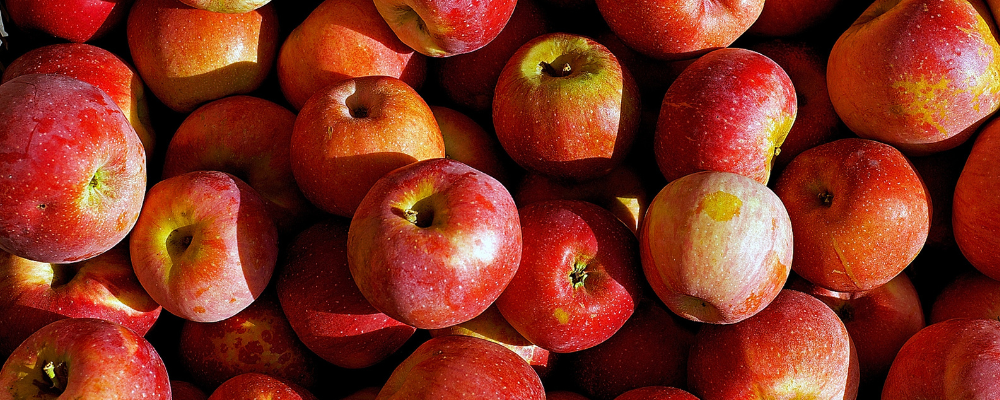
The Apple conceals its seeds in five chambers and returns each year at the ends of the branches. In the Charm of the Nine Herbs, a wild apple enters a balm sung against poison. In the Prose Edda, Iðunn keeps in a chest the apples that restore youth to the aging gods. Between the crushed fruit and the preserved fruit, the Apple becomes a measure of renewal: what must be transformed, what must be preserved, and what must return at the right time.
The cultivated apple tree is Malus domestica (Suckow) Borkh., a tree in the Rosaceae family. Its agricultural history involves several species and centuries of selection. The European wild apple, Malus sylvestris, helps explain the “wood apple” in the Anglo-Saxon text without identifying every medieval fruit with a modern cultivar.
The Apple carries stories of love, discord, royalty, and the beyond across several cultures. This entry narrows the focus to two sources in which the fruit directly takes part in a magical or divine operation: the Anglo-Saxon charm and Iðunn’s chest.
Five chambers at the heart of the fruit
Malus domestica belongs to the Rosaceae family. Its five-petaled flowers produce a fleshy fruit formed with the floral receptacle. At the center, five chambers form a star when the Apple is cut crosswise. Each chamber may contain seeds.
Kew accepts the species and places its native range from Afghanistan to Central Asia and Xinjiang. Trade routes and cultivation carried the apple tree across temperate regions. Kew, Malus domestica.
A seed does not faithfully reproduce the cultivar that produced it. Grafting makes it possible to preserve a variety by joining a scion to a rootstock. The orchard therefore brings together sexual reproduction, horticultural cloning, and the memory of human choices.
This botany sheds light on the magic of the fruit. The seed opens a variation, grafting maintains a lineage, and the fruit fulfills a season. Renewal does not mean repeating identically.
The apple in Anglo-Saxon magic
The Nine Herbs Charm, preserved in Harley MS 585, names a “wild wood apple” among the nine plant materials. The manuscript was copied in England at the beginning of the 11th century. British Library, Harley MS 585.
In the poem, the Apple plays a role in the struggle against poison. The instructions then call for mixing the fruit’s juice with the herbs ground into powder and with soap. The charm must be sung three times over the Apple as well as over each plant.
The fruit therefore has two roles: it belongs to the sacred enumeration and provides a liquid that binds the preparation. The words are addressed to it before its substance joins the balm. Text and translation of the Nine Herbs Charm.
The number nine runs through the text, while the Apple contains five compartments. The two numbers do not form an explicit correspondence in the source. The mystery lies in the actual chain: naming, singing, grinding, mixing, and applying.
Iðunn’s chest and the youth of the gods
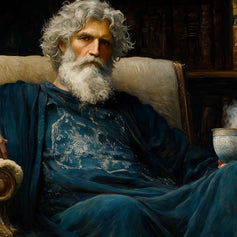
In chapter 26 of Gylfaginning, part of the Prose Edda written in the 13th century, Iðunn is the wife of the poet Bragi. She keeps apples in an ash-wood chest.
When the gods grow old, they bite into these fruits and become young again. Gangleri notes the immense trust placed in Iðunn’s vigilance and good faith. Prose Edda, Gylfaginning, chapter 26.
The power does not reside in the Apple alone. It depends on a guardian, a chest, and the moment when aging appears. Divine youth requires a protected reserve and a trustworthy person.
The fruit of return remains under guard. Iðunn’s Apple unites renewal, responsibility, and the right moment.
Seed, graft, and renewal
The Apple offers three ways to continue. The seed opens the unknown, the graft preserves a chosen quality, and the ripe fruit nourishes the present. Any renewal operation can begin by distinguishing these three movements.
What must remain identical requires a symbolic graft: a phrase, a method, or a commitment passed on without alteration. What must evolve takes the place of the seed. What must be accomplished now belongs to the fruit.
Iðunn’s chest adds a safeguarding rule. A resource left open at all times eventually disappears. Specifying the responsible person, place, and access condition protects what will make the next cycle possible.
The apple’s star-shaped cross-section can serve as a modern diagram, provided it is presented as a botanical observation. None of the texts cited here gives it a secret pentagram. The five compartments simply allow five responsibilities to be distributed around a center.
Preparing a renewal chest
Draw a closed chest in the center of a page. Inside it, draw five compartments arranged in a star. In each one, write a resource that allows your project to renew itself.
Under the chest, create three boxes: “keep,” “transform,” and “accomplish.” Allocate the five resources among these actions. A given resource may occupy only one box.
On the lid, write the name of the person safeguarding the reserve. It may be you. Add the opening date and the precise condition that authorizes it.
Symbolically close the chest with a line. On the appointed date, open the drawing, check each resource, and note what actually made the return possible. The next cycle begins with this record.
Historical correspondences
| Reference | Correspondence |
|---|---|
| Botanical name | Malus domestica (Suckow) Borkh. |
| Family | Rosaceae |
| Anglo-Saxon source | Charm of the Nine Herbs, early 11th century |
| Norse source | Prose Edda, 13th century |
| Magical domains | Renewal, safeguarding, transformation, and return |
| Safe form | Drawing of the chest and allocation of five resources |