




























































































Patchouli first arrived as a scent attached to fabrics. In the 19th century, dried leaves placed with Kashmiri shawls kept moths away during the journey. In Europe, the fragrance became a sign of imported goods, and imitations then sought to reproduce it. Long before its counterculture image, Patchouli therefore preserved the material, followed trade routes, and served as olfactory proof.
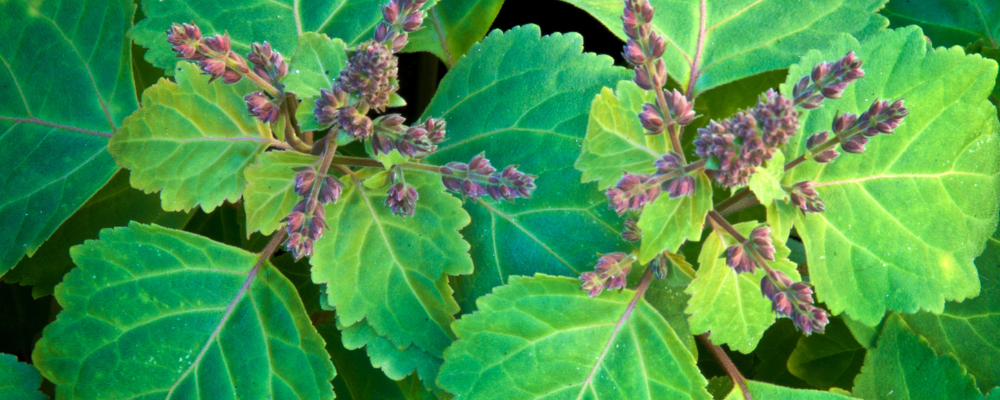
Patchouli is Pogostemon cablin (Blanco) Benth., a tropical subshrub of the Lamiaceae family. Its opposite leaves are broad, toothed, and aromatic. They yield a heavy oil whose scent evolves with drying, distillation, and time.
Its Western magic of money, desire, and earth became established mainly in 20th-century esoteric shops. The history of textiles offers a more tangible root: protecting value during transport, recognizing the authentic by its trace, and understanding how that trace can also be copied.
A tropical leaf that keeps its scent
Pogostemon cablin forms upright, branched stems. Its oval leaves have a toothed margin and a slightly velvety texture. The small, pale flowers cluster at the tops of the stems.
Kew accepts the species and places its native range in Sri Lanka, western and central Malesia, and Papua New Guinea. Kew, Pogostemon cablin.
The fresh leaf does not release exactly the fragrance of the bottle. Drying and distillation release an aromatic substance dominated by patchoulol and other heavy molecules. On a perfume blotter, the trace remains perceptible for a long time.
This persistence gives Patchouli a magic of marking and memory. A presence can leave a place while leaving behind a sign capable of identifying its passage.
The Shawls, the Moths, and the Journey
Patchouli leaves were placed with shawls and textiles from Asia to protect them from insects during transport. The wool arrived in Europe with a scent that bore witness to the journey it had taken.
At the beginning of the 19th century, Kashmir shawls became highly sought-after fashion objects. The Herb Society of America traces the role of dried leaves, the discovery of their identity by French perfumers, and the association between fragrance and imported shawls. Herb Society of America, history of Patchouli.
The fragrance therefore protects the material before becoming a luxury. It connects leaf, cargo, duration, and arrival. The shawl preserves the tangible proof of its journey all the way into the European drawing room.
The scent becomes a seal without wax. It does not close the package: it accompanies the object and tells the story of the distance it has traveled.
When the sign of authenticity is copied
Once the link between Patchouli and imported shawls was understood, European manufacturers scented their own imitations. The sign that once helped identify provenance became reproducible.
L’Officina Profumo-Farmaceutica di Santa Maria Novella notes that Patchouli entered its catalog as early as the 1880s and that its fragrance marked textiles arriving from India. Santa Maria Novella Archives, Patchouli.
This history gives Patchouli a clear-eyed magic of money. Value circulates through stories, scents, and signs of trust. A sign may help with recognition, then become a tool for counterfeiting.
Before making a purchase or entering into an agreement, look for the real chain of provenance: origin, material, seller, invoice, and terms. Fragrance draws attention, but provenance rests on several pieces of evidence.
From wealth to the scent of counterculture
In 19th-century Europe, Patchouli evoked imported fabrics, luxury, and colonial expansion. In the 20th century, its image changed. The counterculture movements of the 1960s and 1970s adopted its scent and detached it from the bourgeois drawing room.
The commercial associations with money and attraction can be understood through this material history. Patchouli signaled an expensive commodity, protected textiles, and marked the body with a persistent fragrance.
The earth attributed to Patchouli comes from its damp, woody, and dark olfactory note, not from a stable correspondence in a medieval grimoire. This note can serve as a way back to an inventory, budget, property, or material task.
Its magic does not promise wealth through scent alone. It supports preserving what already has value and examining the signs that inspire trust.
Create a provenance seal
Draw a square of fabric in the center of a page. Write inside it the object, sum, or project to protect. Around it, draw four Patchouli leaves.
On the first leaf, note the origin. On the second, write the person responsible. On the third, place the preserved proof. On the fourth, indicate the condition for release or transfer.
Place the closed product to the left of the drawing. Do not add any fragrance. Below it, write the date of the next inspection: stock, budget, invoice, contract, or physical condition.
During the inspection, mark each confirmed piece of information. A sheet without proof remains open. The seal acts as a provenance record and turns vigilance into a repeated practice.
Historical correspondences
| Reference | Correspondence |
|---|---|
| Botanical name | Pogostemon cablin (Blanco) Benth. |
| Family | Lamiaceae |
| Material history | Textile protection and the traveler’s olfactory signature |
| European period | Shawl trade and perfumery in the 19th century |
| Magical domains | Preservation, money, provenance, memory, and attraction |
| Safe form | Written inventory, drawn seal, and closed product |