






























































































The Onion grows in tight layers around an almost invisible basal plate. The knife opens it, and the eyes respond with tears. In pharaonic Egypt, it appears in lists and offering scenes. Pliny reports that the Egyptians invoked it in their oaths. In the 17th century, Culpeper assigned it to Mars. Its magic binds concentric protection, sworn truth, separation, and the body’s reaction.
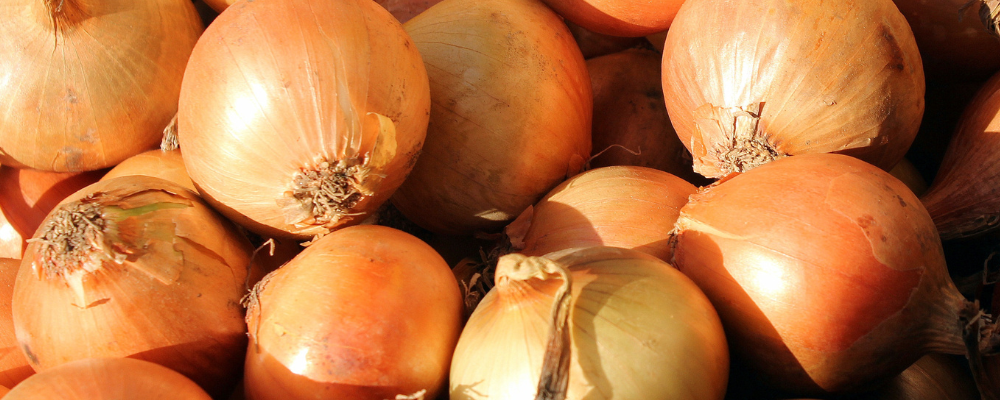
The cultivated Onion is Allium cepa L., a bulbous plant in the Amaryllidaceae family. The bulb results from thickened, overlapping leaf bases. The plant then produces a hollow stalk ending in an almost spherical umbel.
Its magical language comes from ordinary matter placed in solemn contexts: food for the living, provisions for the dead, an object of oath, and a martial plant. The passage between kitchen and sanctuary gives the Onion its historical power.
A bulb built in layers
Allium cepa is a cultivated geophyte. Its green leaves are hollow and cylindrical. At the base, they accumulate reserves and form the fleshy scales of the bulb. The outer layers dry to form a protective tunic.
Kew treats the Onion as a cultigen originating in Central Asia. Its domestication and spread have made it difficult to identify an original wild population. Kew, Allium cepa.
When cut, volatile sulfur compounds reach the eyes and trigger tears. The plant thus transforms a material opening into a bodily response. The effect does not come from hidden sadness in the bulb, but the relationship between cutting and tears remains a powerful magical image.
The bulb preserves a common base beneath all its layers. The coverings protect without forming separate objects. This structure suits workings of defense, confidentiality, and gradual unveiling.
The Onion among Egypt’s offerings
Egyptian tombs show the Onion among the provisions intended for the deceased. A wall in Raemkai’s funerary chapel preserves a list in which bread and Onions precede meat, poultry, beer, wine, fruits, and vegetables.
At the Metropolitan Museum, a relief from the 26th Dynasty still shows a bearer carrying a pile of food that includes a bundle of green Onions. The plant belongs to the ritual care of the deceased. Metropolitan Museum, offering bearer.
The Onion offered remains food, but its deposit changes its recipient and its duration. It crosses the threshold of the tomb as both provision and sign of a bond maintained.
The funerary magic of Onion thus rests on continuity of care. Preparing for the absent, naming what nourishes their memory, and renewing an offering on a fixed date give form to the bond without claiming to hold back the dead.
The oath reported by Pliny
In book 19 of his Natural History, Pliny opens his chapter on varieties of Onion with a striking remark: when swearing oaths, the Egyptians invoke Garlic and Onion among their gods.
This sentence comes from a Roman author of the 1st century and reflects his view of Egyptian practices. At a minimum, it attests that the link between Onion, divinity, and sworn speech circulated in the Roman world. Pliny, Natural History, book 19, chapter 32.
The bulb accompanies a word that binds. Its layers give the oath an image of coherence: each level surrounds the same center.
In current practice, Onion suits a promise limited to its own actions. The outer layer represents public speech, the intermediate layers represent the means, and the center safeguards inner conviction.
Mars in Culpeper’s herbal
Culpeper places Onions under the dominion of Mars. He describes them as hot, irritating, and capable of attracting corruption within his medical system. Their smell, pungency, and effect on the eyes support this martial attribution.
Its chapter associates Onion with Garlic and repeats remedies that no longer correspond to modern medicine. The text remains a direct source for planetary correspondences. Nicholas Culpeper, entry “Onions”.
Mars gives the bulb cutting, defense, and decisiveness. The layers nevertheless prevent a reading reduced to attack. A martial protection can absorb a shock, contain information, and reserve the center.
Onion is suited to clean separations: leaving a habit, breaking an agreement, or withdrawing access. The work requires a visible consequence. Without a change in action, the cut remains an image.
Writing an oath in layers
Cut out four paper ovals of decreasing sizes. On the largest, write the promise that other people may know. On the second, note the means committed.
On the third, write the boundary that voids or suspends the promise. On the smallest, write the personal reason you keep to yourself.
Layer the four shapes and connect them with a thread at the center. The construction remains readable layer by layer, but the core is not apparent at first glance.
Set a verification date on the outer layer. On that date, open the assembly and compare each statement with the actions taken. Remove a layer if it no longer corresponds to reality, then rephrase the commitment.
Historical correspondences
| Reference | Correspondence |
|---|---|
| Botanical name | Allium cepa L. |
| Family | Amaryllidaceae |
| Egyptian context | Lists and scenes of funerary offerings |
| Ancient source | Oath reported by Pliny in the 1st century |
| Magical domains | Protection, oath, separation, memory, and defense |
| Safe form | Paper layers and a dated commitment |