



























































































Myrtle accompanies Aphrodite in sanctuaries, weddings, and images of fertility. Pausanias reports that in Elis, the Charites carry the rose and Myrtle because these plants are sacred to the goddess. A small Greek jewel preserved at the Metropolitan Museum still associates the Myrtle leaf with Aphrodite and Demeter. The mystery of the shrub lies in this evergreen leaf that traverses love, marriage, offering, and memory without reducing the bond to a promise of seduction.
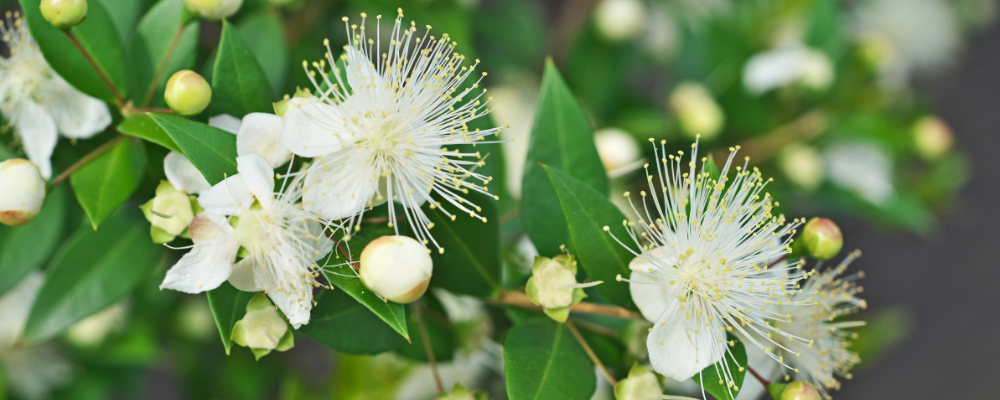
Common Myrtle is Myrtus communis L., an evergreen shrub of the Myrtaceae family. Its opposite, glossy leaves, dotted with aromatic glands, surround white flowers rich in stamens, followed by dark berries.
Its historical magic concerns publicly acknowledged union, fertility, consecrated beauty, and the memory of a bond. It requires agreement and reciprocity. The proposed practice uses a drawn crown and a readable pact; the plant and its oil remain outside the body and away from fire.
An evergreen shrub of the Mediterranean
Myrtus communis bears densely packed branches and entire, opposite leaves whose glands appear through the translucent surface. The white flowers have five petals and a highly visible cluster of stamens.
Kew accepts the species and places it in a Mediterranean and Near Eastern range. Kew, Myrtus communis.
The evergreen foliage connects the seasons, while the brief flower opens a time of brilliance. The berry then preserves the seeds. This succession forms a complete image of the bond: duration, manifestation, and transmission.
The aroma is released when the leaf is crushed. The gesture recalls that a relationship also reveals its quality under pressure. Myrtle magic therefore includes care for boundaries.
The sacred Myrtle of Aphrodite
Pausanias describes the sanctuary of the Charites at Elis. One carries a rose, another a branch of Myrtle, and the author explains that these plants are sacred to Aphrodite.
The passage places Myrtle within a Greek cultic setting and a relationship between goddesses. Pausanias, Description of Greece, 6.24.6–7.
Love appears here together with grace, beauty of gesture, and the public presence of the sanctuary. It is not reduced to private desire or the conquest of a person.
In the grimoire, the correspondence with Aphrodite supports workings of harmony, emotional hospitality, and shared dignity.
Aphrodite's branch consecrates a relationship that accepts being seen and honored.
The Gold Leaf Between Aphrodite and Demeter
The Metropolitan Museum preserves a gold Myrtle leaf, part of a Greek jewel dated to the 3rd–2nd centuries BCE. Its form transposes the living leaf into a durable metal.
The museum links Myrtle to Aphrodite and Demeter, as well as to fertility. Metropolitan Museum, gold Myrtle leaf.
The jewel does not merely copy a plant. It makes its foliage permanent and portable. The branch becomes an adornment, offering, or social symbol according to the object's lost context.
The mystery lies in this metallic durability. A leaf that no longer withers preserves the memory of a ceremony, but it still requires a story to recover its function.
Myrtle of Weddings and Memory
Myrtle accompanied bridal crowns throughout the Mediterranean and later Europe. The Cloisters garden recalls its association with Venus and its use in weddings.
The continuity between antiquity and nuptial customs does not form an unbroken line: each era reinterprets the branch in its own ceremonies. The Met Cloisters, Myrtle as a love herb.
The crown surrounds without closing. It represents a public commitment that keeps a free center, a space for breathing and consent.
Myrtle can also mark the memory of a lost connection. Its evergreen foliage does not deny the loss: it preserves the name, date, and transmitted gestures.
Compose an accord crown
Draw a crown of twelve Myrtle leaves. Divide them into four groups: desire, accord, care, and duration.
In each group, write two commitments and one limit. The wording should concern your own actions. Do not use the name of an absent person as a target.
Leave the center of the crown empty. Write the phrase “a free place to respond” around this empty space. It reminds us that union does not eliminate autonomy.
Date the page and review it with the person concerned if they are participating in the pact. Without mutual agreement, keep the crown as a personal rule of conduct.
Historical correspondences
| Reference | Correspondence |
|---|---|
| Botanical name | Myrtus communis L. |
| Family | Myrtaceae |
| Associated deities | Aphrodite, Venus, and Demeter |
| Historical objects | Ritual branch, crown, and gold leaf |
| Magical domains | Union, accord, fertility, beauty, and memory |
| Safe form | Crown drawn with an open center |