



















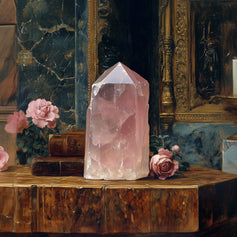















































































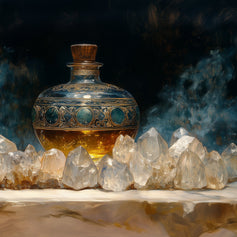















Each morning, the Blue Lotus opens its petals above the water; each evening, it closes again. In pharaonic Egypt, this rhythm made the flower an image of the rising sun, creation, and the return to life. It appears in scenes of banquets and offerings to Hathor, from faience cups to funerary objects, without requiring the modern narrative of a universal sacred drug.
The “Blue Lotus” is a water lily. Kew currently recognizes the name Nymphaea nouchali var. caerulea (Savigny) Verdc., while Nymphaea caerulea remains the best-known name.
The current market sells flowers and extracts under this name whose chemical identities vary widely. The Aeternum product remains sealed. Ritual study is conducted through the image of the flower, its daily cycle, and objects preserved by museums.
The Water Lily That Follows the Sun
Nymphaea nouchali var. caerulea is an aquatic plant in the Nymphaeaceae family. Its rhizome grows in mud, its leaves float on the surface, and its pale blue or purplish flowers rise above the water.
Kew places the Egyptian variety in South Africa, the southern Arabian Peninsula, and the Comoros. Kew, Nymphaea nouchali var. caerulea.
Its daytime opening and nighttime closing provide its religious language. The flower seems to emerge from the water with the light, then return to silence. Silt, water, blue, and the yellow disk compose a miniature of solar creation.
The Flower of the Sun and Creation
Egyptian cosmogonic accounts make the sun emerge from a flower or a mound that appeared in the primordial ocean. The child god Nefertum may be depicted on a lotus, bearing luminous renewal and fragrance.
The Metropolitan Museum of Art explains that the morning opening of the water lily reflected the dawn of creation and daily rebirth. The Met, lotus flower from the Amarna Period.
The blue of the faience extends this idea. It evokes the waters of the Nile, the sky, and the regenerated world. A modeled flower thus becomes more than a decoration: it repeats a sunrise that the tomb must make possible.
Hathor, Bowls, and Offerings
Bowls decorated with lotuses, fish, and papyrus were placed in sanctuaries and tombs. A bowl from the reign of Hatshepsut and Thutmose III comes from the vicinity of a shrine to Hathor. Its flowers link fertility, regeneration, and divine favor.
The British Museum houses a bowl in which a rectangular basin supports Blue Lotuses. The funerary object associates the flower with the return to life in the afterlife. British Museum, Blue Lotus dish.
The bowl becomes a pond. By carrying the water and the flower on its surface, it recreates the place where life reappears and where the goddess receives the offering.
Banquets, Fragrance, and the Modern Market
In banquet paintings, women and men hold the Blue Lotus near their faces, wear it in their hair, or associate it with drinks. The flower signals fragrance, beauty, celebration, sensuality, and renewal.
These images fueled the modern idea of a powerful Egyptian psychoactive. A market study published in 2023 found no chemical resemblance between eleven commercial products and the authentic extracts analyzed; apomorphine was absent, and nuciferine was present only in trace amounts. Chemical Analysis and Evaluation of Blue Lotus Products.
The flower retains a strong ritual place without promising intoxication. Its solar cycle, cup-like forms, and connection to Hathor offer a richer interpretation than seeking a psychotropic effect.
Opening a paper flower at dawn
Cut eight petals from blue paper and attach them around a yellow disk. In the evening, fold the petals toward the center and write on the back what should remain at rest until morning.
At dawn, place the flower near an empty bowl, then open the petals one by one. Name eight forms of return: breathing, movement, speech, memory, desire, work, relationship, and light.
The Blue Lotus sachet remains closed to the left of the bowl. No petal enters the water. Then store the flower with a reproduction of the British Museum bowl and the date of the working.
Historical correspondences
| Reference point | Correspondence |
|---|---|
| Accepted name | Nymphaea nouchali var. caerulea (Savigny) Verdc. |
| Common name | Nymphaea caerulea Savigny |
| Figures | Rising sun, Nefertum, Hathor, Nile, and beyond |
| Objects | Flower, earthenware bowl, cup, basin, and offering |
| Magical domains | Creation, rebirth, fertility, fragrance, and celebration |
| Safe form | Sealed product, paper flower, empty bowl, and museum image |










