





























































































Iris bears three upright petals and three sepals that droop like the folds of a cloak. Its name echoes that of the Greek messenger who crosses the sky and brings back water from the Styx for divine oaths. Later, the fleur-de-lis and the orris rhizome entered emblems, perfumery, and plant books. Its magic belongs to the message, the oath, distinction, and the lingering scented trace of time.
The product is associated with garden Iris, Iris × germanica L., a horticultural hybrid accepted by Kew as originating from Iris pallida and Iris variegata. Irises comprise a vast genus; uses of the fragrant rhizome mainly concern forms called orris, associated with I. pallida, I. germanica, and I. florentina.
The goddess Iris and the plant bear the same Greek name associated with the rainbow, but the messenger’s stories do not describe a cult of the flower. This entry maintains that distinction. It explores an encounter between language and image, then follows the literary traces of the fleur-de-lis and the rhizome.
A hybrid with visible rhizomes
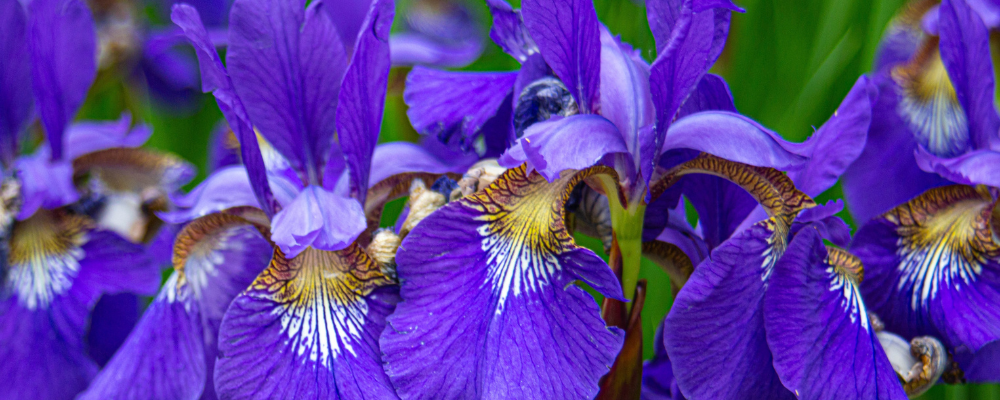
Iris × germanica belongs to the Iridaceae family. The plant develops fleshy rhizomes at the soil surface, flat sword-shaped leaves, and branched flowering stems. Each flower combines upright segments with drooping segments, with a colored “beard” on bearded forms.
Kew treats Iris germanica as a hybrid between I. pallida and I. variegata, originating in the northwestern Balkans and widely cultivated. Kew, Iris × germanica.
The rhizome advances horizontally and produces new fans of leaves. As it grows, it leaves the older portions behind the active shoot. This progression suits lineage and displacement work: the same structure extends without remaining in the same place.
The flower lasts briefly, while the rhizome can be dried for several years before developing the powdery scent sought in perfumery. Iris thus brings together brief brilliance and slow maturation.
Iris, messenger between worlds
In Hesiod’s Theogony, Iris is the daughter of Thaumas and the Oceanid Electra. She moves swiftly and carries the gods’ messages. When falsehood disturbs Olympus, Zeus sends her to fetch the cold water of the Styx in a golden pitcher.
This water serves the great divine oath. The god who swears falsely loses breath and voice for a year, then remains barred from the council for nine years. Hesiod, Theogony, lines 775–806.
The messenger does not merely carry words. She carries the water that tests their truth and connects the sky, the Ocean, and the underworld.
This role gives the Iris a precise magical domain: transmitting without alteration, connecting separate spaces, and measuring the word given. The connection with the flower comes from the name and the colored arc, not from an ancient Greek botanical rite.
Fleur-de-lis, emblem, and confusion
Early modern English texts call several irises flower-de-luce. The term encounters the fleur-de-lis emblem, whose silhouette may recall a stylized iris or a lily. The emblem’s precise identification remains debated, because heraldry transforms the plant into a geometric sign.
This hesitation is part of its history. The sign does not function like a botanical plate: it denotes an authority, a house, a territory, or a devotion. The real flower and the emblem intersect without becoming one.
In the grimoire, the fleur-de-lis teaches reduction. Three forms are enough to make an identity visible on a seal, a banner, or a garment. Magical work can use this principle to create a readable personal mark without copying a protected coat of arms.
Choose only three traits: a duty, a limit, and a destination. Their combination produces an emblem that accompanies a letter or a commitment. The Iris then becomes a rule of visual clarity.
The flower-de-luce under the Moon
In his 17th-century Complete Herbal, Nicholas Culpeper devotes an entry to Flower-de-luce. He places the plant under the Moon and describes root preparations according to the humoral medicine of his time.
The text distinguishes several irises and warns that apothecaries do not always choose the right material for iris oil. Culpeper, The Complete Herbal, “Flower-de-luce”.
The lunar correspondence here comes from a specific author. It does not become a botanical law. However, it converses with the hidden rhizome, the brief flower, and the fragrance that matures in the darkness of storage.
The recipes in the book are not suited to current domestic use. Their magical interest lies in the classification and the attention paid to the species. Culpeper inadvertently reminds us that a flower name is not enough: the part, variety, and preparation change the result.
Carry a faithful message
Write the message you need to convey, then reduce it to three sentences: the fact, your request, and the time limit. Above it, draw three upright segments and below it three drooping segments. Place each sentence in an upright segment.
In the three lower segments, write what could distort the message: fear, anger, unnecessary detail, impossible promise, or vague deadline. Cross out these words without erasing them. They remain visible as points requiring attention.
Finally, draw an arc between the beginning and the recipient. Place the closed product to the left of the page until it is sent. After the reply, note whether the message retained its meaning. The practice echoes the messenger and floral structure without ingestion or religious oath.
Historical correspondences
| Reference | Correspondence |
|---|---|
| Botanical name | Iris × germanica L. |
| Horticultural origin | Hybrid of I. pallida and I. variegata |
| Mythological figure | Iris, messenger and bearer of the water of the Styx |
| Literary source | Culpeper, fleur-de-luce placed under the Moon |
| Magical domains | Message, oath, distinction, and maturation |
| Safe form | Three-part writing and closed product |