
















































































































Rudraksha is a seed that became a prayer bead. Its grooves form faces, its hole receives a thread, and its repetition transforms number into rhythm. In Shaivite traditions, it is worn close to the body and accompanies japa, the recitation of a mantra. Its mystery comes from a living religious link between the tree, Rudra’s tears and the repeated word.
The botanical name recognized by Kew is Elaeocarpus sphaericus (Gaertn.) Heer. The name Elaeocarpus ganitrus, still widespread in commerce, is treated as a synonym. The object called a Rudraksha seed is the hard stone of the fruit, cleaned and then pierced to be incorporated into a mala.
This guide approaches Rudraksha through its Shaivite context. It presents it neither as a universal seed nor as an accessory detached from recitation. The number of faces, rules for wearing it and accounts of merit belong to texts and religious lineages that call for respect, context and restraint.
From the blue fruit to the carved stone
Elaeocarpus sphaericus belongs to the Elaeocarpaceae family. This evergreen tree grows from the Himalayas to northern Myanmar in humid tropical regions. It bears clusters of small fringed flowers, followed by round fruits whose blue color comes from the structure of the skin.
Kew accepts E. sphaericus and gives E. ganitrus as a synonym. This update explains the coexistence of the two names on labels, in catalogs and in the literature. Kew, Elaeocarpus sphaericus.
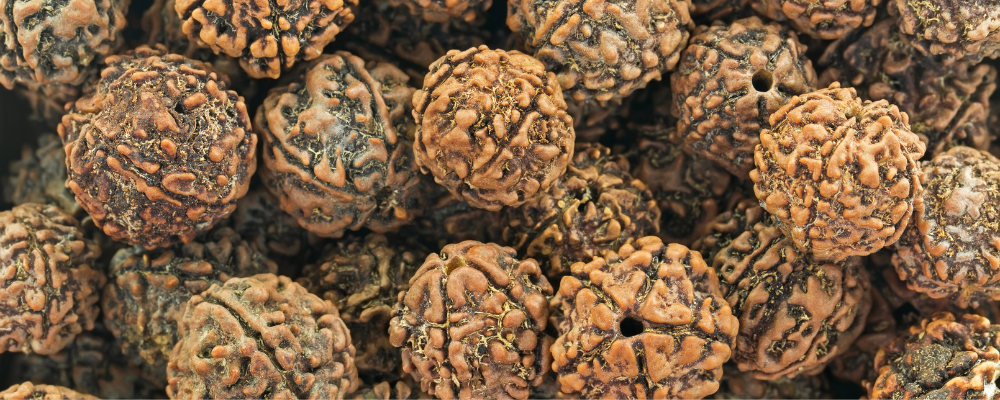
After the pulp is removed, the stone reveals longitudinal lines. The delimited sections are called mukhi, “faces.” Their number varies. An axial perforation makes it possible to thread the stones without their ridges disappearing beneath the fingers.
Botany already provides the three actions of the mala: cleaning, threading and counting. The pulp gives way to a durable stone; the thread transforms separate elements into a sequence; the hand moves from one face and count to the next.
Rudra’s tears in the Upanishad
The Rudraksha Jabala Upanishad presents itself as a dialogue between Bhusunda and Kalagnirudra. Asked about the origin of the seeds, Rudra recounts that he closed his eyes during his action against the three cities. Drops fell from his eyelids and became Rudraksha.
The name thus receives a sacred interpretation: Rudra and aksha, the eye. The text then sets out the qualities sought, the numbers, colors, faces, and mantras associated with wearing them. Translation of the Rudraksha Jabala Upanishad.
The tear becomes a material for recitation. The story does not separate emotion from discipline: the drop receives a lasting form, and the hand then uses it to return to the mantra.
The mystery of the seed lies in this passage between sight, falling, and repetition. A Rudraksha worn outside any practice may retain personal value, but the origin story remains connected to Shiva and the religious world that transmitted it.
The mala and counted speech
An ordinary mala contains 108 beads and a larger terminal bead called the meru, or guru bead. The hand moves each seed forward in time with a recitation. Upon reaching the terminal bead, it reverses direction instead of passing over it. The necklace’s form thus organizes time, number, and return.
The McClung Museum preserves an Indian prayer bead strand made of Rudraksha seeds and recalls its connection with devotees of Shiva. The museum describes the mala as a prayer instrument comparable, through its counting function, to other religious prayer beads. McClung Museum, Indian Rudraksha prayer beads.
Counting is not meant to accumulate words at random. It gives concentration a framework, brings the hand back when attention wanders, and places a session within a shared measure.
For someone outside Shaivism, the most useful lesson concerns the discipline of repetition. A commitment gains strength when it has a stable formula, a defined number, and a stopping point.
The faces and reading the seeds
Catalogues classify Rudraksha according to their number of mukhi. Religious texts attribute deities, mantras, and merits to these categories. Contemporary commerce adds promises of health, wealth, or success that vary from one seller to another.
The face is first and foremost a visible feature of the seed. It can help describe a seed, but it guarantees neither its geographical origin nor its authenticity. Seeds may be reassembled, carved, or imitated in other materials. Examining the ridges, hole, and joins can help identify an alteration.
A respectful reading does not choose a Rudraksha like an automated wish-granting device. It connects the face to the text or lineage that gives it meaning. Without this framework, the seed may remain an object of study, a reminder to recite, or an image of a kept word.
The thread forms a correspondence as strong as the face. It crosses differences without erasing them. In group work, each count can represent a person or a task, while the thread represents the common rule.
Giving the words a measure
Choose a brief sentence that commits only to your own conduct. Write it at the top of a page, then draw nine circles connected by a line. Repeat the sentence once for each circle, aloud softly or silently. Check off each circle after every repetition.
At the ninth circle, stop. Note the concrete action that will follow the recitation during the day. This gives the words a path back into reality: a message to send, an appointment to make, an object to put away, or time to protect.
Place an image of Rudraksha near the page without copying a mantra or initiation rite. If you possess a consecrated mala, follow the rules received within your religious framework. The proposed drawing is intended for other readers and does not turn the Shaivite mala into a decorative accessory.
Historical correspondences
| Reference | Correspondence |
|---|---|
| Accepted botanical name | Elaeocarpus sphaericus (Gaertn.) Heer |
| Commercial synonym | Elaeocarpus ganitrus Roxb. ex G.Don |
| Part used | Hard fruit stone, called a seed |
| Religious framework | Shaivite devotion and mantra recitation |
| Magical applications | Discipline, repetition, speech, and continuity |
| Safe form | Counted writing, drawing, and closed object |










