































































































Juniper keeps its needles when winter strips the leaves from neighboring trees. Its “berries” take two years to ripen, so the same branch bears both green and blue-black fruit. In the Highlands, its smoke blessed homes and livestock at the turn of the year. Culpeper presents it as a solar shrub. Its magic speaks of thresholds, protection, and overlapping time.
This profile concerns Juniperus communis L., common juniper. The genus includes many species, some of which are toxic or difficult to distinguish. “Juniper berries” are fleshy cones called galbuli, not botanical berries.
The magical history draws on Scottish saining and Culpeper’s astrology. Historical fumigations filled rooms with irritating smoke. The current practice preserves the threshold and the blessing, but replaces burning with writing and actual ventilation.
Needles and galbuli over two years
Juniperus communis belongs to the Cupressaceae family. It can form a low shrub or a small tree. Its rigid leaves, grouped in threes, bear a light-colored band on their upper surface and end in a point.
Kew describes a native range covering the subarctic and temperate regions of the Northern Hemisphere. Kew, Juniperus communis.
Male and female plants are generally separate. Fertilized galbuli remain green during their first season, pass through winter, and ripen to blue-black the following season. Several ages therefore coexist on a single female plant.
This slow maturation creates an image of layered time. A project can carry a green promise, a winter stage, and a ripe fruit all at once. Juniper accompanies transitions that require not confusing beginnings with completion.
The saining of the Highlands
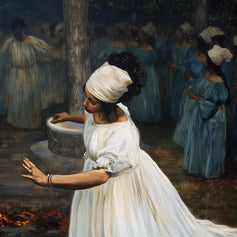
The Scottish word saining refers to a blessing or protection. In the Highlands, juniper branches were burned at the beginning of the year in front of livestock, in homes, and in stables.
The historian Ronald Hutton reports observations from the 18th century and the following century: the openings were blocked to retain the smoke, understood both as material fumigation and ritual protection. Ronald Hutton, purification and blessing rites.
The act marked the New Year. After the smoke, the doors and windows were opened and cold air entered the house. The threshold therefore combined closure, saturation, and reopening.
The blessing does not end in the smoke: it ends when the house breathes again. Opening is as much a part of the rite as Juniper.
Culpeper’s solar shrub
Culpeper calls Juniper a solar shrub and praises its reputation as an antidote in 17th-century medicine. He also notes that the fruits remain green for two summers and one winter before turning black.
This description brings together botanical observation and the governance of the Sun. Nicholas Culpeper, “Juniper Bush”.
The Sun suits an evergreen plant whose galbuli ripen slowly and whose fragrance reveals itself in the wood and fruit. It brings visibility, warmth, and focus, while saining gives it a domestic threshold function.
Culpeper’s remedies are not current advice. Their value lies in the way a practitioner read the fruit’s calendar as a sign of power and endurance.
Close, bless, and reopen
Historical saining reveals a complete sequence. The house is closed, the smoke circulates, then all openings release the stale air. A faithful magical reading must preserve this movement instead of reducing Juniper to “purify.”
Closing protects for a time, but a house closed too long becomes unbreathable. Opening without limits leaves it exposed. Juniper teaches rhythmic warding: determine what enters, what leaves, and when the threshold changes state.
The galbuli spanning two years add a measure. The calendar’s passage does not erase all unfinished work. The new year contains ripe fruits and green fruits. Blessing the house also means acknowledging these timelines side by side.
Its magic is suited to moving house, year-end, returns, and resuming activities after illness. It carries an identifiable Scottish history, without using vocabulary borrowed from Indigenous American ceremonies.
Letting the threshold breathe
Actually open a window for a few minutes. On a sheet of paper, draw a closed door on the left and the same door open on the right. Between them, draw a branch bearing three green galbuli and three ripe ones.
Under the green galbuli, write what continues into the new year. Under the ripe fruits, write what can be brought to a close. On the door, note an entry rule for your home or your time.
Place the sealed sachet near the drawn door, then put it away after ventilating the room. This gesture preserves the sequence of the saining without smoke, embers, or aromatic oil. The protection becomes a clear boundary and a house that breathes.
Historical correspondences
| Reference point | Correspondence |
|---|---|
| Botanical name | Juniperus communis L. |
| Botanical fruit | Fleshy galbulus ripening over two years |
| Scottish practice | Saining at the turn of the year |
| Astrological source | Sun in Nicholas Culpeper |
| Magical domains | Threshold, guardianship, passage, and maturation |
| Safe form | Ventilation, drawing, and sealed sachet |