














































































































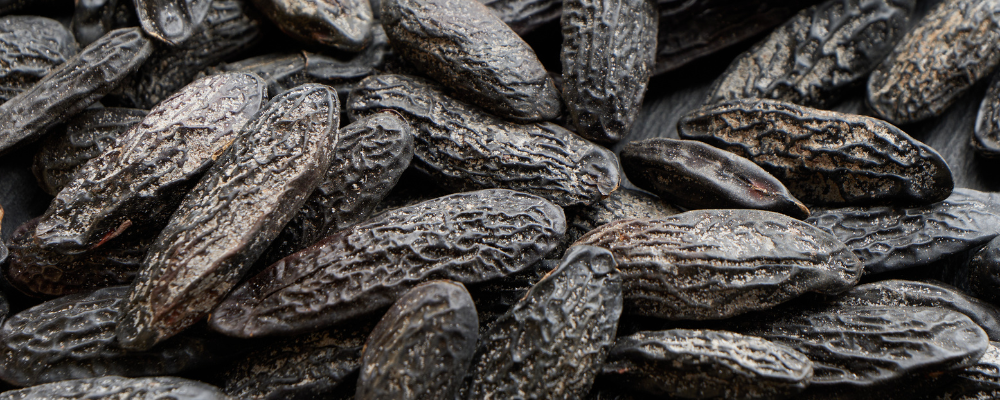
Black, wrinkled, and covered with fragrant crystals after preparation, the Tonka Bean looks like a small pocket object. Its scent of vanilla, almond, and hay opened the doors to perfumers’ workshops, flavored tobaccos, and charm sachets. In African American rootwork, it circulates under the name wish bean, the seed entrusted with a wish.
Tonka comes neither from ancient temples nor from European medieval grimoires. It comes from a large tree in the forests of northern South America. Its magical history belongs to the colonial and postcolonial movements that carried the seed into perfumery, the curiosities trade, and conjure practices.
The coumarin that gives it its fragrance is also why it should be used with caution. Here, the product is used as a sealed, identifiable talisman. No tale of luck or wishes authorizes grating it, infusing it, burning it, or wearing it against the skin.
The Fragrant Seed of Cumaru
The Tonka Bean is the seed of Dipteryx odorata (Aubl.) Forsyth f., a tree in the Fabaceae family. The fruit contains an elongated seed that becomes dark and wrinkled as it dries. Its fragrance comes largely from coumarin, first isolated from Tonka at the beginning of the 19th century.
Kew places the species’ native range in northern South America, from Guyana and Venezuela to northern and western Brazil. Kew, Dipteryx odorata.
The names cumaru, sarrapia, tonco, and tonquin preserve traces of different languages, ports, and markets. The form “Tonka” does not refer to Asian Tonkin: the seed belongs to the Amazonian and Guianan world.
From the River to the Perfume Houses
From the late 18th and throughout the 19th century, the seed made its way to Europe. Its aroma was used to scent tobacco, soaps, liqueurs, and perfume compositions. Coumarin, isolated in 1820 and then synthesized in 1868, transformed this forest product into a flagship molecule of the fragrance industry.
The history of Tonka is therefore the story of a scent set into circulation. Collectors gather the fruits, merchants transport them, and perfumers fix a new olfactory memory. The seed becomes an object of desire because it concentrates a lasting fragrance in a tiny volume.
This economy explains its entry into curiosity and charm shops. A whole seed slips into a pocket, purse, or sachet without immediately losing its scent.
The wish bean of rootwork
In the rootwork and hoodoo of the southern United States, Tonka is called wish bean or love-wishing bean. It joins the small objects carried on one’s person, placed in a pouch, or associated with a request for luck, money, or love.
The extensive collections of Harry Middleton Hyatt, made between 1935 and 1939 and later published under the title Hoodoo—Conjuration—Witchcraft—Rootwork, provide the ethnographic framework for these conjure practices. Bibliographic record of Hyatt’s survey.
A wish fits in the hand. The small seed gives desire a form that can be kept, counted, and given to the current. Its ritual power comes from this trajectory, not from an automatic promise.
The wish entrusted to running water
A contemporary rootwork practice calls for carrying an odd number of seeds for several days, entrusting them with a wish, then throwing them behind you into running water without looking back. The water carries the request away, while leaving without looking back marks the decision no longer to hold on to it.
This gesture should not lead to abandoning a seed in a river. The imported object need not become waste or enter an environment that is not its own. A representation made of soluble paper or a simple written word can take its place.
The motif can be compared with deposit and separation rites found in other folk traditions, while retaining its African American context here. The name rootwork deserves to be mentioned rather than replaced by a vague “universal magic.”
Carry the wish without opening the sachet
Keep the Tonka Bean in its original closed sachet. Slip a piece of paper bearing a single wish phrased as a concrete sentence behind the label. Carry the sachet in a pocket separate from all food for seven days.
On the seventh day, remove only the paper. Tear it at the edge of a body of water, then take the fragments home to recycle or dispose of them. The seed remains in its packaging and does not go into the water or soil.
For a material-luck working, place the sachet near a closed account book and write down one achievable action: send an invoice, prepare a budget, or request a quote. The talisman accompanies the action rather than replacing it.
Historical correspondences
| Reference point | Correspondence |
|---|---|
| Botanical name | Dipteryx odorata (Aubl.) Forsyth f. |
| Origin | Northern South America, the Guianas, Venezuela, and Brazil |
| Magical context | African American rootwork and hoodoo |
| Ritual names | Wish bean and love-wishing bean |
| Magical areas | Wish, luck, money, love, and commitment |
| Safe form | Sealed seed, paper, and concrete action |










