
















































































































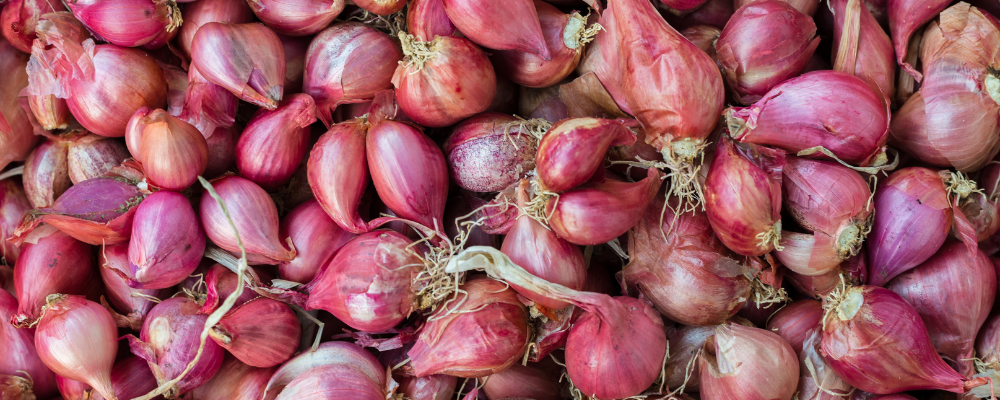
The Shallot divides underground into a group of tightly packed bulbs. Its skin protects fine layers, its aroma emerges when cut, and its multiplication transforms a planted bulb into a small family. Its magic does not require attributing Garlic’s entire history to it: it arises from its real kinship with the Onion, its name linked to Ascalon, and its botanical art of sharing without disappearing.
The common European Shallot belongs to the Allium cepa Aggregatum Group. The name Allium ascalonicum remains visible in books and commerce, but it is treated as a misapplied name for this group. The gray shallot, however, may correspond to Allium oschaninii: the label must therefore remain with the product.
Magical texts speak more of the Onion or Garlic than of the Shallot. This entry follows botanical kinship without conflating the species. The Martian correspondence comes from the Onion in Culpeper; the cluster of bulbils, characteristic of multiplying shallots, adds an interpretation of lineage and distribution.
The Shallot in the Allium cepa Group
The Shallot belongs to the Amaryllidaceae family. Its hollow leaves emerge from a base that forms several small bulbs joined together. Unlike many culinary onions selected for a single large bulb, shallots in the Aggregatum Group produce a clump of daughter bulbs.
The Royal Horticultural Society classifies the Shallot in Allium cepa Aggregatum Group and lists Allium ascalonicum as a misapplied name. RHS, Allium cepa Aggregatum Group.
The group includes round or elongated cultivars, pink, copper-colored, or gray. Some plants sold under the name shallot belong to other species or hybrids. Culinary form alone is therefore insufficient to establish the taxon.
The cluster of bulbs offers a precise image of multiplication. The mother bulb nourishes several units that can be separated and replanted. The magical work concerns the transmission of resources, the creation of relays, and the continuity of a household.
Ascalon in the name
The historical Latin name ascalonicum and the French “échalote” have been linked to Ascalon, a Levantine city now called Ashkelon. This etymology nourished the story of a bulb brought to Europe by the Crusaders.
The name preserves a geography, but it does not by itself provide the act of introduction or the cultivar’s exact route. Plants circulate through seeds, bulbs, markets, and gardens, while names may travel by another route.
In the grimoire, Ascalon becomes a marker of travel and name-memory. The Shallot reminds us that a household object can preserve a distant city in its vocabulary, even when its horticultural lineage has been reshaped.
This story suits provenance work. Before using an inheritance, one asks where the name comes from, who transmitted the practice, and which part of the story remains verifiable. The question protects memory better than a legend repeated as certainty.
Mars and the Onion in Culpeper
Nicholas Culpeper places the Onion under Mars. He attributes to it an ability to attract corruption and recommends it in 17th-century medicine for several ailments. Nicholas Culpeper, “Onions”.
The Shallot belongs to Allium cepa, but a multiplying cultivar is not every onion described by Culpeper. The martial correspondence may be inherited with this botanical reservation: pungent smell, tears when cut, and the vigor of a bulb that grows back.
Mars comes from its kinship with the Onion; the cluster comes from the Shallot. The first image cuts and defends, while the second distributes and transmits.
The remedies in the book belong to 17th-century medicine and must not be reproduced. The Shallot’s martial correspondence comes here from its botanical and material kinship with the Onion: the same tunicate bulb, the same sulfurous pungency, and the same tear-inducing power when cut.
Layers, tears, and multiplication
Each bulb is wrapped in dry tunics, then fleshy layers. Cutting ruptures the cells and releases irritating sulfur compounds. The tears do not come from an occult property: they attest to the opening of the tissue.
This reaction gives a voice to unveiling. Removing one layer can clarify a matter, but every revelation carries a tangible cost. The Shallot invites you to open with restraint, name what will be shared, and leave untouched what still offers protection.
The cluster adds another rule. A resource can be divided without being lost when each share retains the ability to resume. Time, recipes, access, and responsibilities can follow this model, provided that sharing does not reduce the mother bulb to nothing.
Its magic is thus suited to successions, teams, households, and transmitted projects. It is not used to claim the powers attributed to Garlic against vampires or to absorb all the stories of Allium.
Sharing a Burden in Bulbs
Draw a central bulb surrounded by five bulbils. In the center, write a responsibility that has become too burdensome. In each bulbil, write an autonomous share that can be entrusted, planned, or abandoned.
Link each share to a person only after their agreement. When no successor exists, write a date or a tool instead of a name. The cluster should show a possible distribution, not an imaginary delegation.
Place the sealed product beneath the drawing during the decision. When a share actually changes hands, color its outer covering. The work draws on the bulb’s multiplication and Martian frankness, without cutting, ingestion, or contact with animals.
Historical Correspondences
| Reference Point | Correspondence |
|---|---|
| Horticultural Classification | Allium cepa Aggregatum Group |
| Name to Be Handled with Care | Allium ascalonicum |
| Botanical Image | Cluster of Daughter Bulbs |
| Astrological Source | Mars for Onion in Culpeper |
| Magical Domains | Sharing, Succession, Limitation, and Transmission |
| Safe Form | Distribution Map and Sealed Product |










