


























































































In Surah Maryam, Mary withdraws near the trunk of a palm tree at the time of childbirth. A voice asks her to shake the trunk so that fresh dates fall toward her, then to eat, drink, and regain her calm. The fruit does not appear as an abstract talisman of wealth: it responds to an exhausted body, in a precise place, with food descending within reach. Its magic works through concrete aid, hospitality, and the continuity of life.
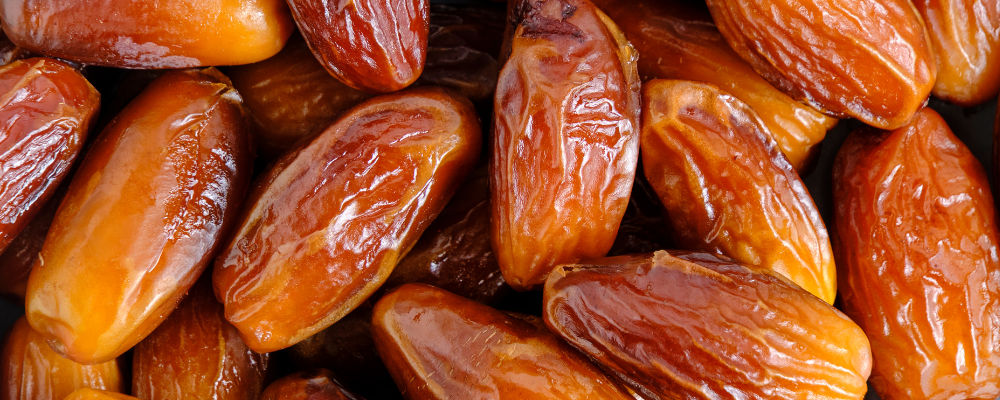
The date is the fruit of Phoenix dactylifera L., a palm tree in the Arecaceae family. Female plants bear large clusters of fruit after pollination. The sweet pulp surrounds an elongated seed marked by a groove.
Religious and artistic images alternately concern the fruit, the entire palm tree, or the frond. This entry keeps their levels distinct. The date nourishes, the trunk supports, and the frond may signify victory or fertility depending on the context. Current practice uses their relationship as a supporting framework, without leaving food offerings exposed or ingesting a ritual product.
The fruit of a cultivated palm tree
Phoenix dactylifera is a palm tree with a solitary trunk or one that forms offshoots. Its crown consists of long pinnate leaves. Male and female flowers grow on separate plants, which requires pollen to meet the female inflorescences.
Kew accepts the species and presents it as a cultigen originating from Iraq to the Arabian Peninsula. Millennia of selection and vegetative propagation have produced numerous cultivars. Kew, Phoenix dactylifera.
The fruit passes through several stages of ripeness that alter its color, texture, and water content. The fresh date in the Quranic account is not identical to the dried fruit preserved and transported.
The palm tree combines vertical growth, a high crown, and clusters that descend toward the hand. This architecture connects the long time of cultivation with the immediate act of nourishment.
Fresh dates beside Mary
Surah 19 recounts that Mary withdraws from her people and that the pains of childbirth lead her to the trunk of a palm tree. At the heart of her distress, a voice calls to her and announces a stream.
Verse 25 asks her to shake the trunk toward herself: fresh, ripe dates will fall. The following verse brings together food, drink, and consolation. Quran, Surah Maryam, verses 25–26.
Aid combines a gift with an action. Water is made available, while Mary acts on the trunk. The help neither denies the physical ordeal nor the need for nourishment.
The fruit descends when the hand meets the trunk. The story connects the aid received with an action possible in the midst of exhaustion.
Palm, life, and fertility in imagery
The Metropolitan Museum recalls that the date palm has been cultivated for more than five millennia and that, in the arts of the Mediterranean basin and the Near East, it has been associated with life, victory, grace, wealth, and fertility.
These meanings change according to religions, periods, and objects. A palm of victory, a tree laden with fruit, and an offered date do not convey the same message. The Metropolitan Museum of Art, cultural history of the palm.
A cylinder seal held by the Institute for the Study of the Ancient World also depicts a ritual scene associating Ishtar with a date palm. The tree occupies the ritual space as a visual sign of growth and fertility. ISAW, cylinder seal with Ishtar and a date palm.
The magic of the Date respects this scale. The fruit speaks of nourishment and sharing; the tree speaks of lineage, culture, and duration. One does not automatically transfer every symbol attributed to the palm to the fruit.
Aid, hospitality, and reserve
A date provides dense nourishment in a small volume. This quality has supported travelers, households, and trade in arid regions. It gives the fruit an association with accessible provisions.
Yet hospitality is not accumulation. It requires knowing who should be received, how much can be shared, and what must remain in reserve for the next day.
The story of Maryam places relief at the level of need: water, fruit, and soothing. A magical practice faithful to this scene therefore begins with three practical questions: What provides nourishment, what quenches thirst, and what words make the situation bearable?
The prosperity of the Date is measured by the continuity it makes possible. A benefit that cannot flow down to the person in distress remains in the tree’s crown. The act consists of creating the passage.
Bringing down the support
Draw a palm tree whose trunk connects three clusters to three open hands. Do not use any real fruit or seed.
In the clusters, write the available resources: food, water, money, time, skill, or presence. In each hand, write the person or situation that should be able to receive them.
Along the trunk, trace the steps that make the support flow downward: call, purchase, travel, authorization, sharing, or appointment. Assign a person responsible and a date to each step.
At the foot of the tree, add a drawn stream and write down the soothing words you can offer without promising the impossible. Keep the page until the first resource actually reaches its destination.
Historical correspondences
| Reference | Correspondence |
|---|---|
| Botanical name | Phoenix dactylifera L. |
| Family | Arecaceae |
| Relevant part | Fleshy fruit surrounding an elongated seed |
| Religious source | Surah Maryam, fresh dates, and a stream |
| Magical domains | Relief, hospitality, fertility, and continuity |
| Safe form | Drawn map of resources and their passage |