




























































































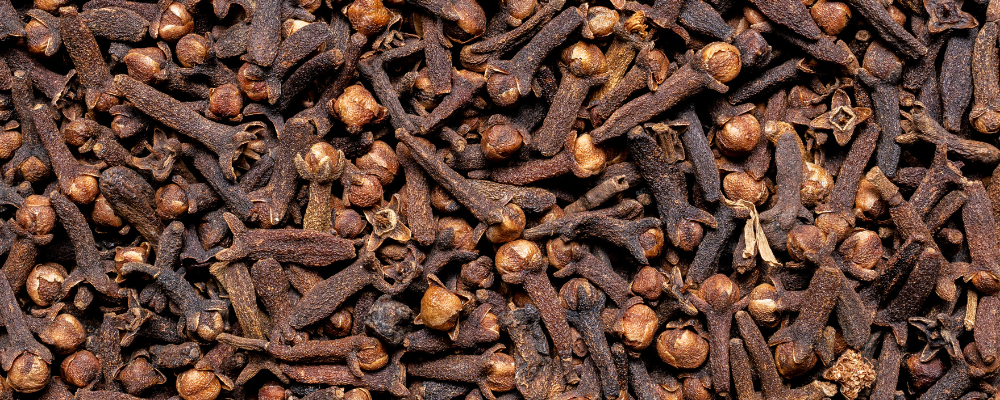
Clove resembles a small nail because it is picked before becoming a flower. This dried bud crossed the seas, prompted murderous monopolies, and found its way into the fragrant compositions of astrological magic. In the grimoire, its power comes less from a vague formula than from a concentrated fragrance, a closed form, and a history in which aroma was worth a fortune.
The clove tree is Syzygium aromaticum (L.) Merr. & L.M.Perry, a tree from the Moluccas. The "clove" sold as a spice is its flower bud, harvested before opening and then dried. It is neither a seed nor the flower called wallflower.
European occult sources assign it several places. Agrippa incorporates it into a solar fumigation, also attributes it to Jupiter's fragrant fruits, and cites it in a Mercurial composition. These correspondences therefore do not form a simple planetary label: they vary with the recipe and the logic of the chapter.
The flower bud of the clove tree
Syzygium aromaticum belongs to the Myrtaceae family. The clove tree is an evergreen tree with opposite, glossy leaves dotted with aromatic glands. Its flower buds change from green to red before opening. Harvesting takes place at this stage, after which drying turns the bud brown and hardens its base.
Kew places its native range in the Moluccas, in Indonesia. The tree has been cultivated in several tropical regions since trade moved its plants. Kew, Syzygium aromaticum.
The bud contains an oil rich in eugenol. This concentration explains Clove's olfactory strength and requires a distinction between the whole spice and the aromatic oil. One drop of oil is not a simple liquid equivalent of a few buds.
The closed form already carries a ritual image. The flower remains in reserve, held by four sepals, while its scent is released when rubbed. Clove is therefore suited to workings in which a decision, a promise, or a word must remain sealed until the chosen moment.
A spice born in the Moluccas
The clove tree was one of the great spices of maritime trade. Kew notes that in the 17th century, the Dutch East India Company destroyed trees outside the islands it controlled in order to maintain its monopoly. Unauthorized cultivation and trade could be punished by death.
This history changes how we read the spice. Clove is not a small exotic object that appeared without routes or violence. Each bud points to producing communities, voyages, attempts at control, and the clandestine movement of plants to Mauritius and Réunion in the 18th century.
The mystery of Clove then lies in the disproportion between size and value. A dark bud could condense fragrance, wealth, and political power. The magic of authority or prosperity benefits from remembering the human cost hidden behind the aroma.
A responsible modern use does not reenact the monopoly. It calls for transparent sourcing, uses little material, and transforms abundance into the capacity to share rather than the desire to accumulate.
Clove in Agrippa’s fumigations
In Book I of Occult Philosophy, Henri-Cornelius Agrippa places Clove in a fumigation of the Sun with saffron, bay laurel, myrrh, and frankincense. The same chapter associates it with Jupiter’s fragrant fruits and includes it again in a recipe for Mercury with mastic and cinquefoil.
The text was published in the 16th century and then translated into English in the 17th century. It belongs to learned natural and astrological magic. Agrippa, Book I, Chapter 44.
Clove is not associated with a single planet. The Sun receives its fragrant brilliance, Jupiter its quality as an aromatic fruit, and Mercury its ability to enter a fluid composition.
The original recipes combine plant materials, animal substances, and dangerous actions. They are textual witnesses, not a household instruction manual. Reading them helps us understand the place of fragrance in magical action without burning the formula or reproducing its ingredients.
Fixing, sealing, and making speech tangible
French names the spice for its resemblance to a nail. This image inspires acts of fixing: piercing fruit, counting points, marking a boundary. Magical vocabulary then follows the bud’s own body, with its rounded head and hard stem.
The floral bud offers a second reading. It contains an opening interrupted by harvesting. Fixing can therefore protect a commitment or prevent a word from dispersing, but fixing can also block growth. The ritual asks us to clarify what must hold and what must still blossom.
The scent acts as a memory marker. A single recognizable Clove in a blend brings back an event, a season, or a cuisine. In a smoke-free practice, the closed sachet is enough to give a decision in writing a sensitive point.
Clove is suitable for workings of authority, contract, and measurement. Its solar association comes from Agrippa, its Jupiterian association from the classification of fragrant fruits, and its fixing function comes from its form. These three threads remain visible instead of being blended into a universal magical quality.
Sealing a word without fixing it
Write a commitment phrase containing a verb, a date, and a limit. Avoid absolute promises. A phrase such as “I will respond by Friday before six p.m.” has a verifiable form.
Draw four Cloves at the corners of the page, with their points turned toward the center. In the middle, draw an opened bud to represent what remains free to grow. Place the closed product to the left of the text.
Read the phrase once, then put the sheet away until the indicated date. After the action, record the result beneath the opened bud. The gesture recalls the clove, the fragrance, and the flower in reserve without combustion, ingestion, or aromatic oil.
Historical correspondences
| Reference | Correspondence |
|---|---|
| Botanical name | Syzygium aromaticum (L.) Merr. & L.M.Perry |
| Part used | Flower bud harvested before opening |
| Native range | Moluccas, Indonesia |
| Occult source | Agrippa, Book I, Chapters 23 and 44 |
| Magical domains | Authority, commitment, fixation, and measurement |
| Safe form | Dated phrase, four drawings, and closed sachet |