




























































































Wild Chicory opens its blue flowers by the roadside and turns them toward the course of the day. In Germanic and Romanian tales, it is a woman condemned to wait: a motionless fiancée before the road, an abandoned princess, or the wife of the Sun who cannot turn her eyes away from the star.
This steadfast watchfulness made the plant a sign of constancy in love, but its magical register goes further. Its root, pulled up with gold or stag antler on apostolic dates, was said to break bonds, remove thorns, and make its bearer invisible. The little roadside flower thus brings together waiting, liberation, and concealment.
The historical correspondences do not all agree: Folkard assigns it to Venus, while Culpeper places Succory under Jupiter. Rather than erase this divergence, the entry preserves it. Venus speaks of connection and fidelity; Jupiter, of the openness and restoration attributed to the plant in the 17th-century herbal.
The Blue Flower by the Roadside
Wild Chicory, Cichorium intybus L., belongs to the Asteraceae family. Its basal rosette produces a stiff, branched stem bearing light blue flower heads. The flowers open in the morning and close as the day progresses. When cut, the plant releases a white latex.
Kew places its native range from Europe and North Africa to Central Asia and the western Himalayas. It has become established in many regions of the world. The plant of these stories is wild Chicory of the roads, not a vegetable variety selected for its leaves or roots. Kew, Cichorium intybus.
Its daily rhythm underpins the solar motif without assigning it a planet based merely on resemblance. The flower head seems to follow the course of the day, while the stem remains at the edge of the path. The plant is at once clock, gaze, and waiting post.
Guardian of the Roads
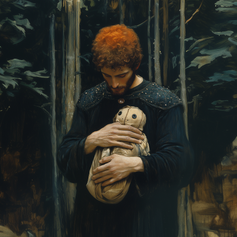
In German, Chicory is known as Wegewarte, “guardian of the roads,” Wegeleuchte, “light of the path,” and Sonnenkraut, “Sun herb.” An Austrian Silesian ballad tells of a young woman who mourned her lover, killed in the war, for seven years. Refusing any other bond, she asked to become a wildflower by the roadside.
Other versions tell of a bride who waits for a traveler’s return until she dies by the roadside, or of a princess abandoned by her husband. In each story, the metamorphosis fulfills the final desire: to remain where the absent one must pass and be seen by him. Richard Folkard, Plant Lore, Legends, and Lyrics, “Endive”.
Chicory expresses a fidelity that becomes a place. It does not chase after the awaited one; it transforms the roadside into a watch post. For work involving memory or commitment, this image offers denser material than a promise of “luck in love.”
The Bride of the Sun
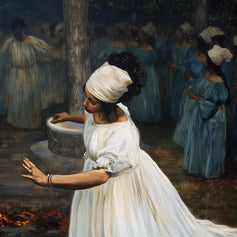
Gerarde reports the Latin name Sponsa solis, “bride of the Sun.” A Romanian ballad develops this title: the Sun proposes marriage to the Lady of Flowers. She refuses, and the star transforms her into Chicory, condemning her to look at him when he appears and then close her petals when he disappears.
The myth reverses the gentle reading of the solar flower. Looking at the light becomes a constraint born of refusal. Chicory therefore preserves a mystery of sovereignty: remaining faithful to one’s own decision, even when offended power imposes its mark.
Wait without yielding. The flower turns toward the Sun, but the story preserves the memory of her refusal. Her first loyalty is to the word she has spoken.
In a rite of consent or boundaries, the plant can represent this sustained word. It reminds us that a bond has value only if it remains chosen, and that constancy toward oneself comes before constancy toward others.
The Root That Breaks Bonds
The Germanic and Roman practices collected by Folkard attribute a power of liberation to the root. It was to be extracted with a piece of gold or a stag’s antler, on June 29 or July 25, two apostles’ feast days. A young woman carrying out this harvest would obtain her lover’s constancy.
Carried on the person, the root was reputed to enhance the wearer’s qualities in the eyes of the beloved. It was also supposed to break bonds, remove thorns from the flesh, and make one invisible. These powers bring together what legend separates: being seen by the absent one, then escaping the gaze that captures.
Folkard identifies Venus as the plant’s planet. Culpeper, in his article “Succory, or Chicory,” places it under Jupiter. Nicholas Culpeper, The Complete Herbal, “Succory, or Chicory”. The two attributions must remain attached to their respective authors: no universal table reconciles them.
Keeping watch, loosening bonds, and remaining free with Chicory
For work on constancy, place a dried flower beside a drawn path. At the end of the line, write the name of a commitment, not that of a person to be coerced. Each morning for a week, reread the sentence, then return the flower to the same spot.
To loosen a situation, tie a thread around a piece of identified commercial root, then undo the knot without cutting it. Name what you are no longer going to maintain and store the thread separately. The gesture reclaims the power to “break bonds” without uprooting a wild plant or pretending to act on someone else’s choice.
By a roadside, the most appropriate practice is to observe the flowers opening and leave the plant in place. A photograph taken in the morning can become the focus of work on visibility: what you agree to show, what you keep out of sight, and the direction you choose.
Historical correspondences
| Reference | Correspondence |
|---|---|
| Botanical name | Cichorium intybus L. |
| Symbolic names | Wegewarte, watcher of the roads; Sponsa solis, bride of the Sun |
| Planets | Venus according to Folkard; Jupiter according to Nicholas Culpeper |
| Reported harvesting dates | June 29 and July 25, with gold or stag antler |
| Magical domains | Constancy, waiting, consent, release from bonds, concealment |
| Ritual forms | Flower left by the roadside, identified commercial root, drawing, or photograph |