



























































































At the beginning of the Charm of Nine Herbs, Mugwort is given the word before all the others. The Anglo-Saxon manuscript calls it “the elder of plants” and credits it with power against poison, infection, and the evil that travels across the land. This introductory position sums up its European reputation: an herb of travel, St. John's Day, and thresholds where protection is sought.
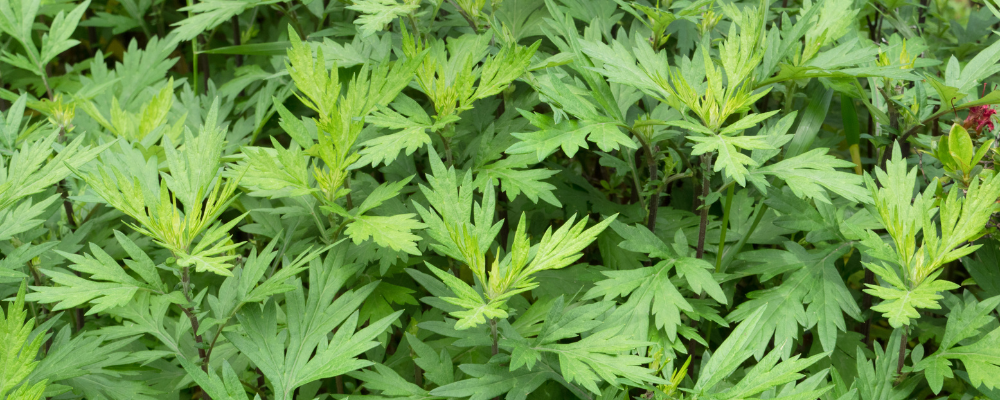
Artemisia vulgaris should not be confused with Wormwood, Artemisia absinthium, or with other species of the same genus. Its leaves, green on top and whitish underneath, have nourished a ritual history connecting the path, the belt, the Midsummer fire, and dreams.
Medical and magical texts combine formulas, prayers, and preparations. This article focuses on the symbolic gestures that can be read and adapted without infusion, fumigation, or consumption. The plant sold remains in its sealed packaging and serves as a material token, never as a household ingredient.
The Silver Herb of the Ways
Artemisia vulgaris L. belongs to the Asteraceae family. This perennial forms upright stems bearing divided leaves, dark on top and covered with fine pale hairs underneath. Its small brownish or reddish flower heads open in branched clusters at the end of summer.
Kew places its native range in temperate Eurasia, extending to Indochina, as well as in North Africa. It thrives on embankments, roadsides, wastelands, and disturbed ground. Kew, Artemisia vulgaris.
This presence on the margins explains part of its magical language. Mugwort accompanies the person who leaves the inhabited place, walks between two territories, then returns. The white underside of the leaf also gives it a dual appearance: green in the light, silvery when it turns over.
The Elder of the Charm of Nine Herbs
The Lacnunga, a compilation copied at the end of the 10th or beginning of the 11th century, preserves the Charm of the Nine Herbs. Mugwort opens the series. The text addresses it directly, recalls its name as Una, and proclaims its power against several forms of harm.
The manuscript Harley MS 585 brings together recipes, Christian prayers, invocations, and charms in Old English, Latin, and Old Irish. It does not separate healing from ritual language as a modern manual would. British Library, Harley MS 585.
The formula was repeated over the plants and the person being treated. The power therefore lay as much in the words, the number nine, and the order of the plants as in their material substance. For the grimoire reader, Mugwort becomes the plant that opens a protective litany.
The belt thrown into the Midsummer fire
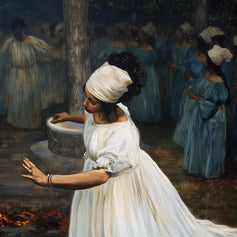
In several customs of Central Europe, sprigs of Mugwort were braided into wreaths or belts during Midsummer fires. The belt was worn around the body and then thrown into the flames with words intended to ward off misfortune, illness, and magical harm.
James George Frazer reports these practices in Bohemia and Germany, with wreaths viewed through the fire or kept in houses and stables. Frazer, The Golden Bough, Midsummer traditions.
Carry, cross, set down. The belt encircles the body during the seasonal passage. The fire then receives what was meant to be left behind. The gesture marks a before and an after.
Travel, sleep, and the turned world
The English name mugwort and folk traditions have associated Mugwort with travelers. Leaves placed in shoes or kept on one’s person were believed to support walking. The roadside plant thus becomes a companion for travel and a guardian of the return.
Its modern link to dreams rests on its place near the bed and its image as a lunar plant. Medieval sources do not offer a universal program of “prophetic dreaming.” Rather, they show a protective herb that was spoken over, carried, and mixed into ritual preparations.
The most accurate mystery lies in the turned leaf. By observing its pale underside, the practitioner moves from the visible to the hidden without absorbing the plant. This alternation is enough for work involving paths, nocturnal memory, and vigilance.
Tie a paper belt
Cut a long strip of paper and write nine protective words drawn from your situation: threshold, road, sleep, return, home, body, name, word, and measure. Tie the strip around a closed notebook, then read aloud the first passage devoted to Mugwort in the Charm of the Nine Herbs.
At Midsummer or when setting out on a journey, untie the strip and tear it into three pieces. Place them in an envelope instead of burning them. Write on the back what you are leaving behind, what you are taking with you, and what you will find upon your return.
The product may remain closed on the left side of the reading space. A photograph of the front and back of the leaf serves as the central element. The rite preserves the belt, the number, the word, and the passage without smoke or ingestion.
Historical correspondences
| Reference point | Correspondence |
|---|---|
| Botanical name | Artemisia vulgaris L. |
| Major text | Charm of the Nine Herbs, Harley MS 585 |
| Ritual timing | Midsummer fires and setting out on a journey |
| Objects | Belt, crown, shoe, path, and reversed leaf |
| Magical domains | Protection, passage, travel, sleep, and return |
| Safe support | Closed product, photograph, and strip of paper |