



















































































































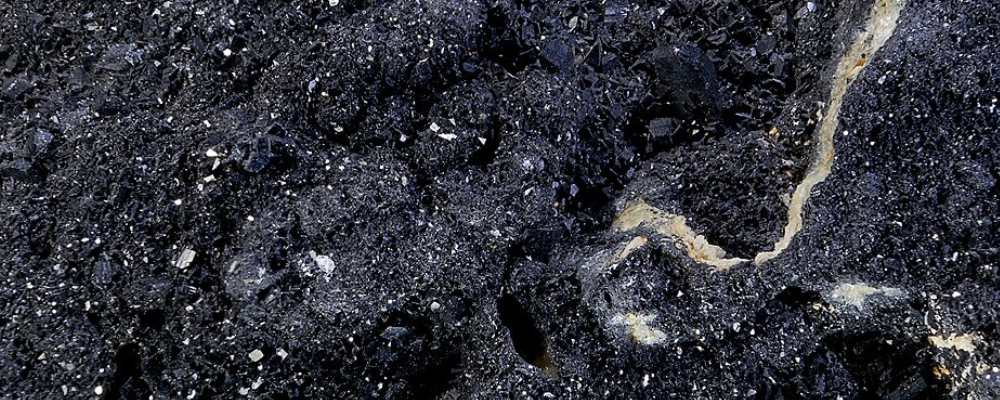
Babingtonite appears as a black punctuation mark in the light-colored cavities of rocks. Its dark, lustrous, well-formed crystals stand out beside Prehnite, Quartz, or Zeolites. It evokes a marker placed at the threshold: one that marks the true beginning of a commitment.
Described in the 19th century, it has no ancient talismanic tradition under this name. Its current symbolism is built on iron, color, and form: Saturn provides the framework, Mars the action, Earth the foundation, and Water the cavity where the crystals settle.
Para situar esta piedra entre minerales relacionados, compárala con Diopsido, Enstatita y Fassaïte.
A dark, iron-rich silicate
Babingtonite is a calcium and iron silicate, with the formula Ca2(Fe2+,Mn)Fe3+Si5O14(OH). The Handbook of Mineralogy indicates a hardness of 5.5 to 6, a triclinic structure, and a very dark green to black color.
Its vitreous luster reveals crisp faces under good lighting. The stone may appear completely black at first glance, then reveal green nuances along its thin edges.
Black crystals in the cavity
Babingtonite forms in cavities of volcanic rocks and in certain metamorphic settings. It may occur with Prehnite, Quartz, Calcite, and Zeolites. The contrast between the black crystals and the lighter minerals creates highly expressive specimens.
The Mindat entry presents its forms and localities. The matrix is not merely secondary decoration: it preserves the history of the cavity and gives the crystals their place.
Lévy, Babington y Massachusetts
Armand Lévy described Babingtonite in 1824 and named it in honor of the physician and mineralogist William Babington. The stone thus belongs to the era of the great mineral classifications of the 19th century.
Massachusetts chose it as its official mineral in 1981, a designation preserved in the state’s civic information. This modern recognition adds a sense of territory and belonging to its symbolism.
La Babingtonita marca el punto en el que una intención entra en la materia. Como el cristal negro que ocupa su lugar en una cavidad, el compromiso se vuelve real cuando recibe una fecha, un lugar y un primer gesto visible.
Saturno, Marte, Tierra y Agua
Saturno rige la duración, el marco y el límite. Marte corresponde al hierro y al acto inaugural. La Tierra aporta estabilidad; el Agua recuerda los fluidos que circulan por las cavidades de la roca.
El sábado es adecuado para los compromisos largos y el martes para el comienzo. Una pequeña piedra negra, un cuenco vacío y una fecha escrita pueden acompañar a la Babingtonita.
Umbral, compromiso y constancia
La Babingtonita acompaña el comienzo de una disciplina, la firma de una promesa, la entrada en un lugar o la reanudación de un trabajo regular. No representa el entusiasmo del primer día, sino el límite que permitirá medir el camino.
Colocada cerca de un calendario o un registro, recuerda que la constancia nace de una cita clara con la acción.
El rito del primer límite
Escribe el compromiso en una frase y añade una fecha de inicio, una frecuencia y una prueba de realización. Coloca la Babingtonita en la parte inferior de la hoja como un sello oscuro.
Di: «Cruzo el umbral, doy forma a mi palabra y marco el primer paso». Realiza inmediatamente una acción lo bastante breve como para poder terminarla ese mismo día.
Correspondencias y referencias
| Referencia | Correspondencia |
|---|---|
| Naturaleza | Silicato de calcio y hierro |
| Astros | Saturno y Marte |
| Elementos | Tierra y Agua |
| Días | Sábado y martes |
| Colores rituales | Negro, verde oscuro, gris |
| Ámbitos | Umbral, compromiso, constancia, territorio |
| Objetos asociados | Calendario, límite, cuenco |
| Gesto | Poner una fecha y dar el primer paso |










