




























































































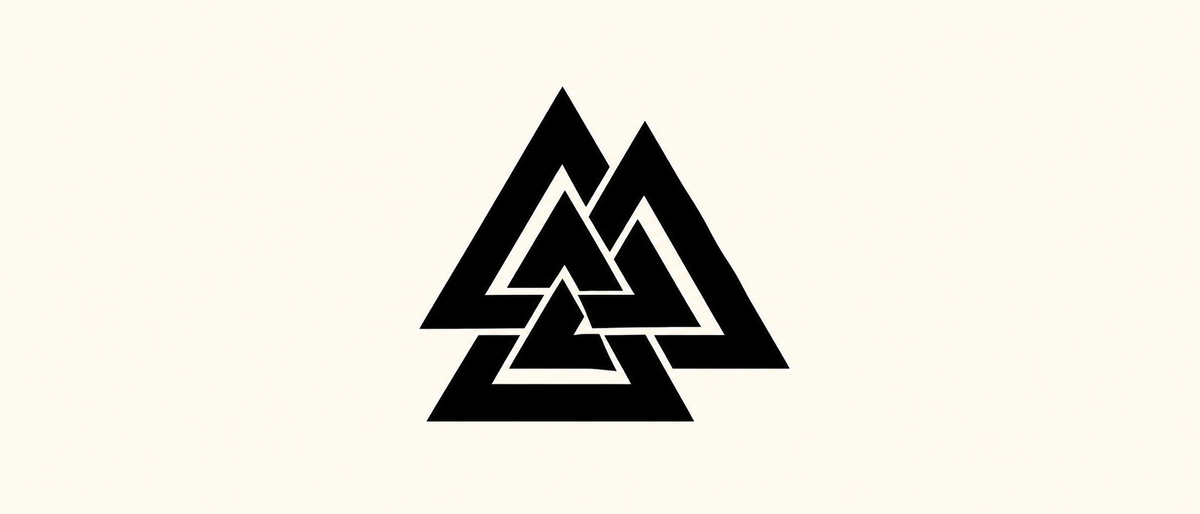
The valknut is a motif formed by three linked or interlaced triangles. It has become one of the most recognizable signs of the contemporary Nordic imagination, where it is generally associated with Odin, dead warriors, and the passage to the afterlife. Archaeology does provide ancient representations of the motif, particularly on stones from Gotland, but it gives us no text directly explaining its name or meaning. Prudence therefore consists in separating what the objects attest from what modern interpretations have reconstructed.
| Form | Three linked triangles, drawn in several ways |
|---|---|
| Period | Motif attested on objects and stones from the Viking Age |
| Name | Modern name, not known as the name of the motif in Old Norse |
| Association | World of the dead and Odin: an interpretation supported by certain iconographic contexts |
| To distinguish | The triquetra, composed of three curved lobes |
How can you recognize the valknut?
The valknut appears in several constructions. One version shows three interlacing triangles; another forms a continuous polygonal line creating three triangular shapes. The exact design varies, but the principle remains that of an angular three-part arrangement.
Confusion with the triquetra is common. Both motifs are based on the number three and may appear in Nordic contexts, but their geometry is not the same. The valknut is triangular; the triquetra is formed from three curved lobes.
This distinction also prevents every three-part knot from being turned into a valknut. Scandinavian art uses many interlacing patterns and geometric motifs. Identification must start from the actual design.
Is the word “valknut” ancient?
The term used today is a modern designation. It is generally explained from Nordic words associated with those who died in battle and with the knot, giving rise to translations such as “knot of fallen warriors.” No text from the Viking Age, however, tells us: “this figure is called valknut.”
This absence changes how its history should be written. The motif is ancient; the name we give it is not necessarily so. We must therefore avoid deriving a complete theology from the etymology of a word that appeared long after the objects.
This phenomenon is common in the history of symbols: researchers and collectors need names to classify forms. These names then become so familiar that they seem to have always existed.
Where can the motif be seen in the Viking Age?
The picture stones of Gotland provide several essential examples. A Lillbjärs stone held by the Swedish History Museum shows a motif identified as a valknut in a scene where a horseman is welcomed by a woman holding a drinking horn. The stone came from a funerary context, which lends weight to interpretations related to death, without providing a certain translation of the sign.
The museum also preserves metal objects bearing valknut shapes. These examples prove that the motif is not a contemporary invention and that it genuinely belongs to the visual vocabulary of medieval northern Europe.
What archaeology does not provide is a legend attached to the symbol. The scenes themselves are complex, and their figures cannot always be identified with certainty. Interpretation must therefore be based on the image as a whole, not on the valknut in isolation.
Why is it associated with the god of the dead?
Odin holds a prominent place in Norse narratives as the god of war, knowledge, and the dead. The Swedish History Museum notes that some fallen warriors join his hall, Valhalla. Several scenes featuring the valknut have been associated with this Odinic world.
This association is plausible, but the shortcut “valknut = Odin's personal symbol” goes beyond the available evidence. No ancient text describes the motif as the god's official emblem. It is more accurate to speak of a motif frequently interpreted in relation to Odin, warrior death, and the funerary passage.
The hammer of Thor offers a useful contrast. For Mjölnir, hammer-shaped amulets directly correspond to Thor's well-known attribute in the texts. The valknut calls for greater restraint because its name and function are not explained by a contemporary written source.
What does it mean in current usage?
The valknut has become a prominent emblem in contemporary Nordic spiritualities, tattooing, and visual culture inspired by the Viking Age. It may express a connection to Odin, the ancestors, courage in the face of death, or Nordic identity.
These meanings are contemporary reinterpretations based on ancient objects. They may be coherent for those who adopt them, but they should not be presented as a word-for-word translation of a Viking Age symbol.
The best interpretation therefore maintains two levels: an archaeologically attested motif and a history of interpretations. This approach protects the valknut from two opposite extremes: considering it a purely modern invention or assigning it an overly precise ancient definition.
Sources and historical context
For the Gotland picture stones bearing the triquetra and valknut, see the records of the Swedish History Museum. For Odin's role in Norse traditions and his connection with fallen warriors, also see the overview Odin – leader of the gods.