

















































































































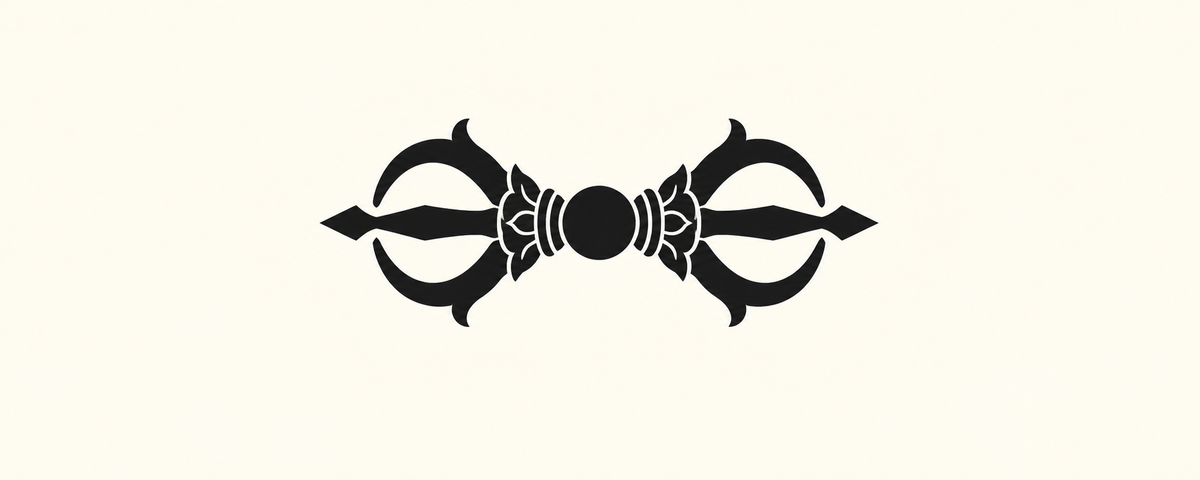
The Vajra, called Dorje in Tibetan, is one of the major ritual objects of Tantric Buddhism. Its compact form, ending in one or more prongs at each end, derives from the thunderbolt-scepter of the Indian god Indra. In Vajrayana, the motif takes on a new meaning: it expresses an indestructible reality, firm “like a diamond,” and a power capable of shattering ignorance. Used with the ritual bell, the Vajra is therefore not merely a graphic emblem but an instrument held, moved, and integrated into recitation and liturgical gestures.
| Sanskrit name | Vajra |
|---|---|
| Tibetan name | Dorje |
| Iconographic origin | Indra’s thunderbolt-scepter |
| Buddhist use | Major ritual instrument of Vajrayana |
| Key ideas | Indestructibility, firmness of Awakening, and destruction of ignorance |
Why is the Vajra both lightning and diamond?
The Sanskrit word vajra has a range of meanings referring to lightning and a material of perfect hardness, hence the frequent translation as “diamond.” This dual idea explains the Buddhist development of the symbol: lightning-like power on one side, indestructibility on the other.
The Metropolitan Museum of Art directly links the Tibetan dorje to Indra’s thunderbolt-scepter, the Indian god associated with rain, clouds, and lightning. Tantric Buddhism adopts this ancient form and transforms it into an instrument of doctrine and ritual.
The British Museum also describes the Vajra as a “ritual thunderbolt.” In esoteric Japanese traditions, it is called kongo and remains a central liturgical object.
How is it used with the bell?
In Tibetan ritual, the Vajra and the bell form a pair. The Met explains that they are generally designed as a set: the bell is held in the left hand and the Vajra in the right during codified gestures that accompany recitations.
The commentaries give this pair several levels of interpretation. The Vajra may refer to method, compassionate action, or the stability of Awakening; the bell to wisdom or intuition. Together, they show that neither object can be fully understood when isolated from its ritual partner.
The British Museum also emphasizes their complementary nature. This practical use prevents the Vajra from being reduced to an abstract drawing or a simple “symbol of energy.”
Why does it exist with one, three, or five prongs?
Vajras may have one, three, five, or more points depending on the traditions and functions. Five-pointed examples are among the best known in Tibetan iconography, while the Japanese objects studied by the British Museum show forms with one, three, or five points.
The number of points receives doctrinal interpretations in different schools. However, it would be imprudent to apply a single dictionary to all Vajras in Asia. The form, school, and ritual use matter.
The branches frequently curve toward a central axis, creating a closed and symmetrical structure. The design itself therefore conveys an impression of concentration and solidity.
What does it represent in Tantric Buddhism?
Vajrayana takes its name from the Vajra. The symbol becomes an image of the indestructible nature of awakened reality and of knowledge that cuts through ignorance.
The British Museum describes it as a symbol of wisdom and as an instrument “hard as a diamond” capable of breaking ignorance. The Met speaks of an unchanging consciousness of the Buddha, firm as a diamond.
The Dharmachakra represents setting the teachings in motion; the Vajra refers more to the power and indestructibility of the tantric path. Both symbols belong to Buddhism, but they are not interchangeable.
What should be avoided in modern interpretations?
The Vajra is now used in jewelry, tattoos, and decorative objects. It is sometimes presented as a general symbol of “inner strength” or “cosmic energy.”
These translations may evoke part of its visual power, but they erase the liturgical context of Vajrayana. The object has a precise ritual history, held in the practitioner’s hand and associated with gestures, mantras, and the bell.
The historical overview should therefore begin with the actual instrument before examining its later uses. The Vajra is not merely a shape: it is a ritual tool whose meaning comes from the religious action accompanying it.
Historical sources and reference points
The Metropolitan Museum of Art describes the Tibetan Dorje with its bell and recalls its origin in Indra’s thunderbolt, as well as its quality of indestructibility. The British Museum presents the Vajra as one of the major instruments of Vajrayana Buddhism.










