



















































































































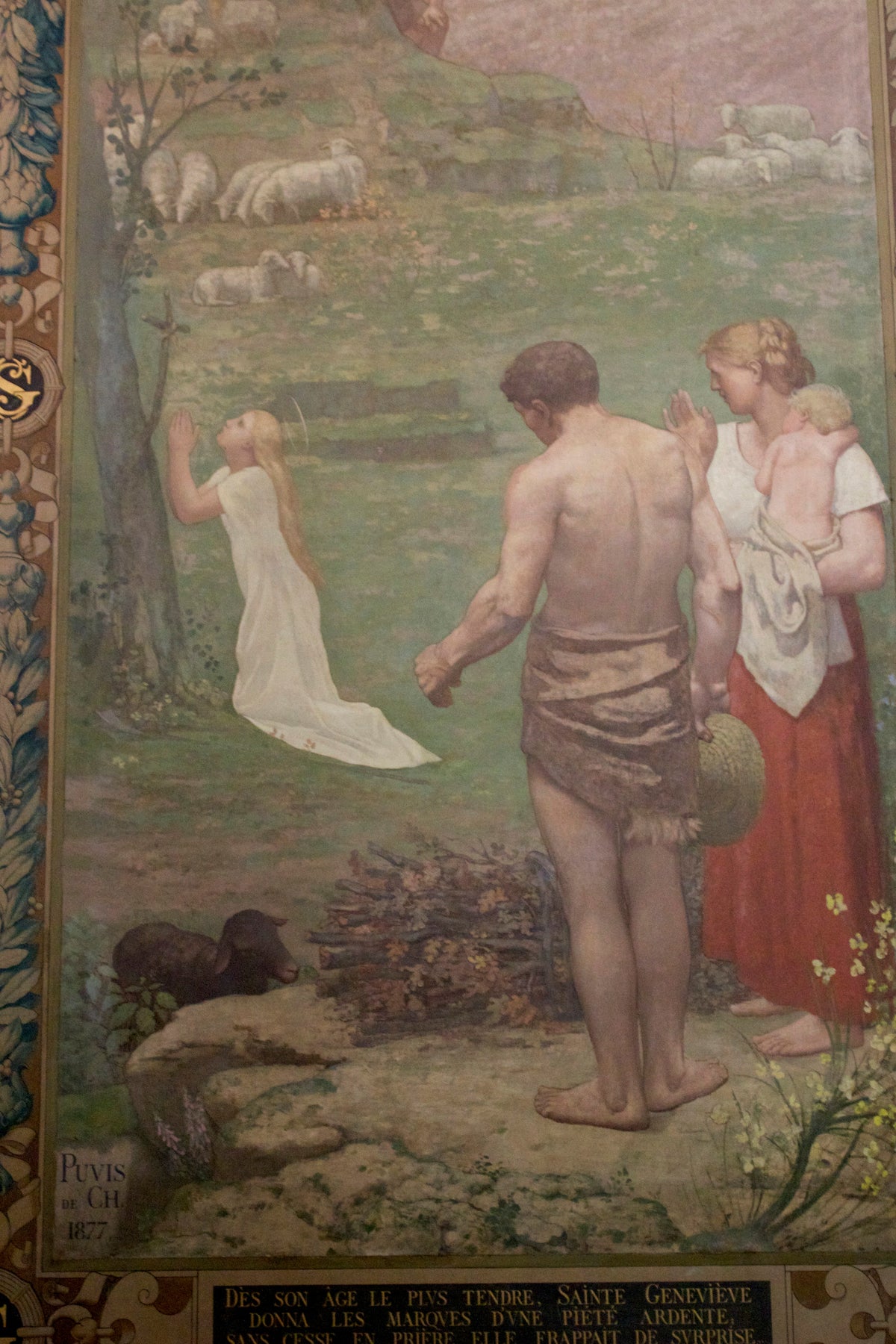
Saint Genevieve is the patron saint of Paris and one of the great figures of 5th-century Christian Gaul. Originally from Nanterre, she chose a consecrated life without entering a cloistered monastery. Her authority was exercised at the heart of the city, when its inhabitants had to face the threat of the Huns, political tensions, and supply difficulties. Tradition says that she encouraged the Parisians to remain in their city as Attila approached, then organized relief during a period of shortage. Her memory is known through an early Life, composed shortly after her death, and through the places that preserve her name in Paris and Saint-Denis.
| Life | c. 420 – c. 502 |
|---|---|
| Origin | Nanterre, near Paris |
| State of life | Consecrated virgin, engaged in civic life |
| Events | Threat of Attila in 451 and the provisioning of Paris |
| Attributes | Candle, book, and on certain occasions keys or sheep |
| Feast day | January 3; patron saint of Paris |
A Child from Nanterre Noticed by Germanus of Auxerre
Genevieve was born at the beginning of the 5th century in Nanterre, a village in the region of Lutetia. Her life belongs to Late Antiquity, a period when Roman power was weakening in Gaul and local authorities were playing an increasingly important role in organizing society. Her family belonged to this changing world, in contact with the Christian communities of the Paris region.
Tradition reports that Bishop Germanus of Auxerre noticed her during a visit to Nanterre when she was still a child. He recognized her religious vocation and encouraged her to consecrate herself to God. The scene gives a major place to the meeting between a young girl and a bishop known for his missions in Gaul and Britain.
Genevieve then pursued a life of prayer and Christian commitment without joining a closed monastic community. This form of consecration was important: it allowed her to remain active in civic life and to exert influence among the inhabitants and political leaders.
A Consecrated Woman in the City of the Parisii
After her parents' deaths, Genevieve moved to Paris and settled there permanently. Accounts of her life present her as devoted to prayer, fasting, and service to those in difficulty. But they also describe a woman capable of speaking to prominent figures and intervening in the most delicate collective circumstances.
The political context was unstable. Borders and alliances were changing, while cities had to ensure their supplies and defense. Genevieve acquired a moral authority that ancient authors explained through her reputation for holiness. This authority did not come from an episcopal title or a monastic office: it was built through her decisions and the trust she inspired.
This particular position gave her memory a civic dimension. Genevieve appears not merely as a woman withdrawn into prayer, but as a figure capable of mobilizing other inhabitants when the community faced a trial.
The Threat of Attila in 451
In 451, Hunnic armies led by Attila crossed part of Gaul. The arrival of these forces caused fear in several cities. In Paris, tradition reports that the inhabitants considered fleeing. Genevieve urged them to remain, pray, and not give in to panic. The city was ultimately spared as the Huns advanced.
The account highlights the courage of a woman who refused to let fear decide the fate of an entire community. Historians place the episode within the course of Attila's campaigns and the military strategies of the period. Religious tradition has preserved the image of a protector of Paris, capable of sustaining hope when the threat appeared imminent.
This scene became one of the great themes of devotion to Genevieve. It should not be reduced to a magical formula of protection: it tells of a public appeal, a shared trust, and a community that refused to disperse.
The Provisioning of Paris During the Troubles
During the tensions between the Frankish powers and the city of Paris, the inhabitants experienced supply difficulties. Tradition describes Genevieve taking the initiative to seek provisions in other regions. She traveled up the Seine by boat and organized the return of food intended for populations facing scarcity.
This episode shows a different form of courage from that of 451. Genevieve did not merely encourage the inhabitants through her words: she sought a practical way to help them. The river route became an instrument of relief, and organizing the supply effort involved travel and relationships with other communities.
The memory of this act helped make Genevieve a figure of civic protection. Her action is linked to solidarity, concern for vulnerable people, and the ability to act when the city's ordinary security could no longer be ensured.
Clovis, Clotilde, and Christian Gaul
Genevieve lived during the establishment of Frankish power in Gaul. Tradition connects her with Clovis and his wife Clotilde, whose story remains associated with the king's conversion. These relationships should be approached through the surviving testimonies, since ancient biographies give a spiritual dimension to the political choices of their time.
Her reputation as a religious authority helps explain the importance assumed by consecrated figures outside episcopal offices. Genevieve could intervene, offer advice, and obtain support for religious works. Her action took place amid the transition from Roman administration to new forms of government.
The significance of her life lies in this ability to navigate political changes while giving prayer and service to the inhabitants a central place. She thus occupies a particular role in the memory of Parisian Christianity.
The Memory of Saint Denis and the First Foundations
Genevieve is also connected with the development of the cult of Saint Denis, traditionally the first bishop of Paris. Ancient accounts attribute to her a role in building or supporting a religious structure over the martyr's tomb, north of the city. This site would become the center of a great shrine, and later the Basilica of Saint-Denis.
The relationship between the two saints is important to the religious history of the region. Denis represents the origins of Parisian Christianity and the witness of martyrdom; Genevieve expresses the continuity of this cult in 5th-century Gaul. Archaeological discoveries confirm the ancient existence of a necropolis and Christian buildings in the area of the future shrine.
This activity reveals a concern for the memory of previous generations. Genevieve did not merely assist her contemporaries; she also helped pass on places of prayer and traditions that would endure beyond her own lifetime.
The Candle, Sainte-Geneviève Hill, and January 3
Genevieve died around the beginning of the 6th century. Her tomb was associated with a church built on a height in Paris that would take the name Sainte-Geneviève Hill. Over the centuries, her cult remained one of the city's major religious landmarks. Tradition also preserves the memory of her shrine and of processions organized during crises affecting the inhabitants.
In art, she carries a candle that an angel keeps lit despite the intervention of a demon. This story expresses the struggle between the light of faith and the forces seeking to extinguish it. The prayer book and the clothing of a consecrated woman complete her iconography.
Her feast is celebrated on January 3. Genevieve remains the patron saint of Paris, as well as a figure of civic solidarity. Her life can be read through the accounts of the Hunnic threat, the provisioning effort, and the founding of shrines: these episodes bring together Christian faith and responsibility toward a city.
Historical Sources and References
Diocese of Paris, notice on Saint Genevieve, origins, Attila, provisioning, and the January 3 feast.
Diocese of Paris, historical study of the dates and context of Genevieve's life.
Ministry of Culture, archaeology of the earliest places of worship at Saint-Denis, concerning the memory of the martyr and the construction of the shrine.
Vita sanctae Genovefae, an early Life of Genevieve and a literary source on her place in Late Antique Paris.










