















































































































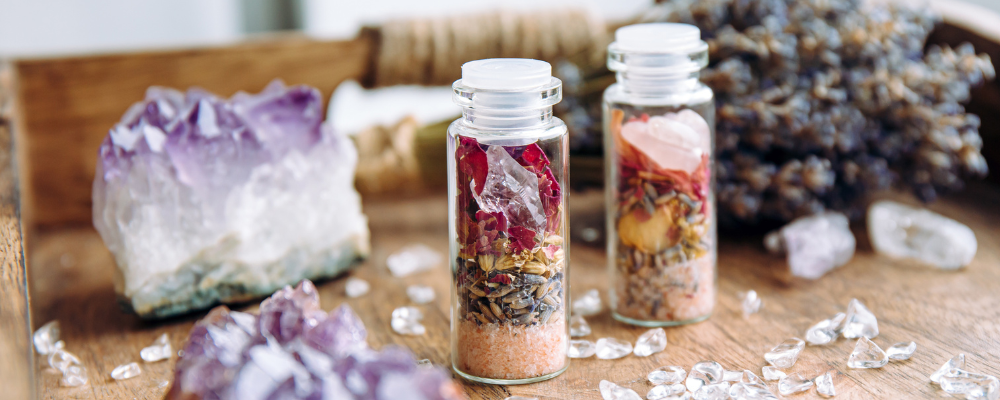
A spell jar is a small container used as a ritual tool. It brings together selected elements to represent an intention: protection, prosperity, love, calming, luck, or breaking away from a situation. The logic remains simple: each material has a clear place in the work, and the jar preserves this arrangement in an enclosed space.
The term “spell jar” is modern and very broad. It should not automatically be identified with old British witch bottles. Archaeology has indeed documented ritual bottles buried from the early modern period onward, particularly with pins, nails, or other elements associated with protection and counter-magic. Modern spell jars adopt the idea of work contained in a vessel, but their recipes, purposes, and references can be very different.
What is a spell jar used for?
A spell jar gives material form to an intention. Instead of relying solely on a spoken word or a candle, you bring several elements together in the same container. The jar then becomes the ritual tool and allows you to keep the petition paper, herbs, powders, minerals, or other chosen elements together.
This method is especially suitable for work you wish to keep for a certain period. A protection jar can remain near an entrance or on an altar. Prosperity work can be placed near a desk or an area connected to professional activity. A jar intended for a temporary situation can be dismantled when the work is complete.
Which jar or vial should you choose?
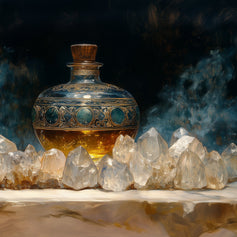
The container should first match the volume of the ingredients. A small vial is sufficient for a short petition with a few herbs and a powder. A wider jar makes it easier to arrange several layers or accommodate a larger piece of paper. Glass allows you to see the contents and holds up well to dry ingredients.
To get started, the 7 cm glass vial offers a simple format and is currently available. The 5 cm wide glass vial is better suited when you want to add larger elements. You can also browse our collection of vials and spell jars.
How do you choose the ingredients?
Start with a precise intention. A protection jar, a love jar, and a prosperity jar do not require the same combinations. The choice becomes easier when each ingredient serves a clear function.
For protection, salt, rosemary, or certain protection powders can accompany the petition paper. For money and professional activity, cinnamon, basil, or elements associated with opening roads find their place more naturally. For love and harmony, rose, lavender, or ingredients linked to gentleness give the work a more coherent direction.
Avoid multiplying ingredients simply to fill the jar. Three or four well-chosen elements create a clearer composition than a long accumulation of plants, stones, and oils without distinct functions.
The petition paper
The paper gives the work direction. Write the name of the person, situation, or objective concerned, then formulate a short petition. An objective such as “protect this house” or “encourage regular sales” is easier to work with than a sentence combining several requests.
The folding can also follow the logic of the rite. In systems that use this convention, fold toward yourself to attract or bring closer, and away from yourself to drive away. This rule is not universal: follow the method of the tradition or system you practice.
How do you assemble a spell jar?
Place the paper in the container first, then add the materials in an order that seems coherent to you. You can work in layers or mix the ingredients before putting them inside. During the assembly, maintain the same wording and direction.
A small amount of powder is enough. If you use herbs, choose dry materials when the jar is meant to remain closed for a long time. Moisture encourages mold and can damage the contents. Oils should also be used sparingly: a few drops are enough to scent or anoint an element without saturating the entire container.
Once the contents are in place, close the vial. Some methods finish the work by placing wax on the stopper. If you choose this finish, work away from alcoholic liquids, flammable oils, and heat-sensitive materials.
Examples of simple compositions
A protection jar can combine a petition paper, a pinch of salt, rosemary, and an element associated with boundaries or banishing. A small amount of cascarilla can be included in work where setting boundaries plays an important role.
A prosperity jar can combine a professional petition, cinnamon, basil, and an element linked to money or opening roads. A love jar can use rose petals, lavender, and a support associated with affection. In every case, the aim is to create a coherent composition, not to mechanically reproduce a recipe.
Does a spell jar need to be “activated”?
The word “activation” generally refers to the moment when the arrangement becomes ritual work. This can involve a prayer, a formula, a candle, fumigation, or a gesture defined by your method. The jar does not need to be shaken or recharged according to a universal schedule.
If you wish to resume the work, return to the same intention. A candle lit nearby on a suitable holder, a repeated prayer, or a pass of incense can serve as a renewal. Avoid adding new ingredients at every session: the original composition would quickly lose its clarity.
Where should you place a spell jar?
The location depends on its function. A protection jar can remain near the area it concerns. A prosperity jar can be placed in the workplace. Personal work can remain on the altar or in a place reserved for ritual materials.
Discretion is part of many folk magic practices. A jar does not need to be displayed to retain its symbolic function. Above all, choose a dry, stable place out of the reach of children or animals when the contents include small pieces, glass, or non-food materials.
How long should you keep a spell jar?
There is no single duration for every type of work. A jar connected to a specific situation can be removed when the situation is over. A protection jar can remain longer if its physical condition is still good and it continues to have a place in your ritual.
When you decide to end it, dismantle the work according to your method. Ordinary, non-hazardous materials can be discarded appropriately. The glass can be cleaned and reused when permitted by the ritual context. Do not scatter large amounts of salt, oils, wax, glass, or toxic plants in nature.
Spell jars and witch bottles: a distinction in history
Ancient magical bottles found in Great Britain mainly belong to contexts of protection and counter-witchcraft. Historic England, for example, records bottles discovered buried in or near buildings, some of which contained pins or nails. These objects provide material evidence of ritual practices involving sealed containers.
Contemporary spell jars have a much broader scope: love, money, protection, luck, or personal work. The similarity of the container is therefore not enough to establish a direct connection between every modern recipe and the witch bottles of the 17th or 18th centuries.
Historical sources and references
Historic England, Heritage Gateway, records of archaeological discoveries of witch bottles and Bellarmine-type jugs interpreted as protection bottles. See in particular the Long Clawson record and the St George’s Parish Church bottle.
Brian Hoggard, “Witch Bottles: Their Contents, Contexts and Uses,” in Physical Evidence for Ritual Acts, Sorcery and Witchcraft in Christian Britain, Palgrave Macmillan, 2016. This work examines the contents, deposition contexts, and functions attributed to counter-witchcraft bottles.







Join the Aeternum community on our Facebook group: advice, tips, rituals, knowledge, products in a friendly atmosphere!
I'm going!