






























































































Seven staffs put a position to the test. In the Tarot de Marseille, a central staff crosses the framework of the other six. In the Waite-Smith, a man standing on higher ground repels six staffs raised from below. The card does not guarantee victory: it shows a real advantage, numerous opponents, and the courage required to defend what has just been won.
The Seven of Wands speaks of resistance, negotiation, and a boundary maintained under pressure. A place, an idea, a price, a decision, or a reputation must be defended. The querent is not without resources: they occupy higher ground, know their terrain, or possess a strong argument. Their difficulty comes from the number of demands and the risk of responding to everything as though it were an attack.
Mathers gives success, gain, advantage, profit, and victory. Book T tempers this assurance: victory remains possible and depends on the energy expended. Waite retains the advantage of the terrain, then adds discussion, negotiation, trade war, barter, and competition. The card’s courage can therefore take the form of firm speech as much as combat.
From the seven staffs to defending the high ground
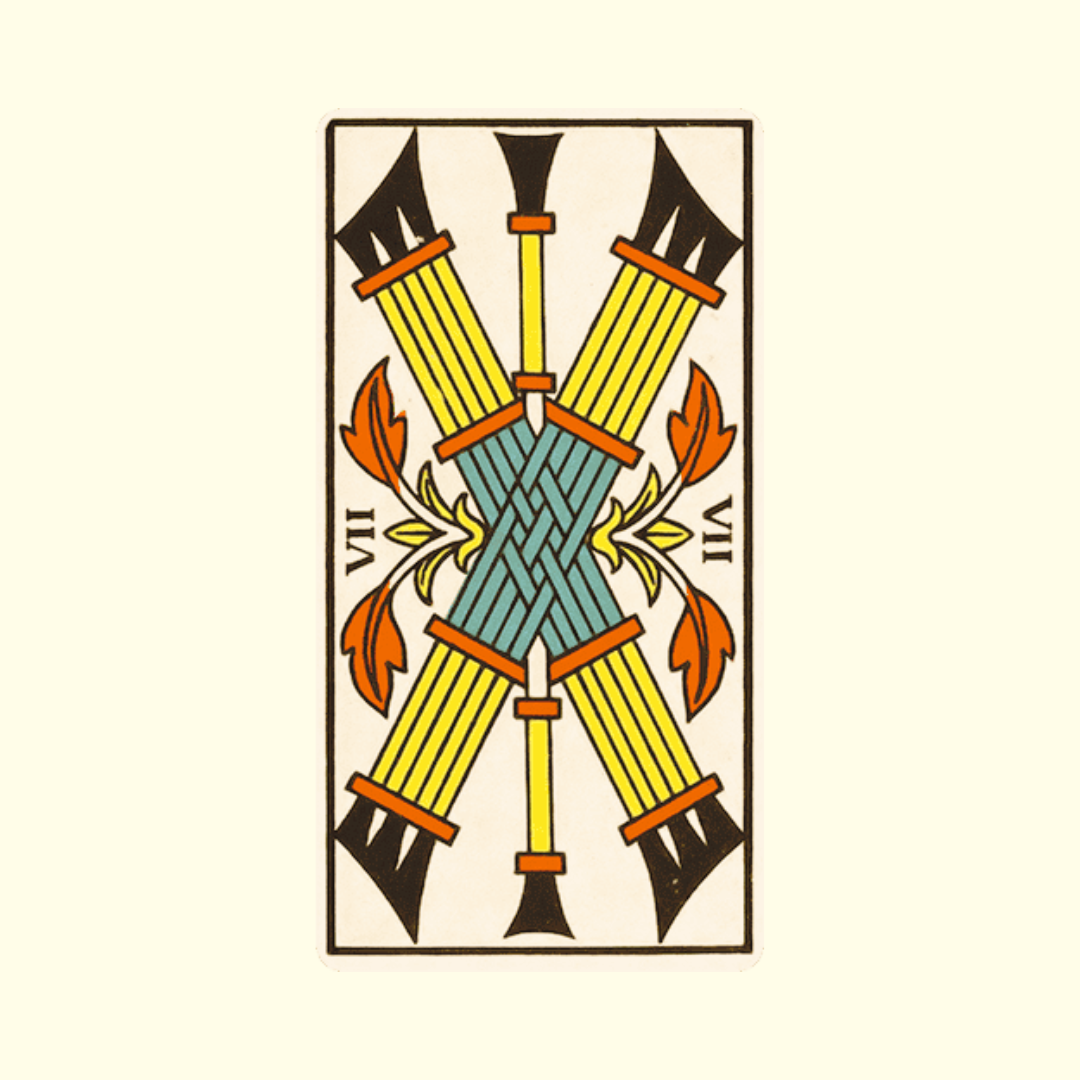
In a Tarot de Marseille, six crossed staffs form a framework pierced by a seventh vertical staff. Leaves and flowers fill the side spaces. No attacker appears on the card. The central staff can be read as a direction maintained amid a structure that has become dense.
Smith places a young man on a rocky rise. He holds his staff diagonally against six staffs rising from the bottom of the image. His shoes are not identical, a visible detail that may suggest urgency or imperfect preparation, although Waite assigns it no precise meaning. The text emphasizes valor, advantage, and the ability to resist.
Iconographic reference. The height, the defender, and the six attackers belong to the Waite-Smith. The Marseille shows seven staffs without a scene. In both decks, the central staff can mark a position; only the English deck turns that position into ground to defend.
Divinatory transmission
Mathers attributes success, gain, advantage, profit, and victory to the Seven of Wands. Reversed, the card signifies indecision, doubt, hesitation, embarrassment, and anxiety. This opposition places decision-making at the heart of its meaning: an advantage is useful only if a position is chosen and maintained.
Book T calls it “Lord of Valour” and assigns it Mars in Leo. Six wands are crossed by a seventh. The text speaks of possible victory, conditional on energy and courage, followed by obstacles, difficulties, quarrels, threats, and influence over subordinates. It also warns against victories limited to secondary stakes.
Waite shows a man attacked by six adversaries but positioned above them. Intellectually, he cites discussion and verbal struggle; in business, negotiation, commercial warfare, bartering, and competition. Reversed, the card brings perplexity, embarrassment, anxiety, and a warning against indecision. The Seven therefore does not ask one to fight everywhere, but to recognize the ground that deserves defending.
Meaning in a spread
In a favorable reading
The Seven of Wands indicates that the querent has an advantage provided they use it. They can defend a price, support an unpopular decision, protect a boundary, respond to criticism, or maintain a line of work despite pressure. The card encourages firmness, preparation, and the choice of appropriate arguments.
Courage does not require an aggressive stance. A brief response, a clear refusal, evidence, or a procedure can hold the high ground better than a long dispute. The card favors resistance when the goal is legitimate and the energy remains proportionate to the stakes.
In a tension reading
Defense can become a reflex. The querent feels attacked by every question, exhausts themself responding to everyone, or maintains a position that has become untenable out of pride. The card then shows isolation, challenged authority, persistent competition, an exaggerated threat, or victory achieved over a detail with no lasting effect.
Indecision also weakens the advantage. Changing arguments, yielding and then going back on one’s word, or responding without knowing one’s limits gives opponents access to the field. The useful question becomes: which position is non-negotiable, and on which points can I still discuss?
Love, work and finances
The Seven puts a position under pressure. The area specifies what must be protected and the acceptable cost of that defense.
| Area | Favorable reading | Tension aspect | Question to ask |
|---|---|---|---|
| Love | Asserted boundary, relationship protected from outside pressure, courageous words. | Constant defensiveness, jealousy, the relationship experienced as a fortress. | Does the boundary protect the relationship or prevent all dialogue? |
| Work | Defended project, firm negotiation, response to competition or criticism. | Contested authority, overload of demands, conflict with every interlocutor. | What argument and what evidence support the position? |
| Finances | Price maintained, budget protected, refusal of an unfavorable condition. | Costly fight for a secondary sum, fear blocking all negotiation. | Does the possible gain outweigh the cost of the defense? |
| Creation | Consciously chosen artistic direction, work protected from contradictory demands. | Refusal of all criticism, identity built against others. | What criticism genuinely threatens the project? |
| Collective life | Minority able to defend a right or a just rule. | Isolated leader, pressure on subordinates, opposition silenced. | Does the position remain legitimate for those it involves? |
Reading associations
The Seven brings resistance and the advantage of the terrain. The neighboring card shows what is being defended, the source of the pressure, and the possibility of holding out without exhaustion.
| Association | Possible dynamic | Point of vigilance |
|---|---|---|
| Seven of Wands + Six of Wands | A recent success attracts competition, criticism, or new demands. | Recognition must be consolidated without arrogance. |
| Seven of Wands + Nine of Wands | Prolonged defense, vigilance, and endurance in the face of persistent pressure. | Plan for rest and support before exhaustion. |
| Seven of Wands + Justice | Position supported by a rule, contract, or evidence. | Firmness must remain within the bounds of the law. |
| Seven of Wands + Strength | Controlled courage, resistance without brutality, control of one’s reaction. | Mastery does not mean enduring everything. |
| Seven of Wands + Eight of Swords | The person has an advantage but believes they are unable to use it. | Identify the real constraint before giving in. |
| Seven of Wands + Ten of Wands | Defense that has become an excessive burden or a responsibility impossible to carry alone. | Delegate, reduce the front, or abandon a secondary issue. |
Correspondences according to the schools
The seventh central wand belongs to the structure of French playing cards. Mars in Leo and Valor come from the Golden Dawn. The man on the height and the commercial interpretation were developed by Smith and Waite.
| Reference | Attribution | Historical scope |
|---|---|---|
| Family | Minor Arcana, Seven of Wands | Seventh numbered card of the suit. |
| Marseille Tarot | Six crossed wands pierced by a central wand | Suit card without attackers. |
| Mathers, 1888 | Success, gain, advantage, profit, victory | Reversed: indecision, doubt, hesitation, embarrassment, anxiety. |
| Golden Dawn | Lord of Valour | Title from Book T. |
| Element | Fire | Occult attribution to the suit of Wands. |
| Astrology | Mars in Leo | Third decan of Leo in the Golden Dawn framework. |
| Waite-Smith | Man on a height, one wand against six | Scene published in 1909. |
| Hebrew letter | No letter specific to the card | The numbered cards are not each assigned a letter in this system. |
| Stone and plant | No common historical agreement | Modern lists should not be confused with the attributions cited. |
| Reading words | Resistance, boundary, courage, advantage, negotiation, defense | Victory depends on the decision and the energy available. |
Reading advice
Begin by naming the height: competence, right, position, support, advantage, or information. Then count the fronts. Can one person really respond to six demands? The card becomes more accurate when the querent chooses what to defend and what to let pass.
Do not advise confrontation for its own sake. Look for the rule, the evidence, the support, and the way out. The Seven of Wands supports a clear boundary; it warns when someone confuses courage with constant fighting.
Sources and reference texts
For the history of decks and suits: Victoria and Albert Museum, A History of Tarot Cards; British Museum, reproduction of Nicolas Conver’s Tarot de Marseille.
For divinatory and occult texts: S. L. MacGregor Mathers, The Tarot, 1888, card meanings; Liber LXXVIII, “The Lord of Valour,” publication of the Book T material; Arthur Edward Waite and Pamela Colman Smith, The Pictorial Key to the Tarot, Seven of Wands, 1911.