






























































































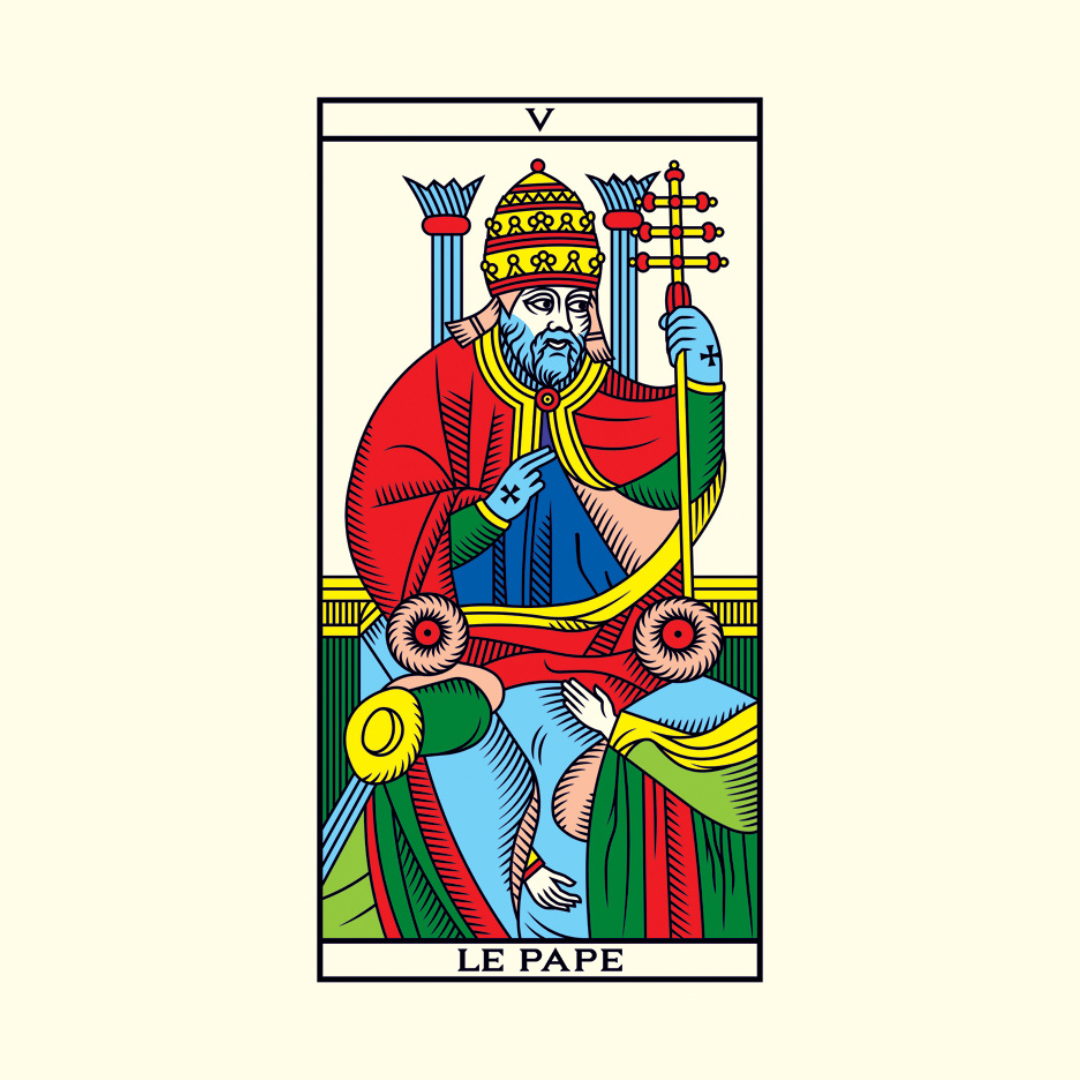

The Pope raises his hand to bless and holds the symbol of his office. Before him, smaller figures receive instruction, authorization, or entry into a community. The fifth card speaks of transmission, shared rules, and the bond between a person and the institution in which they choose to place their trust.
The Pope of the early tarots belongs to the religious order of Christian Europe. The Waite-Smith Hierophant generalizes this function and integrates it into the architecture of the Golden Dawn. Both images evoke recognized authority, but the letters, astrological signs, and temple details belong to different constructions.
The Pope in the earliest tarots
The Pope is attested in 15th-century Italian tarots. The Visconti-Sforza example at the Morgan Library shows a veiled pontiff wearing the triple tiara, blessing with his right hand and holding a cross in his left. The card represents a recognized religious office before becoming an occultist allegory. Morgan Library, Visconti-Sforza Tarot, The Pope.
In the Tarot of Marseille, two figures stand before him. Their size and posture indicate a relationship of teaching, ordination, or reception. The Pope does not work alone: he transmits within a community and speaks from a position that transcends him.
Iconographic reference. The blessing and acolytes place the card in the realm of transmission. Depending on the question, the Pope may be a guide, teacher, adviser, institution, or common rule that allows a group to remain united.
From the Pope to the Hierophant
Mathers calls the card “Hierophant or Pope” and connects it with mercy and benevolence. Papus and Wirth place it under the letter He in the French sequence. This attribution follows directly from Daleth-Emperor.
The Golden Dawn assigns Vau and Taurus to the fifth arcana. In the Waite-Smith, the pontiff becomes the Hierophant. The triple crown, triple cross, crossed keys, and two ministers make up the outward power of organized religion. Waite contrasts him with the High Priestess: she guards hidden knowledge, while the Hierophant represents declared doctrine, public ritual, and recognized hierarchy.
What ancient authors attribute to him
Mathers retains mercy, charity, kindness, and generosity. Reversed, the Pope becomes excessive indulgence, weakness, or generosity poorly exercised. The card is therefore not only rigid: its shadow may also come from an authority that no longer knows how to set limits.
Waite associates the Hierophant with marriage, alliance, seeking the help of a counselor, mercy, and kindness. He adds servitude and captivity, recalling that belonging to an institution creates both support and obligation. In a spread, the Pope asks what is being transmitted, in whose name, and with what commitment.
Meaning in a spread
In a favorable reading
The Pope favors competent advice, teaching, mediation, entry into a community, and the formalization of a commitment. It may indicate a person with the experience required to pass on a method or an institution capable of recognizing a union, qualification, or role.
The card invites the querent to ask for help without abandoning their judgment. It may also place the querent in the position of passing knowledge on in turn, provided they respect the responsibility attached to that word.
In an unfavorable reading
The Pope can point to rigid dogma, morality used to control, dependence on approval, or advice given without competence. Conversely, it can signal indulgence that perpetuates a harmful situation, authority that is too weak to enforce the rule, or a commitment made to satisfy the group.
Love, work, and finances
| Area | Favorable reading | Shadow aspect | Question to ask |
|---|---|---|---|
| Love | Recognized commitment, shared values, mediation or a union project. | Family pressure, a relationship maintained out of duty, imposed morality. | Is the commitment chosen by the people concerned? |
| Work | Training, mentoring, validation, belonging to an institution. | Doctrinaire hierarchy, empty procedure, advice without competence. | What authority can actually validate this step? |
| Finances | Qualified advice, collective framework, regulated funding or agreement. | Dependence, imposed conditions, trust granted solely because of prestige. | Does the advice make the person giving it accountable? |
| Study or transmission | Structured teaching, initiation into a method, passing on knowledge. | Repetition without understanding, secrecy used to create submission. | Does this knowledge make the student more independent? |
How to read its associations
The Pope brings advice, transmission, the common rule, and institutional recognition. The neighboring card specifies what receives this blessing, teaching, or obligation.
| Association | Possible dynamic | Point to watch |
|---|---|---|
| Pope + High Priestess | Declared teaching and reserved knowledge complement each other. | Distinguish what can be shared from what must remain confidential. |
| Pope + Emperor | An institution brings together temporal authority and moral legitimacy. | Preserve checks and balances. |
| Pope + Lovers | A choice leads toward an alliance, commitment, or recognition. | Reject any pressure on consent. |
| Pope + Justice | Advice, arbitration, contract, rite, or commitment receives an official form. | Check the applicable rule and impartiality. |
| Pope + Devil | A doctrine or authority becomes entangled with interest, desire, or dependence. | Risk of coercive control and guilt-tripping. |
| Pope + House of God | An institution, teaching, or authority is called into question. | Separate the necessary function from the structure that has become abusive. |
| Pope + World | Transmission accomplished, recognition by a community, or successful integration. | Do not confuse recognition with blind conformity. |
Correspondences according to the schools
| Guide | Attribution | Historical scope |
|---|---|---|
| Family | Trump or major arcana V | Fifth numbered trump in the French series. |
| Italian tarots | The Pope, tiara, blessing, and cross | Religious authority figure attested in the 15th century. |
| Tarot de Marseille | Pontiff and two acolytes | Image of transmission, blessing, and hierarchy. |
| French occultism | He; mercy and teaching | Attribution found in Papus and Wirth. |
| Golden Dawn | Vau and Taurus | Distinct system from the French suit He-Pope. |
| Waite-Smith | Hierophant, crossed keys, ministers, and triple cross | External religion and hierarchy become the center of the card. |
| Element | Earth in the zodiacal reading of Taurus | Golden Dawn correspondence, not a universal Tarot de Marseille attribution. |
| Stone, plant, and season | No stable historical attribution | Contemporary lists do not form a shared heritage. |
| Reading keywords | Transmission, advice, commitment, institution, alliance | The card connects a person to a rule or a community. |
| Shadow aspect | Dogma, dependence, weakness, harmful indulgence | Authority imposes responsibility or renounces it. |
Sources and reference texts
Morgan Library, Visconti-Sforza Tarot, The Pope ; S. L. MacGregor Mathers, The Tarot, 1888 ; Papus, The Tarot of the Bohemians, 1889 ; Oswald Wirth, The Tarot of the Magicians of the Middle Ages, 1927 ; Arthur Edward Waite, The Pictorial Key to the Tarot, 1911.