



























































































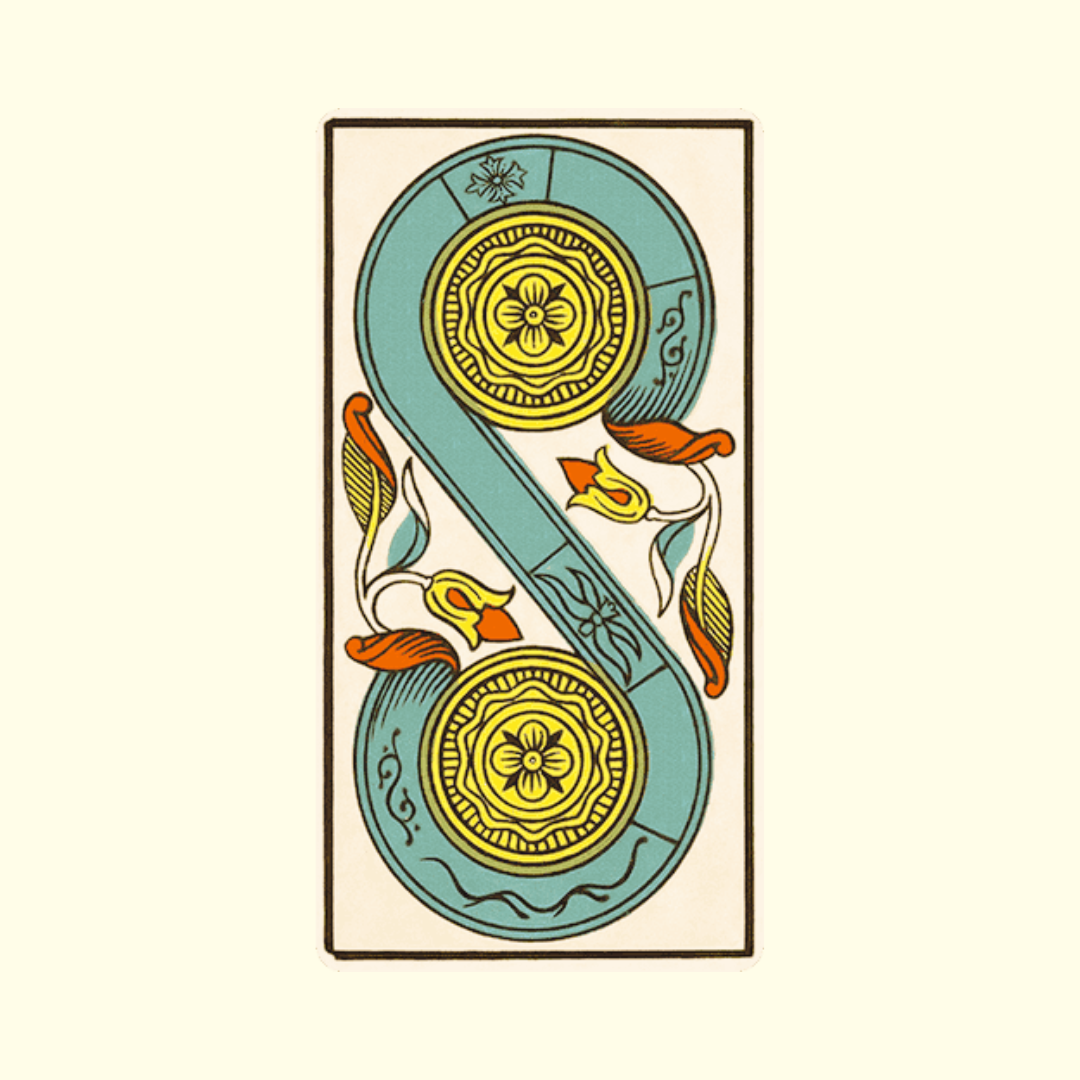

Two deniers answer one another in continuous movement. In many Tarot de Marseille decks, they are connected by a ribbon that may bear the cardmaker's name and the date of manufacture. In the Waite-Smith, a young man dances while holding two pentacles joined by a figure-eight loop, while ships rise and fall on the swell. The card speaks less of motionless balance than of management in progress.
The Two of Pentacles places two burdens, two flows, or two values within the same circuit. Variable budget, dual activity, shifting schedule, exchange of messages, or a visit: the card asks you to maintain movement without pretending to freeze it. Its success is measured by continuity, not by the absence of variation.
The modern reading of the “juggler” comes from the Waite-Smith. The Marseille shows no figure, and its ribbon also has a material function in the history of the deck: it served as a space for manufacturers' signatures. Mathers emphasizes difficulties and written correspondence; the Golden Dawn adds “Harmonious Change” and Jupiter in Capricorn.
From the ribbon of the deniers to the dancing movement
In the Marseille design, two deniers are arranged one above the other. A curved band surrounds or connects them, accompanied by leaves and flowers. In several decks, this ribbon bears the cardmaker's name, city, or a date. The card thus preserves the concrete memory of its manufacture; it is not merely an abstraction about adaptation.
Smith gives movement form. A young man holds a pentacle in each hand and appears to be dancing. A continuous cord forms a loop around the two discs. In the background, two boats face the waves. Waite mentions gaiety and recreation, but also news, written messages, obstacles, agitation, and embarrassment. The figure's smile is therefore not enough to make the situation easy.
Iconographic reference. The figure, dance, loop, and ships belong to the Waite-Smith. The Tarot de Marseille shows two deniers, a ribbon, and ornaments. In both compositions, the connection between the units matters as much as the units themselves: circulation, exchange, and adjustment take precedence over the pursuit of stability without movement.
Divinatory transmission
Mathers gives the Two of Pentacles embarrassment, worry, and difficulties. Reversed, he cites letter, missive, epistle, and message. This list brings the card closer to ongoing affairs and their documentary circulation. It speaks neither of a guaranteed inner balance nor of an innate ability to handle everything at once.
Book T names it the “Lord of Harmonious Change” and attributes it to Jupiter in Capricorn. Two disks are joined by a green-and-gold serpent forming a figure eight and holding its tail in its mouth. The text describes alternating gain and loss, strength and weakness, changing occupations, prudent management, travel, and changes in mood. Harmony denotes continual adjustment, not perfect stillness.
Waite preserves the tone of gaiety, but juxtaposes obstacles, agitation, trouble, and written messages. Reversed, the card can show forced pleasure, composition, writing, or a bill of exchange. The reading therefore benefits from looking for the actual flows: what amounts are coming in and going out, which messages are awaiting a reply, and which tasks need to alternate?
Meaning in a spread
In a favorable reading
The Two indicates someone capable of adjusting the pace without losing the thread. They distribute payments, alternate between two assignments, organize a move, or maintain an exchange despite changing conditions. The skill lies in pacing, follow-up, and the margin left for the unexpected.
The card favors reversible solutions: a limited trial, a budget split into two envelopes, an alternating schedule, or a response in several stages. It also invites you to accept that a living situation does not remain balanced every day. The question is not how to eliminate the swell, but which boats can cross it.
In a tension reading
Adjustment becomes exhausting juggling when each expense depends on the next, when two commitments compete for the same hours, or when someone maintains a carefree appearance to conceal overload. A loop can keep things moving while preventing any way out.
The Two can also indicate a delayed response, ambiguous message, misplaced bill, or alternation between contradictory decisions. It then asks you to reduce the number of variables, set a priority, and write down the next move instead of relying on improvisation.
Love, work, and finances
The Two governs competing flows. The area shows what is circulating, and the next card indicates whether the alternation remains viable or becomes overload.
| Area | Favorable reading | Tension aspect | Question to ask |
|---|---|---|---|
| Love | Harmonized rhythms, flexible organization, messages that maintain the connection. | Intermittent availability, a connection maintained between two incompatible priorities. | What pace can be maintained without making an unrealistic promise? |
| Work | Two coordinated projects, complementary activity, schedule adaptation. | Scattered efforts, constant emergencies, feigned lightness in the face of an excessive burden. | What task must be removed from the process this week? |
| Finances | Inflows and outflows monitored, installment payment, managed cash flow. | Ongoing overdraft, deferred expense, money moved without resolving the shortfall. | What balance remains after the commitments already made? |
| Communication | Mail handled, exchange resumed, document sent at the right time. | Contradictory message, delayed response, agreement only verbal. | What confirmation must be put in writing? |
| Travel | Adaptable route, organized visit, logistics able to absorb variation. | Costly back-and-forth trips, travel added to an overloaded schedule. | What fallback plan protects the time and budget? |
Reading associations
The Two puts the elements in alternation. The neighboring card reveals what must be balanced, what disrupts the rhythm, or which decision can simplify the flow.
| Association | Possible dynamic | Point to watch |
|---|---|---|
| Two of Denarii + Ace of Denarii | A new resource enters the budget or schedule. | Maintaining it may add a lasting burden. |
| Two of Denarii + Two of Swords | Delayed arbitration between two obligations of comparable weight. | Set a criterion before indecision costs more. |
| Two of Denarii + Eight of Wands | Rapid exchanges, sudden variation, remote coordination. | Confirm the amounts and dates before accelerating. |
| Two of Denarii + Temperance | Measured pace, smooth circulation, lasting adjustment between two flows. | Flexibility should not make responsibilities unclear. |
| Two of Denarii + The Tower | Balance disrupted by an expense or abrupt change. | Protect non-negotiable needs first. |
| Two of Denarii + Four of Denarii | Tightened cash flow to rebuild a reserve. | Excessively strict control can block activity. |
Correspondences according to the schools
The former chart attributed Jupiter, spring, agate, oak, and Beit. Jupiter in Capricorn does belong to the Golden Dawn, but the season, stone, plant, and letter do not share a common tradition with it. The Marseille ribbon and Smith’s scene must also remain distinct.
| Reference | Attribution | Historical scope |
|---|---|---|
| Family | Minor Arcana, Two of Denarii | Second numbered card of the suit. |
| Marseille Tarot | Two denarii linked by a ribbon and ornaments | The ribbon may bear the name, city, or date of the cartier. |
| Mathers, 1888 | Embarrassment, worry, difficulties | Reversed: letter, missive, epistle, message. |
| Golden Dawn | Lord of Harmonious Change | Title from Book T. |
| Element | Earth | Occult attribution to the suit of Pentacles. |
| Astrology | Jupiter in Capricorn | First decan of Capricorn in the Golden Dawn grid. |
| Waite-Smith | Dancing young man, two pentacles, loop, and ships | Scene published in 1909. |
| Hebrew letter | No letter specific to the card | Beit belongs to the Magician in the Golden Dawn system. |
| Stone, plant, season | No common historical correspondence | Agate, oak, and spring do not come from the cited sources. |
| Reading words | Alternation, management, message, variation, rhythm, circulation | Duration distinguishes adaptation from overload. |
Reading advice
Draw two columns for the flows concerned: amounts, hours, obligations, or messages. Add their entry and exit dates, then calculate the margin between them. The Two becomes precise as soon as the movement has a schedule.
Do not ask how to “balance everything,” an overly broad formulation. Ask which element should be reduced, shifted, confirmed, or abandoned. In a financial question, a cash-flow statement will show what the card’s dance cannot quantify on its own.
Sources and reference texts
For the history of decks and suits: Victoria and Albert Museum, A History of Tarot Cards; British Museum, reproduction of Nicolas Conver’s Tarot of Marseille.
For divinatory and occult texts: S. L. MacGregor Mathers, The Tarot, 1888, card meanings; Liber LXXVIII, “The Lord of Harmonious Change,” publication of material from Book T; Arthur Edward Waite and Pamela Colman Smith, The Pictorial Key to the Tarot, Two of Pentacles, 1911.