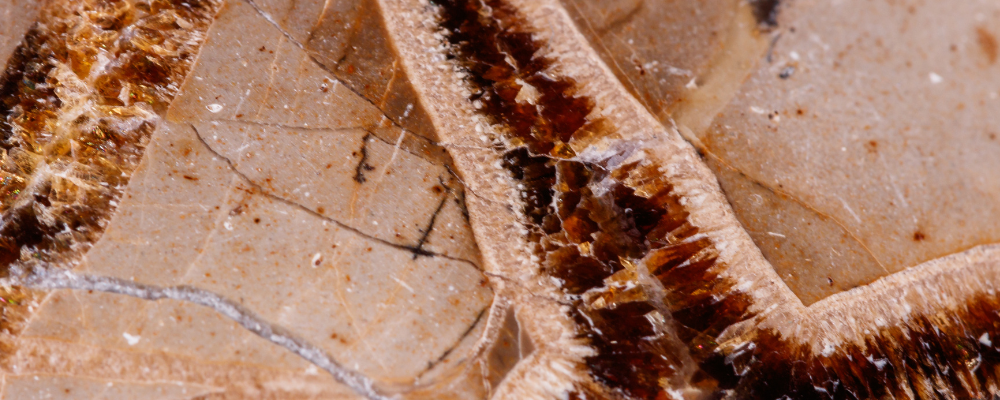
Septaria resembles ancient earth stitched with gold. Its Calcite lines cross a dark mass as if a fracture had been made visible, filled, and then preserved instead of erased.
Also sold under the name “dragon stone,” it nevertheless comes from no medieval bestiary. This commercial name is modern. Its true history, born in sediment, already offers a powerful narrative: material contracts, splits, then allows other minerals to inhabit its openings.
To place this stone among related minerals, compare it with Jasper, Orbicular Jasper, and Dragon's Blood Jasper.
A Concretion Crossed by Partitions
Septaria is not an isolated mineral, but a concretion. A core forms in sediment, then minerals gradually cement the material around it. The Paleontological Research Institution presentation explains this process and the variety of forms obtained.
Polished pieces show brown, gray, or black areas crossed by yellow, white, or honey-colored Calcite; Aragonite and other minerals may also be present. Each pattern depends on the deposit and its chemical history.
The Crack Turned into Architecture
During its formation, the concretion contracts and develops internal cracks. Mineral solutions then circulate through these spaces and deposit Calcite there. The University of Kansas describes these partitions and the shell-like appearance that erosion can reveal.
Recent research on septarian concretions, published by Journal of Sedimentary Environments, shows that their formation can be complex. For ritual purposes, the right idea remains simple: the crack is not disguised; it becomes the passage for new material.
What does “dragon stone” mean?
The trade calls Septaria “dragon egg” or “dragon stone” because of its polygonal networks, resembling scales or a shell. This name does not prove ancient use by peoples who may have dedicated it to dragons.
The dragon can nevertheless serve as a contemporary symbol. It represents the guardianship of the threshold, earthly power, and contained fire. It is used as a chosen image, not as a reconstructed tradition.
Saturn, Sun, Earth, and Fire
Saturn corresponds to structure, boundaries, and time that consolidates. The Sun responds to the yellow veins that illuminate the interior. Earth supports the concretion; Fire gives will and warmth to the golden network. Saturday suits lasting repairs, while Sunday suits reclaiming authority.
A yellow candle placed at a distance, a key, a house plan, or a piece of wood can accompany the stone. The patterns are enough to evoke closure and joining; no warrior-like decoration is required.
Home, Cohesion, and Repair
Septaria suits places that must remain united without denying their disagreements: home, team, workshop, or study circle. It helps you look at the lines of tension, then decide what can fill them: a rule, words, material repair, or a new distribution of responsibilities.
Near an entrance, it marks a calm guard. On a meeting table, it reminds us that cohesion does not mean uniformity. After a rupture, it supports reconstruction when it is desired and safe; it does not command anyone to maintain a harmful connection.
The Rite of the Inhabited Fault
Draw a crack on a sheet of paper and name what it has separated. In the space of the line, write what could now flow through it: an apology, rule, delay, money, silence, care, or departure. Place the Septaria at the center.
On a Saturday, say: “I do not deny the fault; I choose what may inhabit it.” Circle one achievable measure and give it a date. If nothing can repair it safely, write down the boundary that will protect both sides: separation can also be an architecture.
Correspondences and references
| Reference | Correspondence |
|---|---|
| Nature | Cracked concretion, filled mainly with Calcite |
| Current name | “Dragon stone,” a commercial name related to the pattern |
| Planets | Saturn and Sun |
| Elements | Earth and Fire |
| Days | Saturday and Sunday |
| Areas | Home, cohesion, boundaries, repair, and protection |
| Placement | Entrance, shared table, workshop, or reconstruction altar |
| Ritual act | Naming the fault and choosing what may inhabit it |