




























































































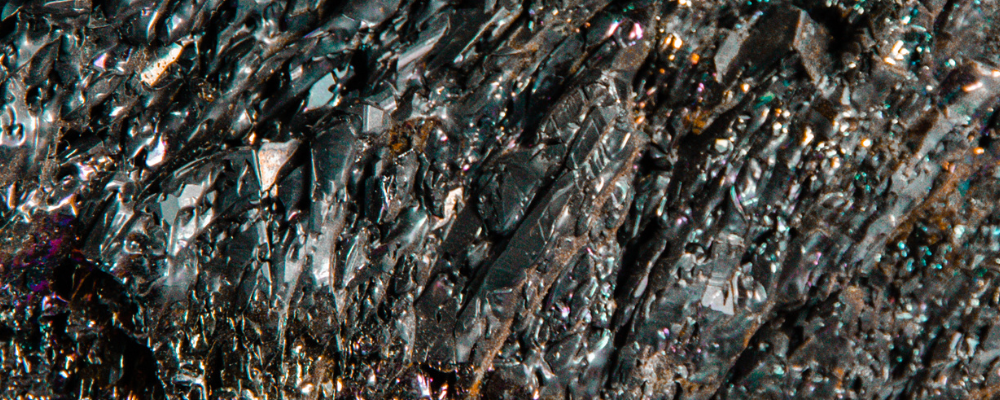
Carborandite was born from the furnace, electricity and human research: the manufacture of a material hard enough to transform other materials. Its dark crystals, covered in metallic iridescence, do not come from an ancient sacred mine. They tell of invention, trial and the passage from rough grain to polished surface.
The trade name refers to synthetic silicon carbide. Its natural equivalent, Moissanite, is very rare. Carborandite therefore has no ancient magical tradition; its correspondences arise from a modern industrial interpretation. Mars brings effort, Saturn resistance, Fire transforms and Earth receives the work.
To place this stone among related minerals, compare it with Goldstone, Corundum, and Fayalite.
A workshop name
Carborundum was the name given by Edward Goodrich Acheson to the material he produced at the end of the 19th century. “Carborandite” is now used in the mineral trade for crystallized, iridescent fragments of this silicon carbide.
The National Museum of American History preserves an Acheson Carborundum specimen. The object belongs as much to the history of materials as to that of collections.
Silicon carbide
Carborandite is silicon carbide, SiC, obtained at high temperature. Its exceptional hardness led to its use as an abrasive: it cuts, grinds and polishes softer materials.
The natural Moissanite information sheet helps distinguish the rare mineral species from the manufactured material. The rainbow sheen of decorative aggregates comes from surface phenomena and enhances their forge-like appearance.
Edward Acheson's experiment
Acheson sought to produce a very hard material using an electric furnace. His 1893 American patent describes the manufacture of a crystalline substance composed of carbon and silicon. The patent text shows how an experiment becomes a process.
The story is not that of a successful artificial diamond, but of a useful discovery born from a result different from the original intention. Carborundum thus carries a rare theme in mineral magic: recognizing the value of a deviation.
The challenge has meaning only if it transforms the work. The abrasive grain does not strike at random: it gradually removes what prevents a form from appearing.
Mars, Saturn, Fire, and Earth
Mars corresponds to effort, the tool, and the gesture that cuts. Saturn embodies hardness, repetition, and mastery of time. Fire produces transformation; Earth is the material being worked and the tangible result.
Tuesday is suitable for starting a demanding task, and Saturday for returning to it regularly. A black square, a symbolic file, and warm light accompany the stone without imitating actual abrasive work.
Challenge, craft, and improvement
Carborundum supports learning, correcting a flaw, training, and perfecting a gesture. It does not promise that the obstacle will disappear: it asks what repeated friction can make the form more precise.
It is also suited to projects that arose from a detour. An unexpected result can become a resource if you stop comparing it with the initial plan and examine what it actually makes possible.
The Rite of the Useful Grain
On a square of black paper, write a concrete rough spot in your work. On the reverse, note the small repeatable gesture that can reduce it. Place the Carborundum beside the paper without rubbing or crumbling it.
Say: “I do not fight the material; I work with its resistance. Each pass makes the form clearer.” Repeat the chosen gesture for seven days.
Correspondences and references
| Reference | Correspondence |
|---|---|
| Nature | Crystallized synthetic silicon carbide |
| Celestial bodies | Mars and Saturn |
| Elements | Fire and Earth |
| Days | Tuesday and Saturday |
| Ritual colors | Black, steel, copper, rainbow |
| Areas | Challenge, craft, endurance, improvement |
| Associated objects | Black square, symbolic tool, warm light |
| Gesture | Transforming a rough spot through repetition |