






























































































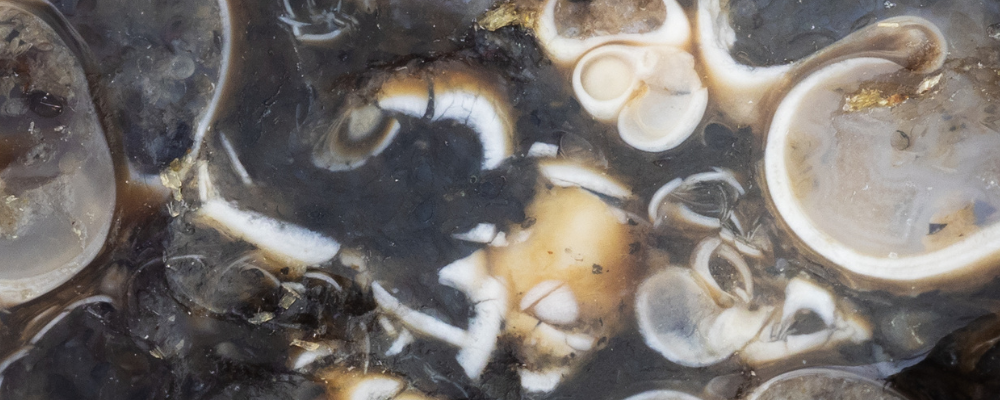
Fossil Agate is a meeting between a living form and mineral matter. In some specimens, silica gradually replaced the structure of coral, a shell, or another organism while preserving part of its pattern.
It does not speak of an immobile past. It shows how a form can pass through a complete transformation and remain recognizable. This is where its symbolic power lies: memory, lineage, and continuity amid change.
To place this stone among related minerals, compare it with Agate, Blue Agate, and Dendritic Agate.
When silica replaces the living
During fossilization, silica-rich solutions can penetrate an organic structure and then replace its components. Chalcedony then preserves partitions, chambers, or patterns derived from the original organism. The result is both a fossil in form and Agate in material.
The Florida Museum of Natural History explains this replacement in Florida’s silicified coral, dating from approximately 34 to 28 million years ago. The Mindat entry gathers further reference points on Fossil Agate.
Coral, shell, and false identities
The name covers several silicified fossil materials. Not all stones with small circles are coral, and not all fossil coral is agatized. Identification depends on the preserved structure, mineral replacement, and, ideally, provenance.
The Gillespie Museum at Stetson University presents agatized coral as both a geological witness and an ornamental material. A clear provenance gives the object more meaning than a spectacular story added after the fact.
Memory without invention
Cultures may have used shells, coral, and veined stones in their own systems, but the modern label “Fossil Agate” does not correspond to a universal talisman of antiquity. Its symbolism is built first from the actual process of fossilization.
Here, memory is not the exact repetition of the past. The original material has changed, while the architecture remains legible. Stone teaches that a lineage can transmit a form, a gesture, or a value without requiring descendants to reproduce every detail.
Saturn, Moon, Earth, and Water
Saturn corresponds to long periods of time, ancestors, and structures that endure. The Moon holds family memory and bonds of descent. Earth represents fossilization; Water recalls the habitat of many organisms and the circulation of mineral solutions.
Saturday suits ancestral work, while Monday suits family memories. A photograph, a written name, an empty shell, or a gray candle creates a simple altar without making the deceased speak in their place.
Lineage, Grief, and Continuity
Fossil Agate supports genealogical research, grief, inheritances, and taking up a project left by a previous generation. It helps ask: what deserves to be kept, what must change form, and what can finally come to an end?
It also has a place in household rites, near archives or inherited objects. Its role is not to prove an ancestral message, but to offer a point of support for honoring, sorting, and passing things on with discernment.
The Rite of the Transmitted Name
On a Saturday, write the name of a person, place, or lineage you wish to honor. Beneath the name, write down one quality you received and one habit you choose to transform. Place the stone between the two sentences.
Say: “I keep what nourishes what comes next, and I change what needs to be changed.” Light a candle for a few minutes, then, within the week, carry out an action connected to the chosen quality.
Correspondences and References
| Reference | Correspondence |
|---|---|
| Nature | Fossil structure replaced by silica |
| Example | Agatized Coral |
| Celestial Bodies | Saturn and the Moon |
| Elements | Earth and Water |
| Days | Saturday and Monday |
| Ritual Colors | Gray, brown, white, muted blue |
| Areas | Lineage, Grief, Memory, Transmission |
| Ritual Act | Naming What You Keep and What You Transform |